Event submissions
Published
 10.3390/eca2022-12705 (registering DOI)
 This submission belongs to the session S1. Antimicrobial Discovery, Development & Optimization of the event The 2nd International Electronic Conference on Antibiotics
Published date
15 Jun, 2022
Academic Editor
'%3e%3cpath%20d='M12.6657%2010.9104C12.4185%2010.325%2012.0599%209.79327%2011.6097%209.34482C11.1609%208.89508%2010.6293%208.5365%2010.0442%208.28888C10.0389%208.28626%2010.0337%208.28495%2010.0285%208.28233C10.8446%207.69279%2011.3752%206.73249%2011.3752%205.64904C11.3752%203.8542%209.92103%202.39999%208.1262%202.39999C6.33136%202.39999%204.87715%203.8542%204.87715%205.64904C4.87715%206.73249%205.40774%207.69279%206.22393%208.28364C6.21869%208.28626%206.21345%208.28757%206.20821%208.29019C5.62129%208.5378%205.09463%208.89284%204.64265%209.34613C4.1929%209.79493%203.83432%2010.3266%203.58671%2010.9117C3.34345%2011.4845%203.21226%2012.0987%203.20023%2012.7209C3.19988%2012.7349%203.20233%2012.7488%203.20744%2012.7619C3.21255%2012.7749%203.22022%2012.7867%203.22998%2012.7968C3.23975%2012.8068%203.25142%2012.8147%203.26431%2012.8202C3.2772%2012.8256%203.29105%2012.8284%203.30504%2012.8284H4.09109C4.14874%2012.8284%204.19459%2012.7825%204.1959%2012.7262C4.2221%2011.7148%204.62823%2010.7676%205.34617%2010.0497C6.08899%209.30683%207.0755%208.89808%208.1262%208.89808C9.17689%208.89808%2010.1634%209.30683%2010.9062%2010.0497C11.6242%2010.7676%2012.0303%2011.7148%2012.0565%2012.7262C12.0578%2012.7838%2012.1037%2012.8284%2012.1613%2012.8284H12.9474C12.9613%2012.8284%2012.9752%2012.8256%2012.9881%2012.8202C13.001%2012.8147%2013.0126%2012.8068%2013.0224%2012.7968C13.0322%2012.7867%2013.0398%2012.7749%2013.0449%2012.7619C13.0501%2012.7488%2013.0525%2012.7349%2013.0522%2012.7209C13.0391%2012.0947%2012.9094%2011.4855%2012.6657%2010.9104ZM8.1262%207.9024C7.52486%207.9024%206.9589%207.6679%206.53312%207.24211C6.10733%206.81633%205.87283%206.25037%205.87283%205.64904C5.87283%205.0477%206.10733%204.48174%206.53312%204.05596C6.9589%203.63018%207.52486%203.39567%208.1262%203.39567C8.72753%203.39567%209.29349%203.63018%209.71927%204.05596C10.1451%204.48174%2010.3796%205.0477%2010.3796%205.64904C10.3796%206.25037%2010.1451%206.81633%209.71927%207.24211C9.29349%207.6679%208.72753%207.9024%208.1262%207.9024Z'%20fill='%235D1EE1'/%3e%3c/g%3e%3c/svg%3e) Manuel Simões
Manuel SimõesCitation
Márcia Braz, Carla Pereira, Adelaide Almeida, Carmen S. R. Freire, Effectiveness of phage phT4A incorporated in pullulan films against Escherichia coli, in Proceedings of The 2nd International Electronic Conference on Antibiotics, 15 June–30 June 2022, MDPI: Basel, Switzerland, doi: 10.3390/eca2022-12705
Share
Email
Facebook
Twitter
LinkedIn
Effectiveness of phage phT4A incorporated in pullulan films against Escherichia coli

Márcia Braz 1

Carla Pereira 1

Adelaide Almeida 1

Carmen S. R. Freire 2
1. Department of Biology & CESAM, University of Aveiro, 3810-193 Aveiro, Portugal
2. Department of Chemistry, CICECO-Aveiro Institute of Materials, University of Aveiro, 3810-193 Aveiro, Portugal.
Abstract
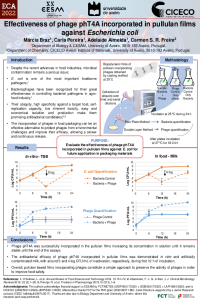
Despite the recent advances achieved in food industries to fulfil the growing consumer demand for high quality and safe food, microbial contamination remains a serious issue. Bacteriophages (phages, viruses that only infect bacteria) have been recognized for their great effectiveness in controlling bacterial pathogens in agro-food industry. Phages exhibit important features that make them promising antibacterial candidates, such as their ubiquity, high specificity against a target host, self-replication capacity while their hosts are present, low inherent toxicity, easy and economical isolation and production, and a long shelf life. The incorporation of phages in food packaging can be an effective alternative to protect phages from environmental challenges and improve its efficacy, allowing slower and continuous release. Escherichia coli is one of the most important foodborne pathogens. The purpose of the study was to evaluate the efficiency of biopolymeric films incorporating phage phT4A for future application in packaging materials. The inactivation of E. coli was first assessed in vitro (liquid culture medium) and ex vivo (milk) with free phage phT4A. The in vitro results showed that phage phT4A was effective to inactivate E. coli with a reduction of about 6 log colony-forming unit per millilitre (CFU/mL) for all tested values of multiplicity of infection (MOI). In milk, a more complex matrix, a maximum inactivation of about 4 log CFU/mL was obtained after 8 h of incubation (MOI of 10 and 100). Phages were successfully incorporated in the pullulan films increasing its concentration in solution until it remains stable until the end of the assays. The antibacterial efficacy of pullulan films was demonstrated in vitro and artificially contaminated milk, with 5-3 log CFU/mL of inactivation during first 12 h of incubation. Overall, pullulan-based films incorporating phages constitute a simple approach to preserve the activity of phages in order to improve food safety.
Keywords
Bacteriophages
Foodborne bacteria
Films
Food safety.
Manuscript
sciforum_060181-done.pdf
Poster
Poster_Marcia_et_al_ECA_2022.pdf
Experience with HB&L Uroquattro instrument for rapid diagnosis of Urinary Tract Infections in Ambulatory Patients
Antibiotic use, incidence and risk factors for surgical site infections among orthopaedic patients in a rural, private teaching hospital in India