Event submissions
Published

This submission belongs to the session S3. Epidemiology & Multidrug Resistance of the event The 2nd International Electronic Conference on Antibiotics
Published date
15 Jun, 2022
Academic Editor
'%3e%3cpath%20d='M12.6657%2010.9104C12.4185%2010.325%2012.0599%209.79327%2011.6097%209.34482C11.1609%208.89508%2010.6293%208.5365%2010.0442%208.28888C10.0389%208.28626%2010.0337%208.28495%2010.0285%208.28233C10.8446%207.69279%2011.3752%206.73249%2011.3752%205.64904C11.3752%203.8542%209.92103%202.39999%208.1262%202.39999C6.33136%202.39999%204.87715%203.8542%204.87715%205.64904C4.87715%206.73249%205.40774%207.69279%206.22393%208.28364C6.21869%208.28626%206.21345%208.28757%206.20821%208.29019C5.62129%208.5378%205.09463%208.89284%204.64265%209.34613C4.1929%209.79493%203.83432%2010.3266%203.58671%2010.9117C3.34345%2011.4845%203.21226%2012.0987%203.20023%2012.7209C3.19988%2012.7349%203.20233%2012.7488%203.20744%2012.7619C3.21255%2012.7749%203.22022%2012.7867%203.22998%2012.7968C3.23975%2012.8068%203.25142%2012.8147%203.26431%2012.8202C3.2772%2012.8256%203.29105%2012.8284%203.30504%2012.8284H4.09109C4.14874%2012.8284%204.19459%2012.7825%204.1959%2012.7262C4.2221%2011.7148%204.62823%2010.7676%205.34617%2010.0497C6.08899%209.30683%207.0755%208.89808%208.1262%208.89808C9.17689%208.89808%2010.1634%209.30683%2010.9062%2010.0497C11.6242%2010.7676%2012.0303%2011.7148%2012.0565%2012.7262C12.0578%2012.7838%2012.1037%2012.8284%2012.1613%2012.8284H12.9474C12.9613%2012.8284%2012.9752%2012.8256%2012.9881%2012.8202C13.001%2012.8147%2013.0126%2012.8068%2013.0224%2012.7968C13.0322%2012.7867%2013.0398%2012.7749%2013.0449%2012.7619C13.0501%2012.7488%2013.0525%2012.7349%2013.0522%2012.7209C13.0391%2012.0947%2012.9094%2011.4855%2012.6657%2010.9104ZM8.1262%207.9024C7.52486%207.9024%206.9589%207.6679%206.53312%207.24211C6.10733%206.81633%205.87283%206.25037%205.87283%205.64904C5.87283%205.0477%206.10733%204.48174%206.53312%204.05596C6.9589%203.63018%207.52486%203.39567%208.1262%203.39567C8.72753%203.39567%209.29349%203.63018%209.71927%204.05596C10.1451%204.48174%2010.3796%205.0477%2010.3796%205.64904C10.3796%206.25037%2010.1451%206.81633%209.71927%207.24211C9.29349%207.6679%208.72753%207.9024%208.1262%207.9024Z'%20fill='%235D1EE1'/%3e%3c/g%3e%3c/svg%3e) Manuel Simões
Manuel SimõesCitation
Kristina Skender, Anna Machowska, Vivek Singh, Yogyata Marothi, Cecilia Stålsby Lundborg, Megha Sharma, Antibiotic use, incidence and risk factors for surgical site infections among orthopaedic patients in a rural, private teaching hospital in India, in Proceedings of The 2nd International Electronic Conference on Antibiotics, 15 June–30 June 2022, MDPI: Basel, Switzerland, doi: 10.3390/eca2022-12706
Share
Email
Facebook
Twitter
LinkedIn
Antibiotic use, incidence and risk factors for surgical site infections among orthopaedic patients in a rural, private teaching hospital in India
'%3e%3cpath%20d='M12.6647%2010.9104C12.4176%2010.325%2012.0589%209.7933%2011.6088%209.34485C11.16%208.89511%2010.6283%208.53653%2010.0432%208.28891C10.038%208.28629%2010.0327%208.28498%2010.0275%208.28236C10.8437%207.69282%2011.3743%206.73252%2011.3743%205.64907C11.3743%203.85423%209.92005%202.40002%208.12522%202.40002C6.33038%202.40002%204.87618%203.85423%204.87618%205.64907C4.87618%206.73252%205.40677%207.69282%206.22296%208.28367C6.21772%208.28629%206.21248%208.2876%206.20724%208.29022C5.62031%208.53783%205.09365%208.89287%204.64167%209.34616C4.19192%209.79496%203.83334%2010.3266%203.58573%2010.9117C3.34247%2011.4846%203.21128%2012.0987%203.19925%2012.721C3.1989%2012.735%203.20135%2012.7489%203.20646%2012.7619C3.21157%2012.7749%203.21924%2012.7868%203.22901%2012.7968C3.23877%2012.8068%203.25045%2012.8148%203.26334%2012.8202C3.27623%2012.8256%203.29007%2012.8284%203.30406%2012.8284H4.09012C4.14776%2012.8284%204.19362%2012.7825%204.19493%2012.7262C4.22113%2011.7148%204.62726%2010.7676%205.34519%2010.0497C6.08802%209.30686%207.07452%208.89811%208.12522%208.89811C9.17592%208.89811%2010.1624%209.30686%2010.9052%2010.0497C11.6232%2010.7676%2012.0293%2011.7148%2012.0555%2012.7262C12.0568%2012.7839%2012.1027%2012.8284%2012.1603%2012.8284H12.9464C12.9604%2012.8284%2012.9742%2012.8256%2012.9871%2012.8202C13%2012.8148%2013.0117%2012.8068%2013.0214%2012.7968C13.0312%2012.7868%2013.0389%2012.7749%2013.044%2012.7619C13.0491%2012.7489%2013.0515%2012.735%2013.0512%2012.721C13.0381%2012.0947%2012.9084%2011.4856%2012.6647%2010.9104ZM8.12522%207.90243C7.52388%207.90243%206.95792%207.66793%206.53214%207.24215C6.10636%206.81636%205.87185%206.2504%205.87185%205.64907C5.87185%205.04773%206.10636%204.48177%206.53214%204.05599C6.95792%203.63021%207.52388%203.3957%208.12522%203.3957C8.72655%203.3957%209.29252%203.63021%209.7183%204.05599C10.1441%204.48177%2010.3786%205.04773%2010.3786%205.64907C10.3786%206.2504%2010.1441%206.81636%209.7183%207.24215C9.29252%207.66793%208.72655%207.90243%208.12522%207.90243Z'%20fill='%235D1EE1'/%3e%3c/g%3e%3c/svg%3e)
Kristina Skender 1
Anna Machowska 1
Vivek Singh 2
Yogyata Marothi 3
Cecilia Stålsby Lundborg 1
Megha Sharma 1,4
1. Department of Global Public Health, Health Systems and Policy, Karolinska Institutet, 17177 Stockholm, Sweden
2. Department of Orthopedics, Ruxmaniben Deepchand Gardi Medical College, Surasa, Ujjain 456006, India
3. APRIAM Project, Ruxmaniben Deepchand Gardi Medical College, Surasa, Ujjain 456006, India
4. Department of Pharmacology, Ruxmaniben Deepchand Gardi Medical College, Surasa, Ujjain 456006, India
Abstract
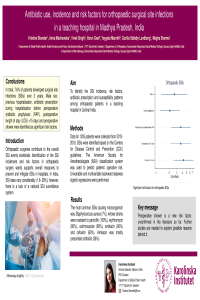
Background: Orthopaedic surgeries are one of the major contributors to the overall surgical site infection (SSI) events worldwide. In India, SSI rates vary considerably depending on geographical location (1.6%- 38%); however, there is a lack of a national SSI surveillance system to identify risk factors for SSIs.
Aim: To identify the incidence and risk factors for SSIs, and antibiotic prescription and susceptibility patterns of infecting bacteria among the operated orthopaedic patients in a tertiary-care, teaching hospital (TH) in Central India.
Methods: Data for 1205 operated orthopaedic patients were collected prospectively from 2013 to 2016 in the TH. SSIs were identified and categorized based on the Centre for Disease Control and Prevention guidelines. The American Society for Anesthesiologists classification system was used to predict patients’ physiological status and operative risk. Patients were grouped and analysed based on the occurrence of SSIs. The Clinical and Laboratory Standard Institute guidelines were followed to process the samples, and antibiotic susceptibility tests were performed using Kirby Bauer’s disc diffusion method according to performance CLSI guidelines. Univariate and multivariable backward stepwise logistic regression was performed to identify risk factors for SSIs.
Results: Overall, 7.6% (91/1205) operated patients developed SSIs over three years. Out of 68 samples sent for culture and sensitivity testing, 22% were culture positive. The most common SSIs causing microorganism was Staphylococcus aureus (7%). Strains of S. aureus were resistant to penicillin (100%), erythromycin (80%), cotrimoxazole (80%), amikacin (60%) and cefoxitin (60%). The most commonly prescribed antibiotic was amikacin (36%). Male sex (OR 2.64; 95%CI 1.32-5.30), previous hospitalisation (OR 2.15; 95%CI 1.25-3.69), prescription of antibiotics during hospital stay before perioperative antibiotic prophylaxis (OR 4.19; 95%CI 2.51-7.00), postoperative length of hospital stay longer than 15 days (OR 3.30; 95%CI 1.83-5.95) and preoperative shower (OR 4.73; 95%CI 2.72-8.22) were identified as significant risk factors for orthopaedic SSIs.
Conclusion: Incidence rate of SSIs was relatively low compared to reported incidence range for India, yet higher than reported SSI incidences for orthopaedic procedures in high- and middle-income countries. Majority of the SSIs were caused by S. aureus. Preoperative shower was found to be a significant risk factor for developing SSIs, which is unforeseen so far. Identification of the incidences and risk factors for SSIs supports the measures to prevent and mitigate SSI events in hospitals.
Keywords
surgical site infections
SSI
incidence
risk factors
orthopaedic
antibiotic susceptibility patterns
private hospital
teaching hospital
tertiary-care hospital
India
Manuscript
sciforum_060186-done.pdf
Poster
Poster.pdf
Effectiveness of phage phT4A incorporated in pullulan films against Escherichia coli
Photodynamic inactivation of phage Phi6 as SARS-CoV-2 model in wastewater disinfection: effectivity and safety