Event submissions
Published
 10.3390/eca2022-12715 (registering DOI)
 This submission belongs to the session P. Poster of the event The 2nd International Electronic Conference on Antibiotics
Published date
15 Jun, 2022
Academic Editor
'%3e%3cpath%20d='M12.6657%2010.9104C12.4185%2010.325%2012.0599%209.79327%2011.6097%209.34482C11.1609%208.89508%2010.6293%208.5365%2010.0442%208.28888C10.0389%208.28626%2010.0337%208.28495%2010.0285%208.28233C10.8446%207.69279%2011.3752%206.73249%2011.3752%205.64904C11.3752%203.8542%209.92103%202.39999%208.1262%202.39999C6.33136%202.39999%204.87715%203.8542%204.87715%205.64904C4.87715%206.73249%205.40774%207.69279%206.22393%208.28364C6.21869%208.28626%206.21345%208.28757%206.20821%208.29019C5.62129%208.5378%205.09463%208.89284%204.64265%209.34613C4.1929%209.79493%203.83432%2010.3266%203.58671%2010.9117C3.34345%2011.4845%203.21226%2012.0987%203.20023%2012.7209C3.19988%2012.7349%203.20233%2012.7488%203.20744%2012.7619C3.21255%2012.7749%203.22022%2012.7867%203.22998%2012.7968C3.23975%2012.8068%203.25142%2012.8147%203.26431%2012.8202C3.2772%2012.8256%203.29105%2012.8284%203.30504%2012.8284H4.09109C4.14874%2012.8284%204.19459%2012.7825%204.1959%2012.7262C4.2221%2011.7148%204.62823%2010.7676%205.34617%2010.0497C6.08899%209.30683%207.0755%208.89808%208.1262%208.89808C9.17689%208.89808%2010.1634%209.30683%2010.9062%2010.0497C11.6242%2010.7676%2012.0303%2011.7148%2012.0565%2012.7262C12.0578%2012.7838%2012.1037%2012.8284%2012.1613%2012.8284H12.9474C12.9613%2012.8284%2012.9752%2012.8256%2012.9881%2012.8202C13.001%2012.8147%2013.0126%2012.8068%2013.0224%2012.7968C13.0322%2012.7867%2013.0398%2012.7749%2013.0449%2012.7619C13.0501%2012.7488%2013.0525%2012.7349%2013.0522%2012.7209C13.0391%2012.0947%2012.9094%2011.4855%2012.6657%2010.9104ZM8.1262%207.9024C7.52486%207.9024%206.9589%207.6679%206.53312%207.24211C6.10733%206.81633%205.87283%206.25037%205.87283%205.64904C5.87283%205.0477%206.10733%204.48174%206.53312%204.05596C6.9589%203.63018%207.52486%203.39567%208.1262%203.39567C8.72753%203.39567%209.29349%203.63018%209.71927%204.05596C10.1451%204.48174%2010.3796%205.0477%2010.3796%205.64904C10.3796%206.25037%2010.1451%206.81633%209.71927%207.24211C9.29349%207.6679%208.72753%207.9024%208.1262%207.9024Z'%20fill='%235D1EE1'/%3e%3c/g%3e%3c/svg%3e) Marc Maresca
Marc MarescaCitation
Enrica Campagnaro, Filippo Vascon, Lorenzo Maso, Monica Chinellato, Frédéric Goormaghtigh, Pierangelo Bellio, Laurence Van Melderen, Maria Ruzzene, Els Pardon, Alessandro Angelini, Giuseppe Celenza, Jan Steyaert, Donatella Tondi, Laura Cendron, Characterisation and Optimisation of Anti-LexA Nanobodies Targeting the SOS-response Pathway to Fight Antibiotic Resistance, in Proceedings of The 2nd International Electronic Conference on Antibiotics, 15 June–30 June 2022, MDPI: Basel, Switzerland, doi: 10.3390/eca2022-12715
Share
Email
Facebook
Twitter
LinkedIn
Characterisation and Optimisation of Anti-LexA Nanobodies Targeting the SOS-response Pathway to Fight Antibiotic Resistance
'%3e%3cpath%20d='M12.6647%2010.9104C12.4176%2010.325%2012.0589%209.7933%2011.6088%209.34485C11.16%208.89511%2010.6283%208.53653%2010.0432%208.28891C10.038%208.28629%2010.0327%208.28498%2010.0275%208.28236C10.8437%207.69282%2011.3743%206.73252%2011.3743%205.64907C11.3743%203.85423%209.92005%202.40002%208.12522%202.40002C6.33038%202.40002%204.87618%203.85423%204.87618%205.64907C4.87618%206.73252%205.40677%207.69282%206.22296%208.28367C6.21772%208.28629%206.21248%208.2876%206.20724%208.29022C5.62031%208.53783%205.09365%208.89287%204.64167%209.34616C4.19192%209.79496%203.83334%2010.3266%203.58573%2010.9117C3.34247%2011.4846%203.21128%2012.0987%203.19925%2012.721C3.1989%2012.735%203.20135%2012.7489%203.20646%2012.7619C3.21157%2012.7749%203.21924%2012.7868%203.22901%2012.7968C3.23877%2012.8068%203.25045%2012.8148%203.26334%2012.8202C3.27623%2012.8256%203.29007%2012.8284%203.30406%2012.8284H4.09012C4.14776%2012.8284%204.19362%2012.7825%204.19493%2012.7262C4.22113%2011.7148%204.62726%2010.7676%205.34519%2010.0497C6.08802%209.30686%207.07452%208.89811%208.12522%208.89811C9.17592%208.89811%2010.1624%209.30686%2010.9052%2010.0497C11.6232%2010.7676%2012.0293%2011.7148%2012.0555%2012.7262C12.0568%2012.7839%2012.1027%2012.8284%2012.1603%2012.8284H12.9464C12.9604%2012.8284%2012.9742%2012.8256%2012.9871%2012.8202C13%2012.8148%2013.0117%2012.8068%2013.0214%2012.7968C13.0312%2012.7868%2013.0389%2012.7749%2013.044%2012.7619C13.0491%2012.7489%2013.0515%2012.735%2013.0512%2012.721C13.0381%2012.0947%2012.9084%2011.4856%2012.6647%2010.9104ZM8.12522%207.90243C7.52388%207.90243%206.95792%207.66793%206.53214%207.24215C6.10636%206.81636%205.87185%206.2504%205.87185%205.64907C5.87185%205.04773%206.10636%204.48177%206.53214%204.05599C6.95792%203.63021%207.52388%203.3957%208.12522%203.3957C8.72655%203.3957%209.29252%203.63021%209.7183%204.05599C10.1441%204.48177%2010.3786%205.04773%2010.3786%205.64907C10.3786%206.2504%2010.1441%206.81636%209.7183%207.24215C9.29252%207.66793%208.72655%207.90243%208.12522%207.90243Z'%20fill='%235D1EE1'/%3e%3c/g%3e%3c/svg%3e)
Enrica Campagnaro 1
Filippo Vascon 1
Lorenzo Maso 1
Monica Chinellato 1
Frédéric Goormaghtigh 2
Pierangelo Bellio 3
Laurence Van Melderen 4

Maria Ruzzene 1
Els Pardon 5
Alessandro Angelini 6
Giuseppe Celenza 7
Jan Steyaert 5

Donatella Tondi 8
Laura Cendron 1
1. Università degli Studi di Padova
2. University of Basel
3. Università degli Studi dell'Aquila
4. Université Libre De Bruxelles
5. Vrije Universiteit Brussel
6. Università Ca' Foscari Venezia
7. Università degli Studi dell’Aquila
8. Università degli Studi di Modena e Reggio Emilia
Abstract
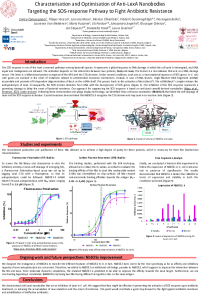
The SOS response was found to be directly involved in the onset of antibiotic resistance. Our research project represents a promising strategy to inhibit this signalling pathway blocking LexA protein autoproteolysis.
For this purpose, we initially identified three nanobodies (NbSOS1-3) that can inhibit LexA autoproteolysis. After extensive characterisation, we father optimised these Nbs by means of rational protein engineering.
Furthermore, biparatopic nanobodies (BiNbSOSs) were constructed, fusing with a flexible amino acid linker two Nbs having different recognition sites to the LexA antigen.
We chose a functional characterisation based on an integrative approach, combining mainly in vitro techniques. We performed assays based on Fluorescence Polarisation (FP) to derive the IC50 values of the NbSOSs tested. This enabled us to detect the inhibitory capacity towards the autoproteolysis of LexA. We also determined KD values of the NbSOSs by Surface Plasmon Resonance technique (SPR) in order to evaluate their binding affinity to LexA.
Finally, NbSOSs, expressed in E. coli, were tested to verify over time their stability and expression in presence and in absence of ciprofloxacin (a strong inducer of exogenous stress capable of activating the SOS response in bacteria).
We demonstrated that these Nbs inhibit LexA autoproteolysis with IC50 values in the low micromolar range. Improvements in terms of both KD, IC50 and expression profile were observed for rationally designed mutants as well as BiNbSOSs.
We believe that these results pave the way for novel approaches in the fight against antibiotic resistance, leaving the door open for further research in this direction.
Keywords
SOS response
LexA
autoproteolysis
RecA
antibiotic resistance
nanobodies
Manuscript
sciforum-060795_original_Characterisation_and_Optimisation_of_Anti_LexA_Nanobodies_Targeting_the_SOS_response_Pathway_to_Fight_Antibiotic_Resistance_Abstract -done.pdf
Poster
Poster Presentation PDF.pdf
Clinical-epidemiological and microbiological characterization of infections by carbapenemase-producing Enterobacterales in a tertiary hospital in Havana, Cuba.
Evaluation of antifungal activities of actinobacterial extracts isolated from deep-sea and Laminaria ochroleuca against pathogenic fungi