Event submissions
Published

This submission belongs to the session S1. Antimicrobial Discovery, Development & Optimization of the event The 2nd International Electronic Conference on Antibiotics
Published date
15 Jun, 2022
Academic Editor
'%3e%3cpath%20d='M12.6657%2010.9104C12.4185%2010.325%2012.0599%209.79327%2011.6097%209.34482C11.1609%208.89508%2010.6293%208.5365%2010.0442%208.28888C10.0389%208.28626%2010.0337%208.28495%2010.0285%208.28233C10.8446%207.69279%2011.3752%206.73249%2011.3752%205.64904C11.3752%203.8542%209.92103%202.39999%208.1262%202.39999C6.33136%202.39999%204.87715%203.8542%204.87715%205.64904C4.87715%206.73249%205.40774%207.69279%206.22393%208.28364C6.21869%208.28626%206.21345%208.28757%206.20821%208.29019C5.62129%208.5378%205.09463%208.89284%204.64265%209.34613C4.1929%209.79493%203.83432%2010.3266%203.58671%2010.9117C3.34345%2011.4845%203.21226%2012.0987%203.20023%2012.7209C3.19988%2012.7349%203.20233%2012.7488%203.20744%2012.7619C3.21255%2012.7749%203.22022%2012.7867%203.22998%2012.7968C3.23975%2012.8068%203.25142%2012.8147%203.26431%2012.8202C3.2772%2012.8256%203.29105%2012.8284%203.30504%2012.8284H4.09109C4.14874%2012.8284%204.19459%2012.7825%204.1959%2012.7262C4.2221%2011.7148%204.62823%2010.7676%205.34617%2010.0497C6.08899%209.30683%207.0755%208.89808%208.1262%208.89808C9.17689%208.89808%2010.1634%209.30683%2010.9062%2010.0497C11.6242%2010.7676%2012.0303%2011.7148%2012.0565%2012.7262C12.0578%2012.7838%2012.1037%2012.8284%2012.1613%2012.8284H12.9474C12.9613%2012.8284%2012.9752%2012.8256%2012.9881%2012.8202C13.001%2012.8147%2013.0126%2012.8068%2013.0224%2012.7968C13.0322%2012.7867%2013.0398%2012.7749%2013.0449%2012.7619C13.0501%2012.7488%2013.0525%2012.7349%2013.0522%2012.7209C13.0391%2012.0947%2012.9094%2011.4855%2012.6657%2010.9104ZM8.1262%207.9024C7.52486%207.9024%206.9589%207.6679%206.53312%207.24211C6.10733%206.81633%205.87283%206.25037%205.87283%205.64904C5.87283%205.0477%206.10733%204.48174%206.53312%204.05596C6.9589%203.63018%207.52486%203.39567%208.1262%203.39567C8.72753%203.39567%209.29349%203.63018%209.71927%204.05596C10.1451%204.48174%2010.3796%205.0477%2010.3796%205.64904C10.3796%206.25037%2010.1451%206.81633%209.71927%207.24211C9.29349%207.6679%208.72753%207.9024%208.1262%207.9024Z'%20fill='%235D1EE1'/%3e%3c/g%3e%3c/svg%3e) Marc Maresca
Marc MarescaCitation
Rita Maioto, Inês Ribeiro, Mariana Girão, Maria Carvalho, Ana Sampaio, Evaluation of antifungal activities of actinobacterial extracts isolated from deep-sea and Laminaria ochroleuca against pathogenic fungi, in Proceedings of The 2nd International Electronic Conference on Antibiotics, 15 June–30 June 2022, MDPI: Basel, Switzerland, doi: 10.3390/eca2022-12716
Share
Email
Facebook
Twitter
LinkedIn
Evaluation of antifungal activities of actinobacterial extracts isolated from deep-sea and Laminaria ochroleuca against pathogenic fungi
'%3e%3cpath%20d='M12.6647%2010.9104C12.4176%2010.325%2012.0589%209.7933%2011.6088%209.34485C11.16%208.89511%2010.6283%208.53653%2010.0432%208.28891C10.038%208.28629%2010.0327%208.28498%2010.0275%208.28236C10.8437%207.69282%2011.3743%206.73252%2011.3743%205.64907C11.3743%203.85423%209.92005%202.40002%208.12522%202.40002C6.33038%202.40002%204.87618%203.85423%204.87618%205.64907C4.87618%206.73252%205.40677%207.69282%206.22296%208.28367C6.21772%208.28629%206.21248%208.2876%206.20724%208.29022C5.62031%208.53783%205.09365%208.89287%204.64167%209.34616C4.19192%209.79496%203.83334%2010.3266%203.58573%2010.9117C3.34247%2011.4846%203.21128%2012.0987%203.19925%2012.721C3.1989%2012.735%203.20135%2012.7489%203.20646%2012.7619C3.21157%2012.7749%203.21924%2012.7868%203.22901%2012.7968C3.23877%2012.8068%203.25045%2012.8148%203.26334%2012.8202C3.27623%2012.8256%203.29007%2012.8284%203.30406%2012.8284H4.09012C4.14776%2012.8284%204.19362%2012.7825%204.19493%2012.7262C4.22113%2011.7148%204.62726%2010.7676%205.34519%2010.0497C6.08802%209.30686%207.07452%208.89811%208.12522%208.89811C9.17592%208.89811%2010.1624%209.30686%2010.9052%2010.0497C11.6232%2010.7676%2012.0293%2011.7148%2012.0555%2012.7262C12.0568%2012.7839%2012.1027%2012.8284%2012.1603%2012.8284H12.9464C12.9604%2012.8284%2012.9742%2012.8256%2012.9871%2012.8202C13%2012.8148%2013.0117%2012.8068%2013.0214%2012.7968C13.0312%2012.7868%2013.0389%2012.7749%2013.044%2012.7619C13.0491%2012.7489%2013.0515%2012.735%2013.0512%2012.721C13.0381%2012.0947%2012.9084%2011.4856%2012.6647%2010.9104ZM8.12522%207.90243C7.52388%207.90243%206.95792%207.66793%206.53214%207.24215C6.10636%206.81636%205.87185%206.2504%205.87185%205.64907C5.87185%205.04773%206.10636%204.48177%206.53214%204.05599C6.95792%203.63021%207.52388%203.3957%208.12522%203.3957C8.72655%203.3957%209.29252%203.63021%209.7183%204.05599C10.1441%204.48177%2010.3786%205.04773%2010.3786%205.64907C10.3786%206.2504%2010.1441%206.81636%209.7183%207.24215C9.29252%207.66793%208.72655%207.90243%208.12522%207.90243Z'%20fill='%235D1EE1'/%3e%3c/g%3e%3c/svg%3e)
Rita Maioto 1
Inês Ribeiro 2

Mariana Girão 2
Maria Carvalho 2,3

Ana Sampaio 1
1. Centro Centro de Investigação e Tecnologias Agroambientais e Biológicas (CITAB)
2. Interdisciplinary Center of Marine and Environmental Research (CIIMAR)
3. School of Medicine and Biomedical Sciences (University of Porto)
Abstract
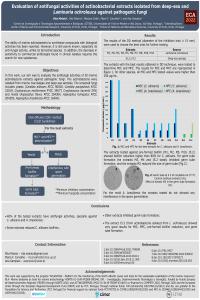
Marine actinobacteria produce secondary metabolites with many biological activities of interest, including antifungals. As fungal infections have increased in the last decade, it is important to search for new compounds. In this work, we aimed to evaluate the antifungal activities of marine actinobacteria extracts against pathogenic fungi. Thirty extracts of actinobacteria isolated from marine macroalgae and deep-sea samples were screened against fungi: yeasts (Candida albicans ATCC 90028, Candida parapsilosis ATCC 22019, Cryptococcus neoformans PYCC 3957T, Cryptococcus laurentii ZY8) and molds (Aspergillus flavus ATCC 204304, Aspergillus fumigatus ATCC 204305, Aspergillus brasiliensis ATCC 16404). We performed the disk diffusion method (DD), following the CLSI guidelines (M44-A, M38-A2 and M61). To determine the minimum inhibitory/fungicide concentration (MIC/MFC) we choose the extracts with inhibition zones ≥ 15mm, the cut-off for amphotericin B. Also, the effect of the best extracts on biofilm and germ tube formation were studied (Candida spp.).
In all organisms and for DD, the susceptibilities varied with species (p< 0.0001) and the extracts (p<0.0001). Cr. neoformans, and C. albicans were the most susceptible species. The highest MICs were obtained for Cryptococcus spp., C. parapsilosis and A. flavus (all MIC >250 µg/mL). For A. brasiliensis, two extracts had the lowest MICs (15.62 µg/mL). The results for C. albicans were in the range of 15.62-125 µg/mL, and for C. parapisilosis MIC was > 250 µg/mL. The MFC ranged from 15.62 to > 250 µg/mL. In the biofilm assay, the percentage of inhibition varied greatly between extracts (0-96%). Also, some extracts significantly delayed the germ tube formation.
The extracts from deep-sea and Laminaria ochroleuca samples exhibited higher efficacy against fungi, mostly against yeasts and among these C. albicans, (33% of extracts), than Chondrus crispus and Codium tomentosum. The dereplication analysis of the extracts explained the antifungal activity of most of them.
Keywords
Candida
Aspergillus
disc diffusion method
minimum inhibitory concentration
minimum fungicide concentration
germ tube
biofilm
Manuscript
done-sciforum_060803-done.pdf
Poster
Poster_ECA_2022.pdf
Characterisation and Optimisation of Anti-LexA Nanobodies Targeting the SOS-response Pathway to Fight Antibiotic Resistance
Putative role of the YbhFSR efflux pump in resistance of Aliarcobacter butzleri to several antimicrobials