Event submissions
Published

This submission belongs to the session P. Poster of the event The 2nd International Electronic Conference on Antibiotics
Published date
15 Jun, 2022
Academic Editor
'%3e%3cpath%20d='M12.6657%2010.9104C12.4185%2010.325%2012.0599%209.79327%2011.6097%209.34482C11.1609%208.89508%2010.6293%208.5365%2010.0442%208.28888C10.0389%208.28626%2010.0337%208.28495%2010.0285%208.28233C10.8446%207.69279%2011.3752%206.73249%2011.3752%205.64904C11.3752%203.8542%209.92103%202.39999%208.1262%202.39999C6.33136%202.39999%204.87715%203.8542%204.87715%205.64904C4.87715%206.73249%205.40774%207.69279%206.22393%208.28364C6.21869%208.28626%206.21345%208.28757%206.20821%208.29019C5.62129%208.5378%205.09463%208.89284%204.64265%209.34613C4.1929%209.79493%203.83432%2010.3266%203.58671%2010.9117C3.34345%2011.4845%203.21226%2012.0987%203.20023%2012.7209C3.19988%2012.7349%203.20233%2012.7488%203.20744%2012.7619C3.21255%2012.7749%203.22022%2012.7867%203.22998%2012.7968C3.23975%2012.8068%203.25142%2012.8147%203.26431%2012.8202C3.2772%2012.8256%203.29105%2012.8284%203.30504%2012.8284H4.09109C4.14874%2012.8284%204.19459%2012.7825%204.1959%2012.7262C4.2221%2011.7148%204.62823%2010.7676%205.34617%2010.0497C6.08899%209.30683%207.0755%208.89808%208.1262%208.89808C9.17689%208.89808%2010.1634%209.30683%2010.9062%2010.0497C11.6242%2010.7676%2012.0303%2011.7148%2012.0565%2012.7262C12.0578%2012.7838%2012.1037%2012.8284%2012.1613%2012.8284H12.9474C12.9613%2012.8284%2012.9752%2012.8256%2012.9881%2012.8202C13.001%2012.8147%2013.0126%2012.8068%2013.0224%2012.7968C13.0322%2012.7867%2013.0398%2012.7749%2013.0449%2012.7619C13.0501%2012.7488%2013.0525%2012.7349%2013.0522%2012.7209C13.0391%2012.0947%2012.9094%2011.4855%2012.6657%2010.9104ZM8.1262%207.9024C7.52486%207.9024%206.9589%207.6679%206.53312%207.24211C6.10733%206.81633%205.87283%206.25037%205.87283%205.64904C5.87283%205.0477%206.10733%204.48174%206.53312%204.05596C6.9589%203.63018%207.52486%203.39567%208.1262%203.39567C8.72753%203.39567%209.29349%203.63018%209.71927%204.05596C10.1451%204.48174%2010.3796%205.0477%2010.3796%205.64904C10.3796%206.25037%2010.1451%206.81633%209.71927%207.24211C9.29349%207.6679%208.72753%207.9024%208.1262%207.9024Z'%20fill='%235D1EE1'/%3e%3c/g%3e%3c/svg%3e) Marc Maresca
Marc MarescaCitation
Madalena Santos, Raquel Santos, Susana Ferreira, Resveratrol, a novel inhibitor of the NorA efflux pump and resistance modulator in Staphylococcus aureus, in Proceedings of The 2nd International Electronic Conference on Antibiotics, 15 June–30 June 2022, MDPI: Basel, Switzerland, doi: 10.3390/eca2022-12718
Share
Email
Facebook
Twitter
LinkedIn
Resveratrol, a novel inhibitor of the NorA efflux pump and resistance modulator in Staphylococcus aureus

Madalena Santos 1

Raquel Santos 1

Susana Ferreira 1
1. CICS-UBI – Health Sciences Research Centre, University of Beira Interior, Covilhã, Portugal
Abstract
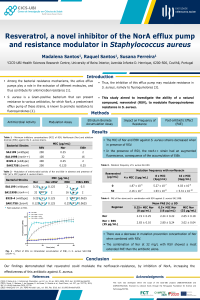
Among the bacterial resistance mechanisms, the active efflux pumps play a role in the extrusion of different molecules, and thus contribute for antimicrobial resistance. Staphylococcus aureus is a Gram-positive bacterium that can present resistance to various antibiotics, for which NorA, a predominant efflux pump of these strains, is known to promote resistant to fluoroquinolones. Thus, the inhibition of this efflux pump may modulate resistance in S. aureus, namely to fluoroquinolones. Therefore, this study aimed to investigate the ability of a natural compound, resveratrol, to modulate fluoroquinolones resistance in S. aureus. The antimicrobial activity of resveratrol, ethidium bromide (EtBr) and norfloxacin were determined, through the minimum inhibitory concentration (MIC). Then, the modulatory effect of resveratrol was evaluated, by the determination of the MIC of the antibiotic or EtBr in presence and absence of resveratrol at a sub-MIC level. The results showed that the MIC of norfloxacin against in a wildtype S. aureus strain decreased by 2-fold and for a NorA overexpressing (norA++) strain decreased by 16-fold, when in presence of resveratrol. A similar behavior was observed for EtBr. Furthermore, EtBr accumulation assay was also performed, showing that in the presence of resveratrol, the norA++ strain had an augmented fluorescence, consequence of the accumulation of EtBr. Altogether, the results suggest that resveratrol may act by inhibiting NorA. The post-antibiotic effect (PAE) of norfloxacin alone and in combination with resveratrol was also determined, showing that the most extended PAE was observed with norfloxacin at 32 mg/L when tested in combination with resveratrol. Furthermore, there was a decrease in mutation prevention concentration of norfloxacin when combined with resveratrol. Our findings demonstrated that resveratrol could modulate the norfloxacin-resistance, by inhibition of NorA, increasing the effectiveness of this antibiotic against S. aureus.
Keywords
Efflux inhibition
NorA
Resistance
Resveratrol
Staphylococcus aureus
Manuscript
done-sciforum_060811-done.pdf
Poster
Poster.pdf
Putative role of the YbhFSR efflux pump in resistance of Aliarcobacter butzleri to several antimicrobials
Variability in antibiotic resistance of persistent and intermittent Staphylococcus aureus strains.