Event submissions
Published
 10.3390/eca2022-12721 (registering DOI)
 This submission belongs to the session S1. Antimicrobial Discovery, Development & Optimization of the event The 2nd International Electronic Conference on Antibiotics
Published date
15 Jun, 2022
Academic Editor
'%3e%3cpath%20d='M12.6657%2010.9104C12.4185%2010.325%2012.0599%209.79327%2011.6097%209.34482C11.1609%208.89508%2010.6293%208.5365%2010.0442%208.28888C10.0389%208.28626%2010.0337%208.28495%2010.0285%208.28233C10.8446%207.69279%2011.3752%206.73249%2011.3752%205.64904C11.3752%203.8542%209.92103%202.39999%208.1262%202.39999C6.33136%202.39999%204.87715%203.8542%204.87715%205.64904C4.87715%206.73249%205.40774%207.69279%206.22393%208.28364C6.21869%208.28626%206.21345%208.28757%206.20821%208.29019C5.62129%208.5378%205.09463%208.89284%204.64265%209.34613C4.1929%209.79493%203.83432%2010.3266%203.58671%2010.9117C3.34345%2011.4845%203.21226%2012.0987%203.20023%2012.7209C3.19988%2012.7349%203.20233%2012.7488%203.20744%2012.7619C3.21255%2012.7749%203.22022%2012.7867%203.22998%2012.7968C3.23975%2012.8068%203.25142%2012.8147%203.26431%2012.8202C3.2772%2012.8256%203.29105%2012.8284%203.30504%2012.8284H4.09109C4.14874%2012.8284%204.19459%2012.7825%204.1959%2012.7262C4.2221%2011.7148%204.62823%2010.7676%205.34617%2010.0497C6.08899%209.30683%207.0755%208.89808%208.1262%208.89808C9.17689%208.89808%2010.1634%209.30683%2010.9062%2010.0497C11.6242%2010.7676%2012.0303%2011.7148%2012.0565%2012.7262C12.0578%2012.7838%2012.1037%2012.8284%2012.1613%2012.8284H12.9474C12.9613%2012.8284%2012.9752%2012.8256%2012.9881%2012.8202C13.001%2012.8147%2013.0126%2012.8068%2013.0224%2012.7968C13.0322%2012.7867%2013.0398%2012.7749%2013.0449%2012.7619C13.0501%2012.7488%2013.0525%2012.7349%2013.0522%2012.7209C13.0391%2012.0947%2012.9094%2011.4855%2012.6657%2010.9104ZM8.1262%207.9024C7.52486%207.9024%206.9589%207.6679%206.53312%207.24211C6.10733%206.81633%205.87283%206.25037%205.87283%205.64904C5.87283%205.0477%206.10733%204.48174%206.53312%204.05596C6.9589%203.63018%207.52486%203.39567%208.1262%203.39567C8.72753%203.39567%209.29349%203.63018%209.71927%204.05596C10.1451%204.48174%2010.3796%205.0477%2010.3796%205.64904C10.3796%206.25037%2010.1451%206.81633%209.71927%207.24211C9.29349%207.6679%208.72753%207.9024%208.1262%207.9024Z'%20fill='%235D1EE1'/%3e%3c/g%3e%3c/svg%3e) Marc Maresca
Marc MarescaCitation
Elodie Lohou, Marie Hanot, Marine Duplantier, Céline Dalle, Nicolas Taudon, Pascal Sonnet, Tackling multi-drug resistance in Pseudomonas aeruginosa thanks to a new promising anti-virulence strategy, in Proceedings of The 2nd International Electronic Conference on Antibiotics, 15 June–30 June 2022, MDPI: Basel, Switzerland, doi: 10.3390/eca2022-12721
Share
Email
Facebook
Twitter
LinkedIn
Tackling multi-drug resistance in Pseudomonas aeruginosa thanks to a new promising anti-virulence strategy

Elodie Lohou 1
'%3e%3cpath%20d='M12.6647%2010.9104C12.4176%2010.325%2012.0589%209.7933%2011.6088%209.34485C11.16%208.89511%2010.6283%208.53653%2010.0432%208.28891C10.038%208.28629%2010.0327%208.28498%2010.0275%208.28236C10.8437%207.69282%2011.3743%206.73252%2011.3743%205.64907C11.3743%203.85423%209.92005%202.40002%208.12522%202.40002C6.33038%202.40002%204.87618%203.85423%204.87618%205.64907C4.87618%206.73252%205.40677%207.69282%206.22296%208.28367C6.21772%208.28629%206.21248%208.2876%206.20724%208.29022C5.62031%208.53783%205.09365%208.89287%204.64167%209.34616C4.19192%209.79496%203.83334%2010.3266%203.58573%2010.9117C3.34247%2011.4846%203.21128%2012.0987%203.19925%2012.721C3.1989%2012.735%203.20135%2012.7489%203.20646%2012.7619C3.21157%2012.7749%203.21924%2012.7868%203.22901%2012.7968C3.23877%2012.8068%203.25045%2012.8148%203.26334%2012.8202C3.27623%2012.8256%203.29007%2012.8284%203.30406%2012.8284H4.09012C4.14776%2012.8284%204.19362%2012.7825%204.19493%2012.7262C4.22113%2011.7148%204.62726%2010.7676%205.34519%2010.0497C6.08802%209.30686%207.07452%208.89811%208.12522%208.89811C9.17592%208.89811%2010.1624%209.30686%2010.9052%2010.0497C11.6232%2010.7676%2012.0293%2011.7148%2012.0555%2012.7262C12.0568%2012.7839%2012.1027%2012.8284%2012.1603%2012.8284H12.9464C12.9604%2012.8284%2012.9742%2012.8256%2012.9871%2012.8202C13%2012.8148%2013.0117%2012.8068%2013.0214%2012.7968C13.0312%2012.7868%2013.0389%2012.7749%2013.044%2012.7619C13.0491%2012.7489%2013.0515%2012.735%2013.0512%2012.721C13.0381%2012.0947%2012.9084%2011.4856%2012.6647%2010.9104ZM8.12522%207.90243C7.52388%207.90243%206.95792%207.66793%206.53214%207.24215C6.10636%206.81636%205.87185%206.2504%205.87185%205.64907C5.87185%205.04773%206.10636%204.48177%206.53214%204.05599C6.95792%203.63021%207.52388%203.3957%208.12522%203.3957C8.72655%203.3957%209.29252%203.63021%209.7183%204.05599C10.1441%204.48177%2010.3786%205.04773%2010.3786%205.64907C10.3786%206.2504%2010.1441%206.81636%209.7183%207.24215C9.29252%207.66793%208.72655%207.90243%208.12522%207.90243Z'%20fill='%235D1EE1'/%3e%3c/g%3e%3c/svg%3e)
Marie Hanot 1
Marine Duplantier 1
Céline Dalle 2
Nicolas Taudon 2

Pascal Sonnet 3
1. Laboratoire AGIR (AGents Infectieux Résistance et chimiothérapie), UR 4294, Université de Picardie Jules Verne (UPJV), UFR de pharmacie, 1 rue des Louvels, F-80037, Amiens Cedex 1, France.
2. IRBA (Institut de Recherche Biomédicale des Armées), Unité de Développements Analytiques et Bioanalyse, F-91220, Brétigny-sur-Orge, France.
3. Laboratoire AGIR (AGents Infectieux Résistance et chimiothérapie), EA 4294, Université de Picardie Jules Verne, UFR de pharmacie, 1 rue des Louvels, F-80037, Amiens Cedex 1, France.
Abstract
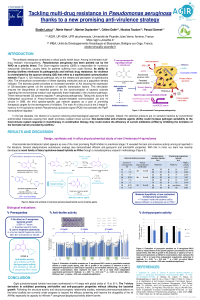
The emergence and the dissemination of multi-drug resistant bacteria constitute a major public health issue. Among incriminated Gram-negative bacteria (GNB), Pseudomonas aeruginosa has been designated by the WHO as a critical priority threat. This pathogen is responsible for various nosocomial infections, usually lethal for patients suffering from cystic fibrosis. Its ability to establish biofilms reinforces its virulence and intrinsic drug resistance. Its pathogenicity is orchestrated by the Quorum Sensing (QS) that refers to bacterial communication systems. This sophisticated coordination network relies on the secretion and perception of small signalling molecules called autoinducers (AIs). The extracellular concentration of AIs acts as a population density indicator. The biomass growth provokes an increased release of AIs inducing the expression of QS-associated genes via the activation of specific transcription factors. This stimulation ensures the biosynthesis of essential proteins for the synchronisation of bacteria colonies regarding the environmental conditions and especially those implicated in the virulence pathways. Three interconnected QS circuits regulate P. aeruginosa pathogenicity. Taking into account the widespread occurrence of N-acyl-homoserine lactone (AHL)-mediated communication las and rhl systems in GNB, the third species-specific pqs network appears as a pool of promising therapeutic targets for the development of inhibitors. The main AI of this circuit is the 2-heptyl-3-hydroxy-4(1H)-quinolone named Pseudomonas quinolone signal (PQS) that activates the PqsR transcriptional regulator.(1)
In the last decades, the interest of a quorum silencing pharmacological approach has emerged. Indeed, the selective pressure put on sensitive bacteria by conventional antimicrobial molecules causing their death promotes resistant strain survival. Non-bactericidal anti-virulence agents (AVAs) could increase pathogen sensibility to the host immune system response in monotherapy. In combination therapy, they could restore the efficiency of current ATBs by inhibiting the formation of the hermetic barrier provided by biofilms.(1) A benzamide-benzimidazole hybrid discovered by Starkey et al. appears as one of the most promising PqsR inhibitor in preclinical stage.(2) It revealed the best anti-virulence activity among all reported in literature with efficient anti-pyocyanin and anti-biofilm properties (IC50s of 300 nM and 1 µM, respectively). With this in mind, our team has recently developed a novel family of 2-heteroaryl-4-quinolones as AVAs. The synthesis pathways, but also the physicochemical and biological evaluations of these compounds (intrinsic antibiotic and anti-virulence properties) will be described in the presentation.
References : (1) Duplantier, M.; Lohou, E.; Sonnet, P. Quorum Sensing Inhibitors to Quench P. aeruginosa Pathogenicity, Pharmaceuticals 2021, 14, 1262; doi:10.3390/ph14121262 ; (2) Starkey, M.; Lepine, F.; Maura, D.; Bandyopadhaya, A.; Lesic, B.; He, J.; Kitao, T.; Righi, V.; Milot, S.; Tzika, A.; et al. Identification of Anti-Virulence Compounds That Disrupt Quorum-Sensing Regulated Acute and Persistent Pathogenicity, PLoS Pathog. 2014, 10, e1004321, doi:10.1371/journal.ppat.1004321.
Keywords
Antibioresistance
Pseudomonas aeruginosa
Anti-virulence strategy
Quorum Sensing
Heterocyclic chemistry
Manuscript
sciforum_060843-done.pdf
Poster
PosterECA2022(ElodieLOHOU)(revised-v3).pdf
Determination of the pattern of resistance to antibiotics among strains of Staphylococcus aureus isolated from the nose or pharynx
New Fluoroquinolone-phenothiazine Hybrids and their Antimicrobial Activity