Event submissions
Published
 10.3390/eca2022-12732 (registering DOI)
 This submission belongs to the session P. Poster of the event The 2nd International Electronic Conference on Antibiotics
Published date
15 Jun, 2022
Academic Editor
'%3e%3cpath%20d='M12.6657%2010.9104C12.4185%2010.325%2012.0599%209.79327%2011.6097%209.34482C11.1609%208.89508%2010.6293%208.5365%2010.0442%208.28888C10.0389%208.28626%2010.0337%208.28495%2010.0285%208.28233C10.8446%207.69279%2011.3752%206.73249%2011.3752%205.64904C11.3752%203.8542%209.92103%202.39999%208.1262%202.39999C6.33136%202.39999%204.87715%203.8542%204.87715%205.64904C4.87715%206.73249%205.40774%207.69279%206.22393%208.28364C6.21869%208.28626%206.21345%208.28757%206.20821%208.29019C5.62129%208.5378%205.09463%208.89284%204.64265%209.34613C4.1929%209.79493%203.83432%2010.3266%203.58671%2010.9117C3.34345%2011.4845%203.21226%2012.0987%203.20023%2012.7209C3.19988%2012.7349%203.20233%2012.7488%203.20744%2012.7619C3.21255%2012.7749%203.22022%2012.7867%203.22998%2012.7968C3.23975%2012.8068%203.25142%2012.8147%203.26431%2012.8202C3.2772%2012.8256%203.29105%2012.8284%203.30504%2012.8284H4.09109C4.14874%2012.8284%204.19459%2012.7825%204.1959%2012.7262C4.2221%2011.7148%204.62823%2010.7676%205.34617%2010.0497C6.08899%209.30683%207.0755%208.89808%208.1262%208.89808C9.17689%208.89808%2010.1634%209.30683%2010.9062%2010.0497C11.6242%2010.7676%2012.0303%2011.7148%2012.0565%2012.7262C12.0578%2012.7838%2012.1037%2012.8284%2012.1613%2012.8284H12.9474C12.9613%2012.8284%2012.9752%2012.8256%2012.9881%2012.8202C13.001%2012.8147%2013.0126%2012.8068%2013.0224%2012.7968C13.0322%2012.7867%2013.0398%2012.7749%2013.0449%2012.7619C13.0501%2012.7488%2013.0525%2012.7349%2013.0522%2012.7209C13.0391%2012.0947%2012.9094%2011.4855%2012.6657%2010.9104ZM8.1262%207.9024C7.52486%207.9024%206.9589%207.6679%206.53312%207.24211C6.10733%206.81633%205.87283%206.25037%205.87283%205.64904C5.87283%205.0477%206.10733%204.48174%206.53312%204.05596C6.9589%203.63018%207.52486%203.39567%208.1262%203.39567C8.72753%203.39567%209.29349%203.63018%209.71927%204.05596C10.1451%204.48174%2010.3796%205.0477%2010.3796%205.64904C10.3796%206.25037%2010.1451%206.81633%209.71927%207.24211C9.29349%207.6679%208.72753%207.9024%208.1262%207.9024Z'%20fill='%235D1EE1'/%3e%3c/g%3e%3c/svg%3e) Marc Maresca
Marc MarescaCitation
Matteo Calcagnile, Pietro Alifano, Off-target activity of spiramycin disarms Pseudomonas aeruginosa by inhibition of biofilm formation, pigment production and phenotypic differentiation, in Proceedings of The 2nd International Electronic Conference on Antibiotics, 15 June–30 June 2022, MDPI: Basel, Switzerland, doi: 10.3390/eca2022-12732
Share
Email
Facebook
Twitter
LinkedIn
Off-target activity of spiramycin disarms Pseudomonas aeruginosa by inhibition of biofilm formation, pigment production and phenotypic differentiation

Matteo Calcagnile 1
'%3e%3cpath%20d='M12.6647%2010.9104C12.4176%2010.325%2012.0589%209.7933%2011.6088%209.34485C11.16%208.89511%2010.6283%208.53653%2010.0432%208.28891C10.038%208.28629%2010.0327%208.28498%2010.0275%208.28236C10.8437%207.69282%2011.3743%206.73252%2011.3743%205.64907C11.3743%203.85423%209.92005%202.40002%208.12522%202.40002C6.33038%202.40002%204.87618%203.85423%204.87618%205.64907C4.87618%206.73252%205.40677%207.69282%206.22296%208.28367C6.21772%208.28629%206.21248%208.2876%206.20724%208.29022C5.62031%208.53783%205.09365%208.89287%204.64167%209.34616C4.19192%209.79496%203.83334%2010.3266%203.58573%2010.9117C3.34247%2011.4846%203.21128%2012.0987%203.19925%2012.721C3.1989%2012.735%203.20135%2012.7489%203.20646%2012.7619C3.21157%2012.7749%203.21924%2012.7868%203.22901%2012.7968C3.23877%2012.8068%203.25045%2012.8148%203.26334%2012.8202C3.27623%2012.8256%203.29007%2012.8284%203.30406%2012.8284H4.09012C4.14776%2012.8284%204.19362%2012.7825%204.19493%2012.7262C4.22113%2011.7148%204.62726%2010.7676%205.34519%2010.0497C6.08802%209.30686%207.07452%208.89811%208.12522%208.89811C9.17592%208.89811%2010.1624%209.30686%2010.9052%2010.0497C11.6232%2010.7676%2012.0293%2011.7148%2012.0555%2012.7262C12.0568%2012.7839%2012.1027%2012.8284%2012.1603%2012.8284H12.9464C12.9604%2012.8284%2012.9742%2012.8256%2012.9871%2012.8202C13%2012.8148%2013.0117%2012.8068%2013.0214%2012.7968C13.0312%2012.7868%2013.0389%2012.7749%2013.044%2012.7619C13.0491%2012.7489%2013.0515%2012.735%2013.0512%2012.721C13.0381%2012.0947%2012.9084%2011.4856%2012.6647%2010.9104ZM8.12522%207.90243C7.52388%207.90243%206.95792%207.66793%206.53214%207.24215C6.10636%206.81636%205.87185%206.2504%205.87185%205.64907C5.87185%205.04773%206.10636%204.48177%206.53214%204.05599C6.95792%203.63021%207.52388%203.3957%208.12522%203.3957C8.72655%203.3957%209.29252%203.63021%209.7183%204.05599C10.1441%204.48177%2010.3786%205.04773%2010.3786%205.64907C10.3786%206.2504%2010.1441%206.81636%209.7183%207.24215C9.29252%207.66793%208.72655%207.90243%208.12522%207.90243Z'%20fill='%235D1EE1'/%3e%3c/g%3e%3c/svg%3e)
Pietro Alifano 1
1. University of Salento
Abstract
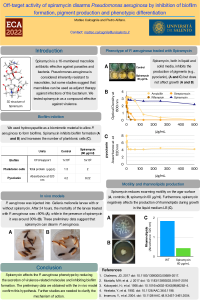
Spiramycin is a 16-membered macrolide used in human medicine as an antibacterial and antiparasitic agent (active against Toxoplasma spp.). Spiramycin is effective against various bacterial pathogens including Gram-positive (Staphylococcus aureus, streptococci of groups A, B, C and D, and pneumococcus), Gram-negative (Neisseria, Legionella) and more (Mycoplasma, Chlamydia). In contrast, Pseudomonas aeruginosa is considered intrinsically resistant to macrolides including azithromycin and spiramycin. Despite the results of in vitro susceptibility tests, interest in macrolides in the treatment of some pseudomonal infections arose from both clinical and preclinical studies. For example, in a mouse model of P. aeruginosa bacteraemia, treatment with erythromycin led to a survival rate of 80% compared with 20% in controls. For this reason, macrolides have drawn attention as adjunct therapy against chronic and/or biofilm-mediated P. aeruginosa infections. While most of the studies on the antivirulence activity of macrolides focus on erythromycin and on its derivative azithromycin, there is almost no information on spiramycin, which differs from erythromycin for a larger macrolactone ring and a different sugar decoration. In this study, we test spiramycin as an antivirulence factor using different assays to characterize the phenotype changes in P. aeruginosa.
Our results show as spiramycin inhibits the production of pyocyanin, pyoverdine and rhamnolipids in P. aeruginosa. Moreover, the treatment of the bacterium with this antibiotic inhibits biofilm formation in an artificial biomimetic system and blocks the motility on the agar surface. Finally, to test the effect of spiramycin against P. aeruginosa in an in-vivo system we used the insect Galleria mellonella and the preliminary data obtained by this colonization model show a marked reduction in mortality. Finally, using computational modeling and docking simulation we explored the probable mechanisms of action of spiramycin against P. aeruginosa.
Keywords
Spiramycin
Pseudomonas aeruginosa
Biofilm
antivirulence factor
Repurposing
Manuscript
done-sciforum_061267_original_Conference_proceeding_Off_target_activity_of_spiramycin_disarms_Pseudomonas_aeru_ginosa_by_inhibition_of_biofilm_formation_pigment_production_and_phenotypic_differentiation_R-done.pdf
Poster
Poster_Pseudomonas_v2.pdf
The Utilization of Antibiotic, Incidence and Risk Aspects for Surgical Site Infections Amongst Surgical Patients
The enigmatic Rid7C protein is an endoribonuclease involved in the differentiation and production of the glycopeptide antibiotic A40926 in Nonomuraea gerenzanensis