Event submissions
Published

This submission belongs to the session P. Poster of the event The 2nd International Electronic Conference on Antibiotics
Published date
15 Jun, 2022
Academic Editor
'%3e%3cpath%20d='M12.6657%2010.9104C12.4185%2010.325%2012.0599%209.79327%2011.6097%209.34482C11.1609%208.89508%2010.6293%208.5365%2010.0442%208.28888C10.0389%208.28626%2010.0337%208.28495%2010.0285%208.28233C10.8446%207.69279%2011.3752%206.73249%2011.3752%205.64904C11.3752%203.8542%209.92103%202.39999%208.1262%202.39999C6.33136%202.39999%204.87715%203.8542%204.87715%205.64904C4.87715%206.73249%205.40774%207.69279%206.22393%208.28364C6.21869%208.28626%206.21345%208.28757%206.20821%208.29019C5.62129%208.5378%205.09463%208.89284%204.64265%209.34613C4.1929%209.79493%203.83432%2010.3266%203.58671%2010.9117C3.34345%2011.4845%203.21226%2012.0987%203.20023%2012.7209C3.19988%2012.7349%203.20233%2012.7488%203.20744%2012.7619C3.21255%2012.7749%203.22022%2012.7867%203.22998%2012.7968C3.23975%2012.8068%203.25142%2012.8147%203.26431%2012.8202C3.2772%2012.8256%203.29105%2012.8284%203.30504%2012.8284H4.09109C4.14874%2012.8284%204.19459%2012.7825%204.1959%2012.7262C4.2221%2011.7148%204.62823%2010.7676%205.34617%2010.0497C6.08899%209.30683%207.0755%208.89808%208.1262%208.89808C9.17689%208.89808%2010.1634%209.30683%2010.9062%2010.0497C11.6242%2010.7676%2012.0303%2011.7148%2012.0565%2012.7262C12.0578%2012.7838%2012.1037%2012.8284%2012.1613%2012.8284H12.9474C12.9613%2012.8284%2012.9752%2012.8256%2012.9881%2012.8202C13.001%2012.8147%2013.0126%2012.8068%2013.0224%2012.7968C13.0322%2012.7867%2013.0398%2012.7749%2013.0449%2012.7619C13.0501%2012.7488%2013.0525%2012.7349%2013.0522%2012.7209C13.0391%2012.0947%2012.9094%2011.4855%2012.6657%2010.9104ZM8.1262%207.9024C7.52486%207.9024%206.9589%207.6679%206.53312%207.24211C6.10733%206.81633%205.87283%206.25037%205.87283%205.64904C5.87283%205.0477%206.10733%204.48174%206.53312%204.05596C6.9589%203.63018%207.52486%203.39567%208.1262%203.39567C8.72753%203.39567%209.29349%203.63018%209.71927%204.05596C10.1451%204.48174%2010.3796%205.0477%2010.3796%205.64904C10.3796%206.25037%2010.1451%206.81633%209.71927%207.24211C9.29349%207.6679%208.72753%207.9024%208.1262%207.9024Z'%20fill='%235D1EE1'/%3e%3c/g%3e%3c/svg%3e) Manuel Simões
Manuel SimõesCitation
Matthew Gavino Donadu, Marco Ferrari, Vittorio Mazzarello, Stefania Zanetti, Ivan Kushkevych, Simon K.-M. R. Rittmann, Anette Stájer, Boglárka Ónódi, Zoltán Baráth, Edit Urbán, Márió Gajdács, Is there a relationship between biofilm forming-capacity and antibiotic resistance in Staphylococcus spp.? In vitro results, in Proceedings of The 2nd International Electronic Conference on Antibiotics, 15 June–30 June 2022, MDPI: Basel, Switzerland, doi: 10.3390/eca2022-12734
Share
Email
Facebook
Twitter
LinkedIn
Is there a relationship between biofilm forming-capacity and antibiotic resistance in Staphylococcus spp.? In vitro results

Matthew Gavino Donadu 1,2
'%3e%3cpath%20d='M12.6647%2010.9104C12.4176%2010.325%2012.0589%209.7933%2011.6088%209.34485C11.16%208.89511%2010.6283%208.53653%2010.0432%208.28891C10.038%208.28629%2010.0327%208.28498%2010.0275%208.28236C10.8437%207.69282%2011.3743%206.73252%2011.3743%205.64907C11.3743%203.85423%209.92005%202.40002%208.12522%202.40002C6.33038%202.40002%204.87618%203.85423%204.87618%205.64907C4.87618%206.73252%205.40677%207.69282%206.22296%208.28367C6.21772%208.28629%206.21248%208.2876%206.20724%208.29022C5.62031%208.53783%205.09365%208.89287%204.64167%209.34616C4.19192%209.79496%203.83334%2010.3266%203.58573%2010.9117C3.34247%2011.4846%203.21128%2012.0987%203.19925%2012.721C3.1989%2012.735%203.20135%2012.7489%203.20646%2012.7619C3.21157%2012.7749%203.21924%2012.7868%203.22901%2012.7968C3.23877%2012.8068%203.25045%2012.8148%203.26334%2012.8202C3.27623%2012.8256%203.29007%2012.8284%203.30406%2012.8284H4.09012C4.14776%2012.8284%204.19362%2012.7825%204.19493%2012.7262C4.22113%2011.7148%204.62726%2010.7676%205.34519%2010.0497C6.08802%209.30686%207.07452%208.89811%208.12522%208.89811C9.17592%208.89811%2010.1624%209.30686%2010.9052%2010.0497C11.6232%2010.7676%2012.0293%2011.7148%2012.0555%2012.7262C12.0568%2012.7839%2012.1027%2012.8284%2012.1603%2012.8284H12.9464C12.9604%2012.8284%2012.9742%2012.8256%2012.9871%2012.8202C13%2012.8148%2013.0117%2012.8068%2013.0214%2012.7968C13.0312%2012.7868%2013.0389%2012.7749%2013.044%2012.7619C13.0491%2012.7489%2013.0515%2012.735%2013.0512%2012.721C13.0381%2012.0947%2012.9084%2011.4856%2012.6647%2010.9104ZM8.12522%207.90243C7.52388%207.90243%206.95792%207.66793%206.53214%207.24215C6.10636%206.81636%205.87185%206.2504%205.87185%205.64907C5.87185%205.04773%206.10636%204.48177%206.53214%204.05599C6.95792%203.63021%207.52388%203.3957%208.12522%203.3957C8.72655%203.3957%209.29252%203.63021%209.7183%204.05599C10.1441%204.48177%2010.3786%205.04773%2010.3786%205.64907C10.3786%206.2504%2010.1441%206.81636%209.7183%207.24215C9.29252%207.66793%208.72655%207.90243%208.12522%207.90243Z'%20fill='%235D1EE1'/%3e%3c/g%3e%3c/svg%3e)
Marco Ferrari 2
Vittorio Mazzarello 2
Stefania Zanetti 2

Ivan Kushkevych 3
Simon K.-M. R. Rittmann 4
Anette Stájer 5
Boglárka Ónódi 5

Zoltán Baráth 6
Edit Urbán 7

Márió Gajdács 8
1. Hospital Pharmacy, Azienda Ospedaliero Universitaria di Sassari, 07100 Sassari, Italy
2. Department of Biomedical Sciences, University of Sassari, Sassari, 07100 Sassari, Italy
3. Department of Experimental Biology, Faculty of Science, Masaryk University, 62500 Brno, Czech Republic
4. Department of Functional and Evolutionary Ecology, Archaea Physiology & Biotechnology Group, Univer-sität Wien, 1090 Wien, Austria
5. Department of Periodontology, Faculty of Dentistry, University of Szeged, Tisza Lajos körút 62-64, 6720 Szeged, Hungary
6. Department of Prosthodontics, Faculty of Dentistry, University of Szeged, Tisza Lajos körút 62–64, 6720 Szeged, Hungary
7. Department of Medical Microbiology and Immunology, University of Pécs Medical School, Szigeti út 12., 7624 Pécs, Hungary
8. Department of Oral Biology and Experimental Dental Research, Faculty of Dentistry, University of Szeged
Abstract
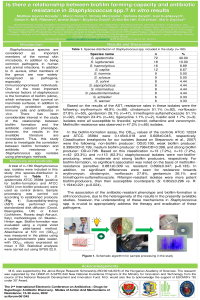
Biofilm-production facilitates the survival of Staphylococcus spp. both in harsh environmental conditions, and provides protection against in vivo and in protecting against various environmental noxa. The possible relationship between the antibiotic-resistant phenotype and biofilm-forming capacity has raised considerable interest in various bacterial species. In the present study, the interdependence between biofilm-forming capacity and the antibiotic-resistant phenotype in 299 environmental Staphylococcus spp. (S. aureus n=143, non-aureus staphylococci [NAS] n=156) was determined. Antimicrobial susceptibility testing and detection of methicillin-resistance (MR) was performed. Biofilm-forming capacity was assessed using Congo Red agar (CRA) plates and a crystal violet micro-titer-plate-based (CV-MTP) method. MR was identified in 46.9% of S. aureus and 53.8% of NAS isolates (p>0.05). Among the commonly-used antimicrobials, resistance was highest for clindamycin (57.9%), erythromycin (52.2%) and trimethoprim-sulfamethoxazole (51.1%). Based on the CRA plates, biofilm was produced by 30.8% of S. aureus and 44.9% of NAS, while based on the CV-MTP method, 51.7% of S. aureus and 62.8% of NAS were identified as strong biofilm-biofilm producers. (mean OD570 values: S. aureus: 0.779±0.471 vs. NAS: 1.053±0.551; p<0.001). No significant differences in biofilm-formation were shown observed on the basis of MR (susceptible: 0.824 ± 0.325 vs. resistant: 0.896 ± 0.367; p=0.101). On the other hand, significant differences in biofilm-formation were identified based on rifampicin susceptibility (S: 0.784 ± 0.281 vs. R: 1.239 ± 0.286; p=0.011). The association of the antibiotic-resistant phenotype and biofilm-formation is still inconclusive, due to the heterogeneity of the results in the presently available studies, however, the understanding of these mechanisms in Staphylococcus spp. is crucial to appropriately address the therapy and eradication of these pathogens.
Keywords
Congo red agar
crystal violet
microtiter plate assay
biofilm-formation
Staphylococcus aureus
non-aureus staphylococci
methicillin-resistance
multidrug resistance
MDR
phenotypic assay
Manuscript
done-sciforum_061345_original_sciforum_061345-done.pdf
Poster
Staphylococcus_biofilm_amended.pdf
The enigmatic Rid7C protein is an endoribonuclease involved in the differentiation and production of the glycopeptide antibiotic A40926 in Nonomuraea gerenzanensis
In vitro synergistic activity of colistin-based antimicrobial combinations against extensively drug-resistant (XDR) Acinetobacter baumannii from a tertiary hospital in Greece