Event submissions
Published
 10.3390/eca2022-12735 (registering DOI)
 This submission belongs to the session S3. Epidemiology & Multidrug Resistance of the event The 2nd International Electronic Conference on Antibiotics
Published date
15 Jun, 2022
Academic Editor
'%3e%3cpath%20d='M12.6657%2010.9104C12.4185%2010.325%2012.0599%209.79327%2011.6097%209.34482C11.1609%208.89508%2010.6293%208.5365%2010.0442%208.28888C10.0389%208.28626%2010.0337%208.28495%2010.0285%208.28233C10.8446%207.69279%2011.3752%206.73249%2011.3752%205.64904C11.3752%203.8542%209.92103%202.39999%208.1262%202.39999C6.33136%202.39999%204.87715%203.8542%204.87715%205.64904C4.87715%206.73249%205.40774%207.69279%206.22393%208.28364C6.21869%208.28626%206.21345%208.28757%206.20821%208.29019C5.62129%208.5378%205.09463%208.89284%204.64265%209.34613C4.1929%209.79493%203.83432%2010.3266%203.58671%2010.9117C3.34345%2011.4845%203.21226%2012.0987%203.20023%2012.7209C3.19988%2012.7349%203.20233%2012.7488%203.20744%2012.7619C3.21255%2012.7749%203.22022%2012.7867%203.22998%2012.7968C3.23975%2012.8068%203.25142%2012.8147%203.26431%2012.8202C3.2772%2012.8256%203.29105%2012.8284%203.30504%2012.8284H4.09109C4.14874%2012.8284%204.19459%2012.7825%204.1959%2012.7262C4.2221%2011.7148%204.62823%2010.7676%205.34617%2010.0497C6.08899%209.30683%207.0755%208.89808%208.1262%208.89808C9.17689%208.89808%2010.1634%209.30683%2010.9062%2010.0497C11.6242%2010.7676%2012.0303%2011.7148%2012.0565%2012.7262C12.0578%2012.7838%2012.1037%2012.8284%2012.1613%2012.8284H12.9474C12.9613%2012.8284%2012.9752%2012.8256%2012.9881%2012.8202C13.001%2012.8147%2013.0126%2012.8068%2013.0224%2012.7968C13.0322%2012.7867%2013.0398%2012.7749%2013.0449%2012.7619C13.0501%2012.7488%2013.0525%2012.7349%2013.0522%2012.7209C13.0391%2012.0947%2012.9094%2011.4855%2012.6657%2010.9104ZM8.1262%207.9024C7.52486%207.9024%206.9589%207.6679%206.53312%207.24211C6.10733%206.81633%205.87283%206.25037%205.87283%205.64904C5.87283%205.0477%206.10733%204.48174%206.53312%204.05596C6.9589%203.63018%207.52486%203.39567%208.1262%203.39567C8.72753%203.39567%209.29349%203.63018%209.71927%204.05596C10.1451%204.48174%2010.3796%205.0477%2010.3796%205.64904C10.3796%206.25037%2010.1451%206.81633%209.71927%207.24211C9.29349%207.6679%208.72753%207.9024%208.1262%207.9024Z'%20fill='%235D1EE1'/%3e%3c/g%3e%3c/svg%3e) Marc Maresca
Marc MarescaCitation
Paraskevi Mantzana, Efthymia Protonotariou, Angeliki Kassomenaki, Maria Arhonti, Georgios Meletis, Olga Vasilaki, Georgia Kagkalou, Areti Tychala, Lemonia Skoura, In vitro synergistic activity of colistin-based antimicrobial combinations against extensively drug-resistant (XDR) Acinetobacter baumannii from a tertiary hospital in Greece, in Proceedings of The 2nd International Electronic Conference on Antibiotics, 15 June–30 June 2022, MDPI: Basel, Switzerland, doi: 10.3390/eca2022-12735
Share
Email
Facebook
Twitter
LinkedIn
In vitro synergistic activity of colistin-based antimicrobial combinations against extensively drug-resistant (XDR) Acinetobacter baumannii from a tertiary hospital in Greece
'%3e%3cpath%20d='M12.6647%2010.9104C12.4176%2010.325%2012.0589%209.7933%2011.6088%209.34485C11.16%208.89511%2010.6283%208.53653%2010.0432%208.28891C10.038%208.28629%2010.0327%208.28498%2010.0275%208.28236C10.8437%207.69282%2011.3743%206.73252%2011.3743%205.64907C11.3743%203.85423%209.92005%202.40002%208.12522%202.40002C6.33038%202.40002%204.87618%203.85423%204.87618%205.64907C4.87618%206.73252%205.40677%207.69282%206.22296%208.28367C6.21772%208.28629%206.21248%208.2876%206.20724%208.29022C5.62031%208.53783%205.09365%208.89287%204.64167%209.34616C4.19192%209.79496%203.83334%2010.3266%203.58573%2010.9117C3.34247%2011.4846%203.21128%2012.0987%203.19925%2012.721C3.1989%2012.735%203.20135%2012.7489%203.20646%2012.7619C3.21157%2012.7749%203.21924%2012.7868%203.22901%2012.7968C3.23877%2012.8068%203.25045%2012.8148%203.26334%2012.8202C3.27623%2012.8256%203.29007%2012.8284%203.30406%2012.8284H4.09012C4.14776%2012.8284%204.19362%2012.7825%204.19493%2012.7262C4.22113%2011.7148%204.62726%2010.7676%205.34519%2010.0497C6.08802%209.30686%207.07452%208.89811%208.12522%208.89811C9.17592%208.89811%2010.1624%209.30686%2010.9052%2010.0497C11.6232%2010.7676%2012.0293%2011.7148%2012.0555%2012.7262C12.0568%2012.7839%2012.1027%2012.8284%2012.1603%2012.8284H12.9464C12.9604%2012.8284%2012.9742%2012.8256%2012.9871%2012.8202C13%2012.8148%2013.0117%2012.8068%2013.0214%2012.7968C13.0312%2012.7868%2013.0389%2012.7749%2013.044%2012.7619C13.0491%2012.7489%2013.0515%2012.735%2013.0512%2012.721C13.0381%2012.0947%2012.9084%2011.4856%2012.6647%2010.9104ZM8.12522%207.90243C7.52388%207.90243%206.95792%207.66793%206.53214%207.24215C6.10636%206.81636%205.87185%206.2504%205.87185%205.64907C5.87185%205.04773%206.10636%204.48177%206.53214%204.05599C6.95792%203.63021%207.52388%203.3957%208.12522%203.3957C8.72655%203.3957%209.29252%203.63021%209.7183%204.05599C10.1441%204.48177%2010.3786%205.04773%2010.3786%205.64907C10.3786%206.2504%2010.1441%206.81636%209.7183%207.24215C9.29252%207.66793%208.72655%207.90243%208.12522%207.90243Z'%20fill='%235D1EE1'/%3e%3c/g%3e%3c/svg%3e)
Paraskevi Mantzana 1
Efthymia Protonotariou 1,2
Angeliki Kassomenaki 1
Maria Arhonti 1

Georgios Meletis 1
Olga Vasilaki 1
Georgia Kagkalou 1
Areti Tychala 1

Lemonia Skoura 1,2
1. Department of Microbiology, AHEPA University Hospital, Thessaloniki, Greece
2. School of Medicine, Aristotle University of Thessaloniki;
Abstract
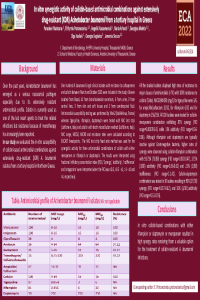
Background: Over the past years, Acinetobacter baumanni has emerged as a serious nosocomial pathogen especially due to its extensively resistant antimicrobial profile. Colistin is currently used as one of the last resort agents to treat the related infections but resistance because of monotherapy has increasingly been reported. We evaluated the in vitro susceptibility of colistin-based antimicrobial combinations against extensively drug-resistant (XDR) A. baumannii isolates from a tertiary hospital in Northern Greece.
Materials: One hundred A. baumannii single clinical isolates with resistance to carbapenems and colistin between March and October 2021 were included in the study; 46 were isolated from blood, 41 from bronchoalveolar secretions, 6 from urine, 3 from central lines, 3 from skin and soft tissues and 1 from cerebrospinal fluid. Antimicrobial susceptibility testing was performed by Vitek2 (bioMérieux, France) whereas tigecycline, rifampicin, daptomycin were tested with MIC test strip (Liofilchem, Italy) and colistin with broth microdilution method (Liofilchem, Italy). MIC range, MIC50, MIC90 and resistance rates were calculated according to EUCAST breakpoints. The MIC test strip fixed ratio method was used for the synergistic activity for three antimicrobial combinations of colistin with either meropenem or rifampicin or daptomycin. The results were interpreted using fractional inhibitory concentration index (FICI). 'Synergy', 'additivity', 'indifference' and 'antagonism' were interpreted when the FICI was ≤0.5, >0.5 - ≤1, >1 - ≤4 and >4, respectively.
Results: All the studied strains displayed high rates of resistance to major classes of antimicrobials (>97%) including carbapenems (imipenem, meropenem), aminoglycosides (amikacin, gentamicin) and with 100% resistance to colistin. MIC50/MIC90 (mg/L) for tigecycline were 3/6, for ampicillin/sulbactam 32/32, for rifampicin 6/32 and for daptomycin 256/256. All 100 isolates were tested for colistin-meropenem combination exhibiting 87% synergy (FICI range=0.00078-0.5) while 13% additivity (FICI range=0.56-0.84). Although rifampicin and daptomycin are typically inactive against Gram-negative bacteria, higher rates of synergy were observed using colistin-rifampicin combination with 93.75% (75/80) synergy (FICI range=0.002-0.47), 3.75% (3/80) additivity (FICI range=0.56-0.62) and 2.5% (2/80) indifference (FICI range=1-1.42). Colistin-daptomycin combination was tested in 30 isolates resulting in 90% (27/30) synergy (FICI range=0.017-0.42), and 10% (3/30) additivity (FICI range=0.51-0.76).
Conclusions: In vitro colistin-based combinations with either rifampicin or daptomycin or meropenem resulted in high synergy rates rendering them a valuable option for the treatment of colistin-resistant A. baumannii infections.
Keywords
XDR-Acinetobacter baumannii
synergy
colistin-based combinations
Manuscript
done-sciforum_061314_original_synergy_acin_MDPI_abstract_final-done.pdf
Poster
POSTERACIN_ΑHEPA.pdf
Is there a relationship between biofilm forming-capacity and antibiotic resistance in Staphylococcus spp.? In vitro results
EXPERIENCE OF REAL-LIFE USE OF DALBAVANCIN AS AN OFF-LABEL TREATMENT OF COMPLICATED INFECTIOUS DISEASES IN A TERTIARY CARE HOSPITAL