Event submissions
Published

This submission belongs to the session S1. Antimicrobial Discovery, Development & Optimization of the event The 2nd International Electronic Conference on Antibiotics
Published date
15 Jun, 2022
Academic Editor
'%3e%3cpath%20d='M12.6657%2010.9104C12.4185%2010.325%2012.0599%209.79327%2011.6097%209.34482C11.1609%208.89508%2010.6293%208.5365%2010.0442%208.28888C10.0389%208.28626%2010.0337%208.28495%2010.0285%208.28233C10.8446%207.69279%2011.3752%206.73249%2011.3752%205.64904C11.3752%203.8542%209.92103%202.39999%208.1262%202.39999C6.33136%202.39999%204.87715%203.8542%204.87715%205.64904C4.87715%206.73249%205.40774%207.69279%206.22393%208.28364C6.21869%208.28626%206.21345%208.28757%206.20821%208.29019C5.62129%208.5378%205.09463%208.89284%204.64265%209.34613C4.1929%209.79493%203.83432%2010.3266%203.58671%2010.9117C3.34345%2011.4845%203.21226%2012.0987%203.20023%2012.7209C3.19988%2012.7349%203.20233%2012.7488%203.20744%2012.7619C3.21255%2012.7749%203.22022%2012.7867%203.22998%2012.7968C3.23975%2012.8068%203.25142%2012.8147%203.26431%2012.8202C3.2772%2012.8256%203.29105%2012.8284%203.30504%2012.8284H4.09109C4.14874%2012.8284%204.19459%2012.7825%204.1959%2012.7262C4.2221%2011.7148%204.62823%2010.7676%205.34617%2010.0497C6.08899%209.30683%207.0755%208.89808%208.1262%208.89808C9.17689%208.89808%2010.1634%209.30683%2010.9062%2010.0497C11.6242%2010.7676%2012.0303%2011.7148%2012.0565%2012.7262C12.0578%2012.7838%2012.1037%2012.8284%2012.1613%2012.8284H12.9474C12.9613%2012.8284%2012.9752%2012.8256%2012.9881%2012.8202C13.001%2012.8147%2013.0126%2012.8068%2013.0224%2012.7968C13.0322%2012.7867%2013.0398%2012.7749%2013.0449%2012.7619C13.0501%2012.7488%2013.0525%2012.7349%2013.0522%2012.7209C13.0391%2012.0947%2012.9094%2011.4855%2012.6657%2010.9104ZM8.1262%207.9024C7.52486%207.9024%206.9589%207.6679%206.53312%207.24211C6.10733%206.81633%205.87283%206.25037%205.87283%205.64904C5.87283%205.0477%206.10733%204.48174%206.53312%204.05596C6.9589%203.63018%207.52486%203.39567%208.1262%203.39567C8.72753%203.39567%209.29349%203.63018%209.71927%204.05596C10.1451%204.48174%2010.3796%205.0477%2010.3796%205.64904C10.3796%206.25037%2010.1451%206.81633%209.71927%207.24211C9.29349%207.6679%208.72753%207.9024%208.1262%207.9024Z'%20fill='%235D1EE1'/%3e%3c/g%3e%3c/svg%3e) Manuel Simões
Manuel SimõesCitation
Arno Christiaan Gouws, Hendrik Gerhardus Kruger, Mike Machaba Sathekge, Jan Rijn Zeevaart, Thavendran Govender, Tricia Naiker, Thomas Ebenhan, Using antibiotics scaffolds will warrant novel radiotracers for effective positron emission tomography imaging of infections: triumph or pitfall ?, in Proceedings of The 2nd International Electronic Conference on Antibiotics, 15 June–30 June 2022, MDPI: Basel, Switzerland, doi: 10.3390/eca2022-12748
Share
Email
Facebook
Twitter
LinkedIn
Using antibiotics scaffolds will warrant novel radiotracers for effective positron emission tomography imaging of infections: triumph or pitfall ?
'%3e%3cpath%20d='M12.6647%2010.9104C12.4176%2010.325%2012.0589%209.7933%2011.6088%209.34485C11.16%208.89511%2010.6283%208.53653%2010.0432%208.28891C10.038%208.28629%2010.0327%208.28498%2010.0275%208.28236C10.8437%207.69282%2011.3743%206.73252%2011.3743%205.64907C11.3743%203.85423%209.92005%202.40002%208.12522%202.40002C6.33038%202.40002%204.87618%203.85423%204.87618%205.64907C4.87618%206.73252%205.40677%207.69282%206.22296%208.28367C6.21772%208.28629%206.21248%208.2876%206.20724%208.29022C5.62031%208.53783%205.09365%208.89287%204.64167%209.34616C4.19192%209.79496%203.83334%2010.3266%203.58573%2010.9117C3.34247%2011.4846%203.21128%2012.0987%203.19925%2012.721C3.1989%2012.735%203.20135%2012.7489%203.20646%2012.7619C3.21157%2012.7749%203.21924%2012.7868%203.22901%2012.7968C3.23877%2012.8068%203.25045%2012.8148%203.26334%2012.8202C3.27623%2012.8256%203.29007%2012.8284%203.30406%2012.8284H4.09012C4.14776%2012.8284%204.19362%2012.7825%204.19493%2012.7262C4.22113%2011.7148%204.62726%2010.7676%205.34519%2010.0497C6.08802%209.30686%207.07452%208.89811%208.12522%208.89811C9.17592%208.89811%2010.1624%209.30686%2010.9052%2010.0497C11.6232%2010.7676%2012.0293%2011.7148%2012.0555%2012.7262C12.0568%2012.7839%2012.1027%2012.8284%2012.1603%2012.8284H12.9464C12.9604%2012.8284%2012.9742%2012.8256%2012.9871%2012.8202C13%2012.8148%2013.0117%2012.8068%2013.0214%2012.7968C13.0312%2012.7868%2013.0389%2012.7749%2013.044%2012.7619C13.0491%2012.7489%2013.0515%2012.735%2013.0512%2012.721C13.0381%2012.0947%2012.9084%2011.4856%2012.6647%2010.9104ZM8.12522%207.90243C7.52388%207.90243%206.95792%207.66793%206.53214%207.24215C6.10636%206.81636%205.87185%206.2504%205.87185%205.64907C5.87185%205.04773%206.10636%204.48177%206.53214%204.05599C6.95792%203.63021%207.52388%203.3957%208.12522%203.3957C8.72655%203.3957%209.29252%203.63021%209.7183%204.05599C10.1441%204.48177%2010.3786%205.04773%2010.3786%205.64907C10.3786%206.2504%2010.1441%206.81636%209.7183%207.24215C9.29252%207.66793%208.72655%207.90243%208.12522%207.90243Z'%20fill='%235D1EE1'/%3e%3c/g%3e%3c/svg%3e)
Arno Christiaan Gouws 1,2

Hendrik Gerhardus Kruger 1
Mike Machaba Sathekge 2,3
Jan Rijn Zeevaart 2,4,5
Thavendran Govender 2,6
Tricia Naiker 1,2
Thomas Ebenhan 2,5,7
1. Catalysis and Peptide Research Unit, University of KwaZulu-Natal, Durban 4000, South Africa
2. Nuclear Medicine Research Infrastructure NPC, Pretoria 0001, South Africa
3. Department of Nuclear Medicine, Steve Biko Academic Hospital and University of Pretoria, Pretoria 0001, South Africa
4. Radiochemistry, The South African Nuclear Energy Corporation, Brits 0420, South Africa
5. DSI/ Preclinical Drug Development Platform, North-West University, Potchefstroom 2520, South Africa
6. Department of Chemistry, University of Zululand, KwaDlangezwa 3886, South Africa
7. Department of Nuclear Medicine, University of Pretoria, Pretoria 0001, South Africa
Abstract
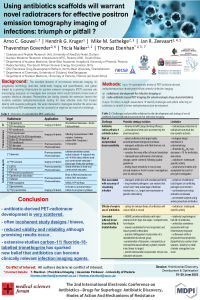
Background: The excellent features of non-invasive molecular imaging, its progressive technology (real-time, whole-body imaging and quantification), and global impact by a growing infrastructure for positron emission tomography (PET) scanners are encouraging prospects to investigate new concepts which could transform clinical care of complex infectious diseases. Researchers are aiming towards the extension beyond the routinely available radiopharmaceuticals looking for more effective tools that interact directly with causative pathogens. We were interested to investigate whether the actual use of antibiotics as PET-radiotracers can be successful or might be too much of a challenge.
Methods: We systematically reviewed and critically evaluated antibiotic-derived PET radiopharmaceutical development efforts aimed at infection imaging either considered for a) radiotracer development for infection imaging or b) radio-antibiotic based PET imaging supplementing other tools for pharmacologic drug characterization. Overall, a total of twenty original PET radiotracers derived from eleven different approved antibiotics (*listed below). A critical, in-depth assessment was performed thereby revealing the challenges and pitfalls reflecting on antibiotics as input for their radiopharmaceutical development as infection imaging agents.
Results: There are a few shortcomings making the antibiotic scaffold for radiotracer development a questionable choice: a) the radiolabelling protocol is unable to match with antibiotic activity, b) a risk of compromised tracer sensitivity, c) the risk of questionable accuracy of visualizing infectious foci in humans, d) the detrimental effect of the rampant (often only prophylactical) use of antibiotics mismatching radiotracers of antibiotic origin, and e) the occurrence of misjudged radiotracer bioavailability and unwanted biodistribution. Our conceivable strategies or solutions to overcome these pitfalls may therefore include: the more efficient, early-on usage of computational tests, data libraries or structure-activity-relationship (SAR) investigations, a proactive disregard for antibiotics with a cumbersome or predisposed mechanism of action (e.g., selection of molecules showing unique mechanisms of action), pre-emptive action towards the different isotopic mass effect for radiotracer preparation, opting for radiotracer testing in non-human primates to supplement phase-0 clinical trial safety dossiers, selecting vectors (for drug-resistant pathogens) that support target overexpression or genetic redundancy. Particularly burdensome radiotracer ADME effects may be conquered by the following guidelines: prioritize antibiotics featuring a rapid clearance from high-risk organs for infection, perform candidate selection based on host-enzymatic and tissue-specific interactions, practice SAR-guided incorporation of a radiolabelled functional group, contemplate pharmacologically inert delivery systems, and solely permit radionuclide incorporation into non-cleavable prosthetic groups.
Conclusion: We found that antibiotic-derived PET-radiotracer development is very scattered and often represented by single studies, afflicted with incoherent study designs which consequently introduce biases which, in turn, reduces the validity and reliability of otherwise promising results. However, the high-quality and extensive studies on carbon-11– and fluoride-18-labelled trimethoprim has sparked new belief that antibiotics can become clinically relevant infection imaging agents that facilitate improving disease prognostication and allow for more intricate understanding the mechanisms governing antibiotic performance and emergence of resistance.
*List of PET radiotracers
1) [11C]trimethoprim
2) [18F]FP-trimethoprim
3) [18F]F-ciprofloxacin
4) [68Ga]Ga(NOTA-SCN)-ciprofloxacin
5) [68Ga]Ga(DOTA-SCN)-ciprofloxacin
6) [68Ga]Ga-DOTA-ciprofloxacin
7) [18F]FP-ciprofloxacin
8) [18F]F-lomefloxacin
9) [18F]F-fleroxacin
10) [18F]F-trovafloxacin
11) [11C]isoniazid
12) 2-[18F]F-isoniazid
13) [11C]PT70 (Isoniazid analogue)
14) [11C]PT119 (Isoniazid analogue)
15) [11C]pyrazinamide
16) 5-[18F]F-pyrazinamide
17) [18F]F-linezolid
18) [76Br]Br-bedaquiline
19) [11C]rifampin
20) [11C]erythromycin
Keywords
Positron Emission Tomography
Antibiotic-derived
Imaging of Infection
Infection Diagnosis
Nuclear Medicine
Molecular Imaging
Radiopharmaceutical Development
Treatment monitoring
Mechanism of Action
antibiotics
Manuscript
Type of the Paper.pdf
Poster
poster ECA2022-antibiotics.pdf
Persister cell formation in clinical isolates of Pseudomonas aeruginosa
Antimicrobial Activities of Compounds Produced by Newly Isolated Streptomyces Strains from Mountain Caves