Event submissions
Published
 10.3390/eca2022-12754 (registering DOI)
 This submission belongs to the session P. Poster of the event The 2nd International Electronic Conference on Antibiotics
Published date
16 Jun, 2022
Academic Editor
'%3e%3cpath%20d='M12.6657%2010.9104C12.4185%2010.325%2012.0599%209.79327%2011.6097%209.34482C11.1609%208.89508%2010.6293%208.5365%2010.0442%208.28888C10.0389%208.28626%2010.0337%208.28495%2010.0285%208.28233C10.8446%207.69279%2011.3752%206.73249%2011.3752%205.64904C11.3752%203.8542%209.92103%202.39999%208.1262%202.39999C6.33136%202.39999%204.87715%203.8542%204.87715%205.64904C4.87715%206.73249%205.40774%207.69279%206.22393%208.28364C6.21869%208.28626%206.21345%208.28757%206.20821%208.29019C5.62129%208.5378%205.09463%208.89284%204.64265%209.34613C4.1929%209.79493%203.83432%2010.3266%203.58671%2010.9117C3.34345%2011.4845%203.21226%2012.0987%203.20023%2012.7209C3.19988%2012.7349%203.20233%2012.7488%203.20744%2012.7619C3.21255%2012.7749%203.22022%2012.7867%203.22998%2012.7968C3.23975%2012.8068%203.25142%2012.8147%203.26431%2012.8202C3.2772%2012.8256%203.29105%2012.8284%203.30504%2012.8284H4.09109C4.14874%2012.8284%204.19459%2012.7825%204.1959%2012.7262C4.2221%2011.7148%204.62823%2010.7676%205.34617%2010.0497C6.08899%209.30683%207.0755%208.89808%208.1262%208.89808C9.17689%208.89808%2010.1634%209.30683%2010.9062%2010.0497C11.6242%2010.7676%2012.0303%2011.7148%2012.0565%2012.7262C12.0578%2012.7838%2012.1037%2012.8284%2012.1613%2012.8284H12.9474C12.9613%2012.8284%2012.9752%2012.8256%2012.9881%2012.8202C13.001%2012.8147%2013.0126%2012.8068%2013.0224%2012.7968C13.0322%2012.7867%2013.0398%2012.7749%2013.0449%2012.7619C13.0501%2012.7488%2013.0525%2012.7349%2013.0522%2012.7209C13.0391%2012.0947%2012.9094%2011.4855%2012.6657%2010.9104ZM8.1262%207.9024C7.52486%207.9024%206.9589%207.6679%206.53312%207.24211C6.10733%206.81633%205.87283%206.25037%205.87283%205.64904C5.87283%205.0477%206.10733%204.48174%206.53312%204.05596C6.9589%203.63018%207.52486%203.39567%208.1262%203.39567C8.72753%203.39567%209.29349%203.63018%209.71927%204.05596C10.1451%204.48174%2010.3796%205.0477%2010.3796%205.64904C10.3796%206.25037%2010.1451%206.81633%209.71927%207.24211C9.29349%207.6679%208.72753%207.9024%208.1262%207.9024Z'%20fill='%235D1EE1'/%3e%3c/g%3e%3c/svg%3e) Marc Maresca
Marc MarescaCitation
Péter Pallós, Zsuzsanna Kívés, Márió Gajdács, Information seeking behaviour regarding antibiotics and common infectious ailments in Hungary: a Google Trends-based infodemiological study, in Proceedings of The 2nd International Electronic Conference on Antibiotics, 15 June–30 June 2022, MDPI: Basel, Switzerland, doi: 10.3390/eca2022-12754
Share
Email
Facebook
Twitter
LinkedIn
Information seeking behaviour regarding antibiotics and common infectious ailments in Hungary: a Google Trends-based infodemiological study
'%3e%3cpath%20d='M12.6647%2010.9104C12.4176%2010.325%2012.0589%209.7933%2011.6088%209.34485C11.16%208.89511%2010.6283%208.53653%2010.0432%208.28891C10.038%208.28629%2010.0327%208.28498%2010.0275%208.28236C10.8437%207.69282%2011.3743%206.73252%2011.3743%205.64907C11.3743%203.85423%209.92005%202.40002%208.12522%202.40002C6.33038%202.40002%204.87618%203.85423%204.87618%205.64907C4.87618%206.73252%205.40677%207.69282%206.22296%208.28367C6.21772%208.28629%206.21248%208.2876%206.20724%208.29022C5.62031%208.53783%205.09365%208.89287%204.64167%209.34616C4.19192%209.79496%203.83334%2010.3266%203.58573%2010.9117C3.34247%2011.4846%203.21128%2012.0987%203.19925%2012.721C3.1989%2012.735%203.20135%2012.7489%203.20646%2012.7619C3.21157%2012.7749%203.21924%2012.7868%203.22901%2012.7968C3.23877%2012.8068%203.25045%2012.8148%203.26334%2012.8202C3.27623%2012.8256%203.29007%2012.8284%203.30406%2012.8284H4.09012C4.14776%2012.8284%204.19362%2012.7825%204.19493%2012.7262C4.22113%2011.7148%204.62726%2010.7676%205.34519%2010.0497C6.08802%209.30686%207.07452%208.89811%208.12522%208.89811C9.17592%208.89811%2010.1624%209.30686%2010.9052%2010.0497C11.6232%2010.7676%2012.0293%2011.7148%2012.0555%2012.7262C12.0568%2012.7839%2012.1027%2012.8284%2012.1603%2012.8284H12.9464C12.9604%2012.8284%2012.9742%2012.8256%2012.9871%2012.8202C13%2012.8148%2013.0117%2012.8068%2013.0214%2012.7968C13.0312%2012.7868%2013.0389%2012.7749%2013.044%2012.7619C13.0491%2012.7489%2013.0515%2012.735%2013.0512%2012.721C13.0381%2012.0947%2012.9084%2011.4856%2012.6647%2010.9104ZM8.12522%207.90243C7.52388%207.90243%206.95792%207.66793%206.53214%207.24215C6.10636%206.81636%205.87185%206.2504%205.87185%205.64907C5.87185%205.04773%206.10636%204.48177%206.53214%204.05599C6.95792%203.63021%207.52388%203.3957%208.12522%203.3957C8.72655%203.3957%209.29252%203.63021%209.7183%204.05599C10.1441%204.48177%2010.3786%205.04773%2010.3786%205.64907C10.3786%206.2504%2010.1441%206.81636%209.7183%207.24215C9.29252%207.66793%208.72655%207.90243%208.12522%207.90243Z'%20fill='%235D1EE1'/%3e%3c/g%3e%3c/svg%3e)
Péter Pallós 1
Zsuzsanna Kívés 2

Márió Gajdács 1
1. Department of Oral Biology and Experimental Dental Research, Faculty of Dentistry, University of Szeged
2. Institute of Health Insurance, Faculty of Health Sciences, University of Pécs; Pécs, Hungary
Abstract
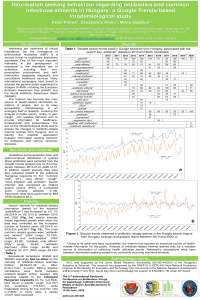
Introduction: Antibiotics are medicines of critical importance, but the emergence of antimicrobial resistance (AMR) is a serious threat to healthcare institutions worldwide. One of the most important hallmarks in the development of resistance is the imprudent use of antibiotics, including their non-prescription procurement and self-medication, bypassing diagnostic and consultative healthcare services. Many international campaigns have aimed to educate the general public regarding the dangers of AMR, including the European Antibiotic Awareness Day (EAAD) and the World Antibiotic Awareness Week (WAAW). Aims: The aim of this infodemiological study was to assess the changes in antibiotic-related Internet queries from Hungary, and to identify the possible association between information seeking behaviour for antibiotics and various infectious diseases. Materials and methods: Qualitative and quantitative data, and spatio-temporal distribution of queries about antibiotics were extracted from the Google Trends analysis tool for the time-period between 2010.01.01-2020.12.31. In addition, search intensity data were also collected related to the colloquial Hungarian keywords for “flu”, “common cold”, “UTI”, “sore throat”, “cough”,“sinus infection” and „probiotic”. Search intensity was expressed as relative search volume (RSV), a normalized score ranging between 0-100. Parametric tests were performed by IBM SPSS Statistics 22.0. Results: Search intensity for antibiotic-related in-formation (based on the keyword “antibiotikum”) has increased by 211.1% (26.2±4.8 vs. 55.1±12.6) between 2010 and 2020; search instensity shows significant growth even when the data was controlled for the increased number of Internet users (26.2±4.8 vs. 43.3±9.9; p<0.001). The most common related queries were “antibiotic and alcohol” (RSV range: 72-100), “antibiotic and contraceptive” (RSV range: 43-82), “antibiotic side effects” (RSV range: 39-82), “antibiotic diarrhoea” (RSV range: 44-86) and “antibiotic for UTI” (RSV range: 29-100). Educational campaigns (EAAD and WAAW) seemingly had no effect on the intensity of antibiotic-related searches (before: 66.59±15.49 vs. after: 67.91±14.07; p>0.05). Strong positive correlations were found between antibiotic-related online queries and searches related to the colloquial Hungarian keywords for flu (r=0.594), sore throat (r=0.644), cough (r=0.707) and probiotics (r=0.812), while moderately strong for the common cold (r=0.465); in every case, p values <0.001 were recorded. Conclusions: Owing to its quick and easy accessibility, the Internet has become an important source of health-related information for the public. Analysis of antibiotic-related Internet queries may be a valuable source of information of collective health utilization trends. Noteworthy associations were seen between information-seeking behaviour on commonly occurring infectious ailments.
Keywords
infodemiology
Google Trends
antibiotic
RSV
educational campaign
Internet
Hungary
Manuscript
sciforum-061325 abstract.pdf
Poster
Infodemiological_Pallós_2022.pdf
Self-medication with antibiotics: practices and related factors among the Pakistani public
Novel organic salts and ionic liquids based on Mefloquine drugs for application in Tuberculosis treatment