Event submissions
Published
 10.3390/eca2022-12755 (registering DOI)
 This submission belongs to the session P. Poster of the event The 2nd International Electronic Conference on Antibiotics
Published date
16 Jun, 2022
Academic Editor
'%3e%3cpath%20d='M12.6657%2010.9104C12.4185%2010.325%2012.0599%209.79327%2011.6097%209.34482C11.1609%208.89508%2010.6293%208.5365%2010.0442%208.28888C10.0389%208.28626%2010.0337%208.28495%2010.0285%208.28233C10.8446%207.69279%2011.3752%206.73249%2011.3752%205.64904C11.3752%203.8542%209.92103%202.39999%208.1262%202.39999C6.33136%202.39999%204.87715%203.8542%204.87715%205.64904C4.87715%206.73249%205.40774%207.69279%206.22393%208.28364C6.21869%208.28626%206.21345%208.28757%206.20821%208.29019C5.62129%208.5378%205.09463%208.89284%204.64265%209.34613C4.1929%209.79493%203.83432%2010.3266%203.58671%2010.9117C3.34345%2011.4845%203.21226%2012.0987%203.20023%2012.7209C3.19988%2012.7349%203.20233%2012.7488%203.20744%2012.7619C3.21255%2012.7749%203.22022%2012.7867%203.22998%2012.7968C3.23975%2012.8068%203.25142%2012.8147%203.26431%2012.8202C3.2772%2012.8256%203.29105%2012.8284%203.30504%2012.8284H4.09109C4.14874%2012.8284%204.19459%2012.7825%204.1959%2012.7262C4.2221%2011.7148%204.62823%2010.7676%205.34617%2010.0497C6.08899%209.30683%207.0755%208.89808%208.1262%208.89808C9.17689%208.89808%2010.1634%209.30683%2010.9062%2010.0497C11.6242%2010.7676%2012.0303%2011.7148%2012.0565%2012.7262C12.0578%2012.7838%2012.1037%2012.8284%2012.1613%2012.8284H12.9474C12.9613%2012.8284%2012.9752%2012.8256%2012.9881%2012.8202C13.001%2012.8147%2013.0126%2012.8068%2013.0224%2012.7968C13.0322%2012.7867%2013.0398%2012.7749%2013.0449%2012.7619C13.0501%2012.7488%2013.0525%2012.7349%2013.0522%2012.7209C13.0391%2012.0947%2012.9094%2011.4855%2012.6657%2010.9104ZM8.1262%207.9024C7.52486%207.9024%206.9589%207.6679%206.53312%207.24211C6.10733%206.81633%205.87283%206.25037%205.87283%205.64904C5.87283%205.0477%206.10733%204.48174%206.53312%204.05596C6.9589%203.63018%207.52486%203.39567%208.1262%203.39567C8.72753%203.39567%209.29349%203.63018%209.71927%204.05596C10.1451%204.48174%2010.3796%205.0477%2010.3796%205.64904C10.3796%206.25037%2010.1451%206.81633%209.71927%207.24211C9.29349%207.6679%208.72753%207.9024%208.1262%207.9024Z'%20fill='%235D1EE1'/%3e%3c/g%3e%3c/svg%3e) Marc Maresca
Marc MarescaCitation
Dário Silva, Miguel M. Santos, Zeljko Petrovski, Raoni S. B. Gonçalves, Luis C. Branco, Novel organic salts and ionic liquids based on Mefloquine drugs for application in Tuberculosis treatment, in Proceedings of The 2nd International Electronic Conference on Antibiotics, 15 June–30 June 2022, MDPI: Basel, Switzerland, doi: 10.3390/eca2022-12755
Share
Email
Facebook
Twitter
LinkedIn
Novel organic salts and ionic liquids based on Mefloquine drugs for application in Tuberculosis treatment
'%3e%3cpath%20d='M12.6647%2010.9104C12.4176%2010.325%2012.0589%209.7933%2011.6088%209.34485C11.16%208.89511%2010.6283%208.53653%2010.0432%208.28891C10.038%208.28629%2010.0327%208.28498%2010.0275%208.28236C10.8437%207.69282%2011.3743%206.73252%2011.3743%205.64907C11.3743%203.85423%209.92005%202.40002%208.12522%202.40002C6.33038%202.40002%204.87618%203.85423%204.87618%205.64907C4.87618%206.73252%205.40677%207.69282%206.22296%208.28367C6.21772%208.28629%206.21248%208.2876%206.20724%208.29022C5.62031%208.53783%205.09365%208.89287%204.64167%209.34616C4.19192%209.79496%203.83334%2010.3266%203.58573%2010.9117C3.34247%2011.4846%203.21128%2012.0987%203.19925%2012.721C3.1989%2012.735%203.20135%2012.7489%203.20646%2012.7619C3.21157%2012.7749%203.21924%2012.7868%203.22901%2012.7968C3.23877%2012.8068%203.25045%2012.8148%203.26334%2012.8202C3.27623%2012.8256%203.29007%2012.8284%203.30406%2012.8284H4.09012C4.14776%2012.8284%204.19362%2012.7825%204.19493%2012.7262C4.22113%2011.7148%204.62726%2010.7676%205.34519%2010.0497C6.08802%209.30686%207.07452%208.89811%208.12522%208.89811C9.17592%208.89811%2010.1624%209.30686%2010.9052%2010.0497C11.6232%2010.7676%2012.0293%2011.7148%2012.0555%2012.7262C12.0568%2012.7839%2012.1027%2012.8284%2012.1603%2012.8284H12.9464C12.9604%2012.8284%2012.9742%2012.8256%2012.9871%2012.8202C13%2012.8148%2013.0117%2012.8068%2013.0214%2012.7968C13.0312%2012.7868%2013.0389%2012.7749%2013.044%2012.7619C13.0491%2012.7489%2013.0515%2012.735%2013.0512%2012.721C13.0381%2012.0947%2012.9084%2011.4856%2012.6647%2010.9104ZM8.12522%207.90243C7.52388%207.90243%206.95792%207.66793%206.53214%207.24215C6.10636%206.81636%205.87185%206.2504%205.87185%205.64907C5.87185%205.04773%206.10636%204.48177%206.53214%204.05599C6.95792%203.63021%207.52388%203.3957%208.12522%203.3957C8.72655%203.3957%209.29252%203.63021%209.7183%204.05599C10.1441%204.48177%2010.3786%205.04773%2010.3786%205.64907C10.3786%206.2504%2010.1441%206.81636%209.7183%207.24215C9.29252%207.66793%208.72655%207.90243%208.12522%207.90243Z'%20fill='%235D1EE1'/%3e%3c/g%3e%3c/svg%3e)
Dário Silva 1
Miguel M. Santos 1

Zeljko Petrovski 1
Raoni S. B. Gonçalves 2

Luis C. Branco 1
1. Universidade Nova
2. Instituto de Química, Universidade Federal do Rio de Janeiro
Abstract
Tuberculosis (TB) remains a major public health concern and currently is the leading cause of human death by an infectious disease. According to the World Health Organization, around 10 million people were infected with the Mycobacterium tuberculosis in 2018 and 1.5 million deceased.1
The development of novel pharmaceutical tools to efficiently tackle tuberculosis are in the order of the day due to the rapid development of resistant strains of Mycobacterium tuberculosis.2 Our group reported different classes of pharmaceutical drugs as organic salts and ionic liqudis (API-OSILs) for therapeutical applications including tuberculosis treatment.3,4
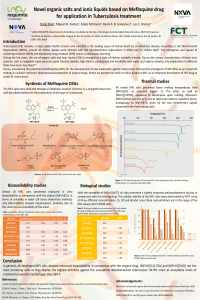
Herein, we report novel potential formulations of a repurposed drug, the antimalarial mefloquine (MFL), which was combined with suitable and biocompatible counter-ions. Eight mefloquine organic salts were obtained by ion metathesis reaction between mefloquine hydrochloride ([MFLH][Cl]) and several organic acid sodium salts in high yields. One of the salts ([MFLH][MsO]) presented increased water solubility in comparison with [MFLH][Cl]. Moreover, all salts with the exception of [MFLH][AOT] showed improved permeability and diffusion through synthetic membranes. Finally, in vitro activity studies against Mycobacterium tuberculosis revealed that these ionic formulations exhibited up to 1.5-times lower MIC values when compared with [MFLH][Cl], in particular [MFLH][(1R)-CSA], [MFLH][(1S)-CSA] and [MFLH][HEPES].
In the case of meropenem based pharmaceutical ionic liquids, several organic cations were considered using acid-base neutralization reaction. The detailed characterization of the compounds as well as biological studies were also performed.
Keywords
tuberculosis
mefloquine
organic salts and ionic liquids with active pharmaceutical ingredients (OSIL-APIs)
Manuscript
sciforum-061355 abstract.pdf
Poster
Poster_Mefloquina.pdf
Information seeking behaviour regarding antibiotics and common infectious ailments in Hungary: a Google Trends-based infodemiological study
Alkylguanidino Ureas, from a serendipitous discovery to a rational design: molecular simplification approach and membrane-based MoA investigation