Event submissions
Published
 10.3390/ecas2022-12827 (registering DOI)
 This submission belongs to the session S7. Meteorology of the event The 5th International Electronic Conference on Atmospheric Sciences
Published date
14 Jul, 2022
Academic Editor
'%3e%3cpath%20d='M12.6657%2010.9104C12.4185%2010.325%2012.0599%209.79327%2011.6097%209.34482C11.1609%208.89508%2010.6293%208.5365%2010.0442%208.28888C10.0389%208.28626%2010.0337%208.28495%2010.0285%208.28233C10.8446%207.69279%2011.3752%206.73249%2011.3752%205.64904C11.3752%203.8542%209.92103%202.39999%208.1262%202.39999C6.33136%202.39999%204.87715%203.8542%204.87715%205.64904C4.87715%206.73249%205.40774%207.69279%206.22393%208.28364C6.21869%208.28626%206.21345%208.28757%206.20821%208.29019C5.62129%208.5378%205.09463%208.89284%204.64265%209.34613C4.1929%209.79493%203.83432%2010.3266%203.58671%2010.9117C3.34345%2011.4845%203.21226%2012.0987%203.20023%2012.7209C3.19988%2012.7349%203.20233%2012.7488%203.20744%2012.7619C3.21255%2012.7749%203.22022%2012.7867%203.22998%2012.7968C3.23975%2012.8068%203.25142%2012.8147%203.26431%2012.8202C3.2772%2012.8256%203.29105%2012.8284%203.30504%2012.8284H4.09109C4.14874%2012.8284%204.19459%2012.7825%204.1959%2012.7262C4.2221%2011.7148%204.62823%2010.7676%205.34617%2010.0497C6.08899%209.30683%207.0755%208.89808%208.1262%208.89808C9.17689%208.89808%2010.1634%209.30683%2010.9062%2010.0497C11.6242%2010.7676%2012.0303%2011.7148%2012.0565%2012.7262C12.0578%2012.7838%2012.1037%2012.8284%2012.1613%2012.8284H12.9474C12.9613%2012.8284%2012.9752%2012.8256%2012.9881%2012.8202C13.001%2012.8147%2013.0126%2012.8068%2013.0224%2012.7968C13.0322%2012.7867%2013.0398%2012.7749%2013.0449%2012.7619C13.0501%2012.7488%2013.0525%2012.7349%2013.0522%2012.7209C13.0391%2012.0947%2012.9094%2011.4855%2012.6657%2010.9104ZM8.1262%207.9024C7.52486%207.9024%206.9589%207.6679%206.53312%207.24211C6.10733%206.81633%205.87283%206.25037%205.87283%205.64904C5.87283%205.0477%206.10733%204.48174%206.53312%204.05596C6.9589%203.63018%207.52486%203.39567%208.1262%203.39567C8.72753%203.39567%209.29349%203.63018%209.71927%204.05596C10.1451%204.48174%2010.3796%205.0477%2010.3796%205.64904C10.3796%206.25037%2010.1451%206.81633%209.71927%207.24211C9.29349%207.6679%208.72753%207.9024%208.1262%207.9024Z'%20fill='%235D1EE1'/%3e%3c/g%3e%3c/svg%3e) Anthony Lupo
Anthony LupoCitation
Katsiaryna Sumak, Inna Semenova, Assessment of fire weather conditions in Belarus under modern climate warming, in Proceedings of The 5th International Electronic Conference on Atmospheric Sciences, 16 July–31 July 2022, MDPI: Basel, Switzerland, doi: 10.3390/ecas2022-12827
Share
Email
Facebook
Twitter
LinkedIn
Assessment of fire weather conditions in Belarus under modern climate warming
'%3e%3cpath%20d='M12.6647%2010.9104C12.4176%2010.325%2012.0589%209.7933%2011.6088%209.34485C11.16%208.89511%2010.6283%208.53653%2010.0432%208.28891C10.038%208.28629%2010.0327%208.28498%2010.0275%208.28236C10.8437%207.69282%2011.3743%206.73252%2011.3743%205.64907C11.3743%203.85423%209.92005%202.40002%208.12522%202.40002C6.33038%202.40002%204.87618%203.85423%204.87618%205.64907C4.87618%206.73252%205.40677%207.69282%206.22296%208.28367C6.21772%208.28629%206.21248%208.2876%206.20724%208.29022C5.62031%208.53783%205.09365%208.89287%204.64167%209.34616C4.19192%209.79496%203.83334%2010.3266%203.58573%2010.9117C3.34247%2011.4846%203.21128%2012.0987%203.19925%2012.721C3.1989%2012.735%203.20135%2012.7489%203.20646%2012.7619C3.21157%2012.7749%203.21924%2012.7868%203.22901%2012.7968C3.23877%2012.8068%203.25045%2012.8148%203.26334%2012.8202C3.27623%2012.8256%203.29007%2012.8284%203.30406%2012.8284H4.09012C4.14776%2012.8284%204.19362%2012.7825%204.19493%2012.7262C4.22113%2011.7148%204.62726%2010.7676%205.34519%2010.0497C6.08802%209.30686%207.07452%208.89811%208.12522%208.89811C9.17592%208.89811%2010.1624%209.30686%2010.9052%2010.0497C11.6232%2010.7676%2012.0293%2011.7148%2012.0555%2012.7262C12.0568%2012.7839%2012.1027%2012.8284%2012.1603%2012.8284H12.9464C12.9604%2012.8284%2012.9742%2012.8256%2012.9871%2012.8202C13%2012.8148%2013.0117%2012.8068%2013.0214%2012.7968C13.0312%2012.7868%2013.0389%2012.7749%2013.044%2012.7619C13.0491%2012.7489%2013.0515%2012.735%2013.0512%2012.721C13.0381%2012.0947%2012.9084%2011.4856%2012.6647%2010.9104ZM8.12522%207.90243C7.52388%207.90243%206.95792%207.66793%206.53214%207.24215C6.10636%206.81636%205.87185%206.2504%205.87185%205.64907C5.87185%205.04773%206.10636%204.48177%206.53214%204.05599C6.95792%203.63021%207.52388%203.3957%208.12522%203.3957C8.72655%203.3957%209.29252%203.63021%209.7183%204.05599C10.1441%204.48177%2010.3786%205.04773%2010.3786%205.64907C10.3786%206.2504%2010.1441%206.81636%209.7183%207.24215C9.29252%207.66793%208.72655%207.90243%208.12522%207.90243Z'%20fill='%235D1EE1'/%3e%3c/g%3e%3c/svg%3e)
Katsiaryna Sumak 1
Inna Semenova 2
1. Belarussian State University
2. Odessa State Environmental University
Abstract
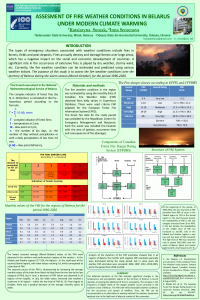
The types of emergency situations associated with weather conditions include fires in forests, fields and peat deposits. Fires destroy and damage forests over large areas, which have a negative impact on the social and economic development of countries. A significant role in the occurrence of extensive fires is play by dry weather, stormy wind.
The purpose of this study is to assess the fire weather conditions over the territory of Belarus during the warm season (March-October) for the period 1990-2020 using the monthly area-averaged data of Fire Weather Index (FWI).
It is shown that the lowest seasonal average values of the FWI were observed in the Vitebsk and Grodno regions, the highest – in the Gomel region. The seasonal course of the FWI was characterized by increasing the average monthly values of the index from March to May, but in June a decrease of FWI values was observed. In July the index values reached a maximum. Analysis of the frequency of the fire weather in separate time intervals showed that the high level of FWI was observed only in period 2015-2020 over the south of Belarus (2%). During the study period the months with negative FWI anomalies generally were dominated in all regions of Belarus, but in some years the positive FWI anomalies were prevailed: 2002, 2007, 2011, 2014-2015, and in the period from 2018 to 2020.
Additionally three periods for different seasons with real large-scale wildfires were considered: June 2015, August-October 2016 and April 2020. It was revealed that FWI maxima values were observed on the first days of fires and start to decrease in the next days.
The obtained dynamics of the FWI indicates significant changes in the temperature and precipitation regime of the territory of Belarus in recent decades.
Keywords
Fire Weather Index
fire weather conditions
wildfires
Manuscript
sciforum_061604_original_sciforum_061604-done.pdf
Poster
sciforum-061604 poster.pdf
An Introduction to Atmospheric Pollutant Dispersion Modelling
Climatological variations in the intensity of tropical cyclones formed over the North Atlantic basin using the Hurricane Maximum Potential Intensity (HuMPI) model