Event submissions
Published

This submission belongs to the session S8. Upper Atmosphere of the event The 5th International Electronic Conference on Atmospheric Sciences
Published date
08 Aug, 2022
Academic Editor
'%3e%3cpath%20d='M12.6657%2010.9104C12.4185%2010.325%2012.0599%209.79327%2011.6097%209.34482C11.1609%208.89508%2010.6293%208.5365%2010.0442%208.28888C10.0389%208.28626%2010.0337%208.28495%2010.0285%208.28233C10.8446%207.69279%2011.3752%206.73249%2011.3752%205.64904C11.3752%203.8542%209.92103%202.39999%208.1262%202.39999C6.33136%202.39999%204.87715%203.8542%204.87715%205.64904C4.87715%206.73249%205.40774%207.69279%206.22393%208.28364C6.21869%208.28626%206.21345%208.28757%206.20821%208.29019C5.62129%208.5378%205.09463%208.89284%204.64265%209.34613C4.1929%209.79493%203.83432%2010.3266%203.58671%2010.9117C3.34345%2011.4845%203.21226%2012.0987%203.20023%2012.7209C3.19988%2012.7349%203.20233%2012.7488%203.20744%2012.7619C3.21255%2012.7749%203.22022%2012.7867%203.22998%2012.7968C3.23975%2012.8068%203.25142%2012.8147%203.26431%2012.8202C3.2772%2012.8256%203.29105%2012.8284%203.30504%2012.8284H4.09109C4.14874%2012.8284%204.19459%2012.7825%204.1959%2012.7262C4.2221%2011.7148%204.62823%2010.7676%205.34617%2010.0497C6.08899%209.30683%207.0755%208.89808%208.1262%208.89808C9.17689%208.89808%2010.1634%209.30683%2010.9062%2010.0497C11.6242%2010.7676%2012.0303%2011.7148%2012.0565%2012.7262C12.0578%2012.7838%2012.1037%2012.8284%2012.1613%2012.8284H12.9474C12.9613%2012.8284%2012.9752%2012.8256%2012.9881%2012.8202C13.001%2012.8147%2013.0126%2012.8068%2013.0224%2012.7968C13.0322%2012.7867%2013.0398%2012.7749%2013.0449%2012.7619C13.0501%2012.7488%2013.0525%2012.7349%2013.0522%2012.7209C13.0391%2012.0947%2012.9094%2011.4855%2012.6657%2010.9104ZM8.1262%207.9024C7.52486%207.9024%206.9589%207.6679%206.53312%207.24211C6.10733%206.81633%205.87283%206.25037%205.87283%205.64904C5.87283%205.0477%206.10733%204.48174%206.53312%204.05596C6.9589%203.63018%207.52486%203.39567%208.1262%203.39567C8.72753%203.39567%209.29349%203.63018%209.71927%204.05596C10.1451%204.48174%2010.3796%205.0477%2010.3796%205.64904C10.3796%206.25037%2010.1451%206.81633%209.71927%207.24211C9.29349%207.6679%208.72753%207.9024%208.1262%207.9024Z'%20fill='%235D1EE1'/%3e%3c/g%3e%3c/svg%3e) Anthony Lupo
Anthony LupoCitation
Valentina Antonova, Vadim Lutsenko, Galina Gordiyenko, Sergey Kryukov, Impact of various sources of disturbances on the atmospheric electric field and the lower ionosphere, in Proceedings of The 5th International Electronic Conference on Atmospheric Sciences, 16 July–31 July 2022, MDPI: Basel, Switzerland, doi: 10.3390/ecas2022-12868
Share
Email
Facebook
Twitter
LinkedIn
Impact of various sources of disturbances on the atmospheric electric field and the lower ionosphere
'%3e%3cpath%20d='M12.6647%2010.9104C12.4176%2010.325%2012.0589%209.7933%2011.6088%209.34485C11.16%208.89511%2010.6283%208.53653%2010.0432%208.28891C10.038%208.28629%2010.0327%208.28498%2010.0275%208.28236C10.8437%207.69282%2011.3743%206.73252%2011.3743%205.64907C11.3743%203.85423%209.92005%202.40002%208.12522%202.40002C6.33038%202.40002%204.87618%203.85423%204.87618%205.64907C4.87618%206.73252%205.40677%207.69282%206.22296%208.28367C6.21772%208.28629%206.21248%208.2876%206.20724%208.29022C5.62031%208.53783%205.09365%208.89287%204.64167%209.34616C4.19192%209.79496%203.83334%2010.3266%203.58573%2010.9117C3.34247%2011.4846%203.21128%2012.0987%203.19925%2012.721C3.1989%2012.735%203.20135%2012.7489%203.20646%2012.7619C3.21157%2012.7749%203.21924%2012.7868%203.22901%2012.7968C3.23877%2012.8068%203.25045%2012.8148%203.26334%2012.8202C3.27623%2012.8256%203.29007%2012.8284%203.30406%2012.8284H4.09012C4.14776%2012.8284%204.19362%2012.7825%204.19493%2012.7262C4.22113%2011.7148%204.62726%2010.7676%205.34519%2010.0497C6.08802%209.30686%207.07452%208.89811%208.12522%208.89811C9.17592%208.89811%2010.1624%209.30686%2010.9052%2010.0497C11.6232%2010.7676%2012.0293%2011.7148%2012.0555%2012.7262C12.0568%2012.7839%2012.1027%2012.8284%2012.1603%2012.8284H12.9464C12.9604%2012.8284%2012.9742%2012.8256%2012.9871%2012.8202C13%2012.8148%2013.0117%2012.8068%2013.0214%2012.7968C13.0312%2012.7868%2013.0389%2012.7749%2013.044%2012.7619C13.0491%2012.7489%2013.0515%2012.735%2013.0512%2012.721C13.0381%2012.0947%2012.9084%2011.4856%2012.6647%2010.9104ZM8.12522%207.90243C7.52388%207.90243%206.95792%207.66793%206.53214%207.24215C6.10636%206.81636%205.87185%206.2504%205.87185%205.64907C5.87185%205.04773%206.10636%204.48177%206.53214%204.05599C6.95792%203.63021%207.52388%203.3957%208.12522%203.3957C8.72655%203.3957%209.29252%203.63021%209.7183%204.05599C10.1441%204.48177%2010.3786%205.04773%2010.3786%205.64907C10.3786%206.2504%2010.1441%206.81636%209.7183%207.24215C9.29252%207.66793%208.72655%207.90243%208.12522%207.90243Z'%20fill='%235D1EE1'/%3e%3c/g%3e%3c/svg%3e)
Valentina Antonova 1
Vadim Lutsenko 1
Galina Gordiyenko 1
Sergey Kryukov 1
1. Institute of Ionosphere of the National Center for Space Research and Technology, Almaty, Kazakhstan.
Abstract
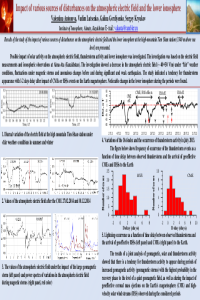
Results of studying the impact of solar activity on variations in the atmospheric electric field, thunderstorm activity and the lower ionosphere, obtained at the Tien- Shan high-mountain experimental complex (height 3340 m) and the Alma-Ata ionospheric station [43.25N, 76.92E]) in 2005-2015 are presented in this work. It has been established that a decrease in the intensity of galactic cosmic rays at low magnetic activity lowers the average level of the electric field by 40÷60 V/m. Large magnetic storms affect the average level of the electric field, and also cause its fluctuations in the minute range (10-3 ÷10-1) Hz. Tendency has been established for the appearance of thunderstorm activity with a delay of 1-2 days or more after the impact on the Earth's atmosphere and magnetosphere of geoeffective coronal mass ejections (CME), high-speed solar wind streams (HSS). Noticeable changes in the state of the lower ionosphere and geomagnetic field (fmin and Dst) are observed during these periods. Cases of increasing fmin values and critical frequencies of the sporadic Es layer were recorded under conditions of low geomagnetic activity during thunderstorms with powerful positive discharges or in combination with negative discharges. Long-term anomalous changes in the electric field are observed on the eve of and during significant earthquakes with a magnitude of more than 5.0, as well as before weak earthquakes, but with epicenters located in the immediate vicinity of the electric field detector.
Keywords
atmospheric-electric-field
ionosphere
cosmic-rays
magnetic-storms
thunderstorm
Manuscript
sciforum_061131_original_Manuscript_Antonova_V_P.pdf
Poster
presentation_Antonova V.P.pdf
Household indoor concentration levels of nitrogen dioxide (NO2) and ozone (O3) in Eskişehir, Türkiye
Helical cyclogenesis in the Earth’s atmosphere and beyond