Event submissions
Published

This submission belongs to the session 4. Neuropsychology of the event The 3rd International Electronic Conference on Brain Sciences
Published date
30 Sep, 2022
Academic Editor
'%3e%3cpath%20d='M12.6657%2010.9104C12.4185%2010.325%2012.0599%209.79327%2011.6097%209.34482C11.1609%208.89508%2010.6293%208.5365%2010.0442%208.28888C10.0389%208.28626%2010.0337%208.28495%2010.0285%208.28233C10.8446%207.69279%2011.3752%206.73249%2011.3752%205.64904C11.3752%203.8542%209.92103%202.39999%208.1262%202.39999C6.33136%202.39999%204.87715%203.8542%204.87715%205.64904C4.87715%206.73249%205.40774%207.69279%206.22393%208.28364C6.21869%208.28626%206.21345%208.28757%206.20821%208.29019C5.62129%208.5378%205.09463%208.89284%204.64265%209.34613C4.1929%209.79493%203.83432%2010.3266%203.58671%2010.9117C3.34345%2011.4845%203.21226%2012.0987%203.20023%2012.7209C3.19988%2012.7349%203.20233%2012.7488%203.20744%2012.7619C3.21255%2012.7749%203.22022%2012.7867%203.22998%2012.7968C3.23975%2012.8068%203.25142%2012.8147%203.26431%2012.8202C3.2772%2012.8256%203.29105%2012.8284%203.30504%2012.8284H4.09109C4.14874%2012.8284%204.19459%2012.7825%204.1959%2012.7262C4.2221%2011.7148%204.62823%2010.7676%205.34617%2010.0497C6.08899%209.30683%207.0755%208.89808%208.1262%208.89808C9.17689%208.89808%2010.1634%209.30683%2010.9062%2010.0497C11.6242%2010.7676%2012.0303%2011.7148%2012.0565%2012.7262C12.0578%2012.7838%2012.1037%2012.8284%2012.1613%2012.8284H12.9474C12.9613%2012.8284%2012.9752%2012.8256%2012.9881%2012.8202C13.001%2012.8147%2013.0126%2012.8068%2013.0224%2012.7968C13.0322%2012.7867%2013.0398%2012.7749%2013.0449%2012.7619C13.0501%2012.7488%2013.0525%2012.7349%2013.0522%2012.7209C13.0391%2012.0947%2012.9094%2011.4855%2012.6657%2010.9104ZM8.1262%207.9024C7.52486%207.9024%206.9589%207.6679%206.53312%207.24211C6.10733%206.81633%205.87283%206.25037%205.87283%205.64904C5.87283%205.0477%206.10733%204.48174%206.53312%204.05596C6.9589%203.63018%207.52486%203.39567%208.1262%203.39567C8.72753%203.39567%209.29349%203.63018%209.71927%204.05596C10.1451%204.48174%2010.3796%205.0477%2010.3796%205.64904C10.3796%206.25037%2010.1451%206.81633%209.71927%207.24211C9.29349%207.6679%208.72753%207.9024%208.1262%207.9024Z'%20fill='%235D1EE1'/%3e%3c/g%3e%3c/svg%3e) Pierluigi Zoccolotti
Pierluigi ZoccolottiCitation
Shirin Rahgozar, Lydia Giménez-Llort, Immigration and Logotherapy: Addressing and Mental Health Problems among Muslim Immigrants in Europe., in Proceedings of The 3rd International Electronic Conference on Brain Sciences, 1 October–15 October 2022, MDPI: Basel, Switzerland, doi: 10.3390/IECBS2022-12937
Share
Email
Facebook
Twitter
LinkedIn
Immigration and Logotherapy: Addressing and Mental Health Problems among Muslim Immigrants in Europe.
'%3e%3cpath%20d='M12.6647%2010.9104C12.4176%2010.325%2012.0589%209.7933%2011.6088%209.34485C11.16%208.89511%2010.6283%208.53653%2010.0432%208.28891C10.038%208.28629%2010.0327%208.28498%2010.0275%208.28236C10.8437%207.69282%2011.3743%206.73252%2011.3743%205.64907C11.3743%203.85423%209.92005%202.40002%208.12522%202.40002C6.33038%202.40002%204.87618%203.85423%204.87618%205.64907C4.87618%206.73252%205.40677%207.69282%206.22296%208.28367C6.21772%208.28629%206.21248%208.2876%206.20724%208.29022C5.62031%208.53783%205.09365%208.89287%204.64167%209.34616C4.19192%209.79496%203.83334%2010.3266%203.58573%2010.9117C3.34247%2011.4846%203.21128%2012.0987%203.19925%2012.721C3.1989%2012.735%203.20135%2012.7489%203.20646%2012.7619C3.21157%2012.7749%203.21924%2012.7868%203.22901%2012.7968C3.23877%2012.8068%203.25045%2012.8148%203.26334%2012.8202C3.27623%2012.8256%203.29007%2012.8284%203.30406%2012.8284H4.09012C4.14776%2012.8284%204.19362%2012.7825%204.19493%2012.7262C4.22113%2011.7148%204.62726%2010.7676%205.34519%2010.0497C6.08802%209.30686%207.07452%208.89811%208.12522%208.89811C9.17592%208.89811%2010.1624%209.30686%2010.9052%2010.0497C11.6232%2010.7676%2012.0293%2011.7148%2012.0555%2012.7262C12.0568%2012.7839%2012.1027%2012.8284%2012.1603%2012.8284H12.9464C12.9604%2012.8284%2012.9742%2012.8256%2012.9871%2012.8202C13%2012.8148%2013.0117%2012.8068%2013.0214%2012.7968C13.0312%2012.7868%2013.0389%2012.7749%2013.044%2012.7619C13.0491%2012.7489%2013.0515%2012.735%2013.0512%2012.721C13.0381%2012.0947%2012.9084%2011.4856%2012.6647%2010.9104ZM8.12522%207.90243C7.52388%207.90243%206.95792%207.66793%206.53214%207.24215C6.10636%206.81636%205.87185%206.2504%205.87185%205.64907C5.87185%205.04773%206.10636%204.48177%206.53214%204.05599C6.95792%203.63021%207.52388%203.3957%208.12522%203.3957C8.72655%203.3957%209.29252%203.63021%209.7183%204.05599C10.1441%204.48177%2010.3786%205.04773%2010.3786%205.64907C10.3786%206.2504%2010.1441%206.81636%209.7183%207.24215C9.29252%207.66793%208.72655%207.90243%208.12522%207.90243Z'%20fill='%235D1EE1'/%3e%3c/g%3e%3c/svg%3e)
Shirin Rahgozar 1

Lydia Giménez-Llort 1,2
1. Department of Psychiatry and Forensic Medicine, School of Medicine, Universitat Autònoma de Barcelona, Barcelona, Spain
2. Institut de Neurociències, Universitat Autònoma de Barcelona, Barcelona, Spain
Abstract
Depression, stress, anxiety disorders, and PTSD are some of the mental health problems which are prevalent among immigrant populations despite being underdiagnosed. Stigma, difficulties in adapting, cultural barriers, and reduced access to mental health support can seriously hamper their ability to build resilience and recover. Other limitations include assuming that therapies can be universally applied, the lack of sufficient evidence on mental health issues of this population, and the use of therapeutic models developed on Caucasian populations. Here, professional guidance to find the meaning of life through interventions such as logotherapy could help them in this process. The present work systematically reviewed studies investigating the effectiveness of logotherapy in diverse populations and its relevance to a Muslim immigrant population in Europe. Following PRISMA guidelines and the keywords 'logotherapy, mental health problems, immigrant, and treatment', the search identified 16 relevant studies conducted since 2005. The studies revealed that logotherapy could be implemented through paradoxical intention, dereflection, Socratic dialogue, and attitude modification. All these techniques had the potential to help the client to realize long-term relief for underlying stressors associated with migration and settling in a new location. Though data on logotherapy is still scarce, it is evident that it deserves more research so that a structured, evidence-based, and effective therapy for Muslim immigrants in Europe can be developed and tested. In this regard, we propose that the four logotherapy techniques have huge potential in helping psychiatrists develop an effective therapy for mental health problems among these immigrant populations confronting adversity.
Keywords
logotherapy
Muslim
immigration
mental health
Manuscript
sciforum-063417.pdf
Poster
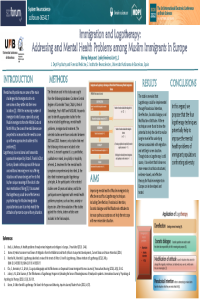
Posters Sciforum 2022 Raghozar and Gimenez-Llort Submitted.pdf
The influence of the body processing in the development of empathy in early adolescence: a preliminary study
Obesity, impaired glucose metabolism and hepatic histopathological damage in 3xTg-AD mice at different stages of disease compared to mice with normal aging