Event submissions
Published

This submission belongs to the session 5. Systems Neuroscience of the event The 3rd International Electronic Conference on Brain Sciences
Published date
30 Sep, 2022
Academic Editor
'%3e%3cpath%20d='M12.6657%2010.9104C12.4185%2010.325%2012.0599%209.79327%2011.6097%209.34482C11.1609%208.89508%2010.6293%208.5365%2010.0442%208.28888C10.0389%208.28626%2010.0337%208.28495%2010.0285%208.28233C10.8446%207.69279%2011.3752%206.73249%2011.3752%205.64904C11.3752%203.8542%209.92103%202.39999%208.1262%202.39999C6.33136%202.39999%204.87715%203.8542%204.87715%205.64904C4.87715%206.73249%205.40774%207.69279%206.22393%208.28364C6.21869%208.28626%206.21345%208.28757%206.20821%208.29019C5.62129%208.5378%205.09463%208.89284%204.64265%209.34613C4.1929%209.79493%203.83432%2010.3266%203.58671%2010.9117C3.34345%2011.4845%203.21226%2012.0987%203.20023%2012.7209C3.19988%2012.7349%203.20233%2012.7488%203.20744%2012.7619C3.21255%2012.7749%203.22022%2012.7867%203.22998%2012.7968C3.23975%2012.8068%203.25142%2012.8147%203.26431%2012.8202C3.2772%2012.8256%203.29105%2012.8284%203.30504%2012.8284H4.09109C4.14874%2012.8284%204.19459%2012.7825%204.1959%2012.7262C4.2221%2011.7148%204.62823%2010.7676%205.34617%2010.0497C6.08899%209.30683%207.0755%208.89808%208.1262%208.89808C9.17689%208.89808%2010.1634%209.30683%2010.9062%2010.0497C11.6242%2010.7676%2012.0303%2011.7148%2012.0565%2012.7262C12.0578%2012.7838%2012.1037%2012.8284%2012.1613%2012.8284H12.9474C12.9613%2012.8284%2012.9752%2012.8256%2012.9881%2012.8202C13.001%2012.8147%2013.0126%2012.8068%2013.0224%2012.7968C13.0322%2012.7867%2013.0398%2012.7749%2013.0449%2012.7619C13.0501%2012.7488%2013.0525%2012.7349%2013.0522%2012.7209C13.0391%2012.0947%2012.9094%2011.4855%2012.6657%2010.9104ZM8.1262%207.9024C7.52486%207.9024%206.9589%207.6679%206.53312%207.24211C6.10733%206.81633%205.87283%206.25037%205.87283%205.64904C5.87283%205.0477%206.10733%204.48174%206.53312%204.05596C6.9589%203.63018%207.52486%203.39567%208.1262%203.39567C8.72753%203.39567%209.29349%203.63018%209.71927%204.05596C10.1451%204.48174%2010.3796%205.0477%2010.3796%205.64904C10.3796%206.25037%2010.1451%206.81633%209.71927%207.24211C9.29349%207.6679%208.72753%207.9024%208.1262%207.9024Z'%20fill='%235D1EE1'/%3e%3c/g%3e%3c/svg%3e) Konstantin Slavin
Konstantin SlavinCitation
Clara Pérez-Gozalbo, Lydia Giménez-Llort, Obesity, impaired glucose metabolism and hepatic histopathological damage in 3xTg-AD mice at different stages of disease compared to mice with normal aging, in Proceedings of The 3rd International Electronic Conference on Brain Sciences, 1 October–15 October 2022, MDPI: Basel, Switzerland, doi: 10.3390/IECBS2022-12938
Share
Email
Facebook
Twitter
LinkedIn
Obesity, impaired glucose metabolism and hepatic histopathological damage in 3xTg-AD mice at different stages of disease compared to mice with normal aging
'%3e%3cpath%20d='M12.6647%2010.9104C12.4176%2010.325%2012.0589%209.7933%2011.6088%209.34485C11.16%208.89511%2010.6283%208.53653%2010.0432%208.28891C10.038%208.28629%2010.0327%208.28498%2010.0275%208.28236C10.8437%207.69282%2011.3743%206.73252%2011.3743%205.64907C11.3743%203.85423%209.92005%202.40002%208.12522%202.40002C6.33038%202.40002%204.87618%203.85423%204.87618%205.64907C4.87618%206.73252%205.40677%207.69282%206.22296%208.28367C6.21772%208.28629%206.21248%208.2876%206.20724%208.29022C5.62031%208.53783%205.09365%208.89287%204.64167%209.34616C4.19192%209.79496%203.83334%2010.3266%203.58573%2010.9117C3.34247%2011.4846%203.21128%2012.0987%203.19925%2012.721C3.1989%2012.735%203.20135%2012.7489%203.20646%2012.7619C3.21157%2012.7749%203.21924%2012.7868%203.22901%2012.7968C3.23877%2012.8068%203.25045%2012.8148%203.26334%2012.8202C3.27623%2012.8256%203.29007%2012.8284%203.30406%2012.8284H4.09012C4.14776%2012.8284%204.19362%2012.7825%204.19493%2012.7262C4.22113%2011.7148%204.62726%2010.7676%205.34519%2010.0497C6.08802%209.30686%207.07452%208.89811%208.12522%208.89811C9.17592%208.89811%2010.1624%209.30686%2010.9052%2010.0497C11.6232%2010.7676%2012.0293%2011.7148%2012.0555%2012.7262C12.0568%2012.7839%2012.1027%2012.8284%2012.1603%2012.8284H12.9464C12.9604%2012.8284%2012.9742%2012.8256%2012.9871%2012.8202C13%2012.8148%2013.0117%2012.8068%2013.0214%2012.7968C13.0312%2012.7868%2013.0389%2012.7749%2013.044%2012.7619C13.0491%2012.7489%2013.0515%2012.735%2013.0512%2012.721C13.0381%2012.0947%2012.9084%2011.4856%2012.6647%2010.9104ZM8.12522%207.90243C7.52388%207.90243%206.95792%207.66793%206.53214%207.24215C6.10636%206.81636%205.87185%206.2504%205.87185%205.64907C5.87185%205.04773%206.10636%204.48177%206.53214%204.05599C6.95792%203.63021%207.52388%203.3957%208.12522%203.3957C8.72655%203.3957%209.29252%203.63021%209.7183%204.05599C10.1441%204.48177%2010.3786%205.04773%2010.3786%205.64907C10.3786%206.2504%2010.1441%206.81636%209.7183%207.24215C9.29252%207.66793%208.72655%207.90243%208.12522%207.90243Z'%20fill='%235D1EE1'/%3e%3c/g%3e%3c/svg%3e)
Clara Pérez-Gozalbo 1

Lydia Giménez-Llort 2,3
1. Institut de Neurociències, Universitat Autònoma de Barcelona, Barcelona, Spain
Department of Psychiatry and Forensic Medicine, School of Medicine, Universitat Autònoma de Barcelona, Barcelona, Spain
2. Institut de Neurociències, Universitat Autònoma de Barcelona, Barcelona, Spain
3. Department of Psychiatry and Forensic Medicine, School of Medicine, Universitat Autònoma de Barcelona, Barcelona, Spain
Abstract
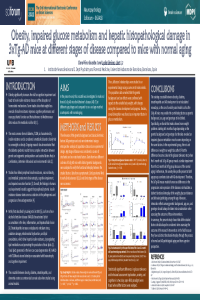
The crosstalk between obesity, diabetes, steatohepatitis, and dementia creates a controversial scenario also when studied using animal models. In the present work, this crosstalk was investigated in male and female 3xTg-AD mice for Alzheimer’s disease (AD) at different ages/stages and compared to sex- and age-matched counterparts with normal aging. The relevance of the genetic background and classical intrinsic factors (AD genotype and sex) were determined using a retrospective analysis of population data and an experimental design. Age/stage of disease was considered a source of stochastic and non-stochastic factors. Data from two different colonies of 3xTg-AD mice with distinct genetic backgrounds were analyzed to verify the functional interplay between the studied factors. Data from asymptomatic/prodromal to early/advanced stages of the disease were screened. Then, all factors' relationships were studied in an experimental design using the same set of animals. The population data unveiled that the genetic background and sex effects were confirmed with regards to the variable body weight, with changes during the disease development and progress. Besides, sexual dimorphism was found as an important factor in glucose metabolism. Statistically significant differences in glucose tolerance and behavioral assessment (exploration, anxiety, and cognition in a two-days open-field paradigm) were found when all the factors were analyzed. In summary, the present study shows that all the studied factors should always be considered when assessing the outcome of the research interventions in the field because they have a distinct functional interplay through the process of normal and AD-pathological aging and from a gender perspective.
Keywords
Obesity
glucose metabolism
liver
dementia
Alzheimer's disease
aging
sex/gender perspective
Manuscript
sciforum 063418.pdf
Poster
Poster Sciforum 2022 OB Perez-Gozalbo – 063418.pdf
Immigration and Logotherapy: Addressing and Mental Health Problems among Muslim Immigrants in Europe.
Reference models for children and young people with Epidermolysis bullosa: First case report on the challenges, rewards and limiting factors for successful academic and professional achievements