Event submissions
Published

This submission belongs to the session 10. Poster Session of the event The 3rd International Electronic Conference on Brain Sciences
Published date
30 Sep, 2022
Academic Editor
'%3e%3cpath%20d='M12.6657%2010.9104C12.4185%2010.325%2012.0599%209.79327%2011.6097%209.34482C11.1609%208.89508%2010.6293%208.5365%2010.0442%208.28888C10.0389%208.28626%2010.0337%208.28495%2010.0285%208.28233C10.8446%207.69279%2011.3752%206.73249%2011.3752%205.64904C11.3752%203.8542%209.92103%202.39999%208.1262%202.39999C6.33136%202.39999%204.87715%203.8542%204.87715%205.64904C4.87715%206.73249%205.40774%207.69279%206.22393%208.28364C6.21869%208.28626%206.21345%208.28757%206.20821%208.29019C5.62129%208.5378%205.09463%208.89284%204.64265%209.34613C4.1929%209.79493%203.83432%2010.3266%203.58671%2010.9117C3.34345%2011.4845%203.21226%2012.0987%203.20023%2012.7209C3.19988%2012.7349%203.20233%2012.7488%203.20744%2012.7619C3.21255%2012.7749%203.22022%2012.7867%203.22998%2012.7968C3.23975%2012.8068%203.25142%2012.8147%203.26431%2012.8202C3.2772%2012.8256%203.29105%2012.8284%203.30504%2012.8284H4.09109C4.14874%2012.8284%204.19459%2012.7825%204.1959%2012.7262C4.2221%2011.7148%204.62823%2010.7676%205.34617%2010.0497C6.08899%209.30683%207.0755%208.89808%208.1262%208.89808C9.17689%208.89808%2010.1634%209.30683%2010.9062%2010.0497C11.6242%2010.7676%2012.0303%2011.7148%2012.0565%2012.7262C12.0578%2012.7838%2012.1037%2012.8284%2012.1613%2012.8284H12.9474C12.9613%2012.8284%2012.9752%2012.8256%2012.9881%2012.8202C13.001%2012.8147%2013.0126%2012.8068%2013.0224%2012.7968C13.0322%2012.7867%2013.0398%2012.7749%2013.0449%2012.7619C13.0501%2012.7488%2013.0525%2012.7349%2013.0522%2012.7209C13.0391%2012.0947%2012.9094%2011.4855%2012.6657%2010.9104ZM8.1262%207.9024C7.52486%207.9024%206.9589%207.6679%206.53312%207.24211C6.10733%206.81633%205.87283%206.25037%205.87283%205.64904C5.87283%205.0477%206.10733%204.48174%206.53312%204.05596C6.9589%203.63018%207.52486%203.39567%208.1262%203.39567C8.72753%203.39567%209.29349%203.63018%209.71927%204.05596C10.1451%204.48174%2010.3796%205.0477%2010.3796%205.64904C10.3796%206.25037%2010.1451%206.81633%209.71927%207.24211C9.29349%207.6679%208.72753%207.9024%208.1262%207.9024Z'%20fill='%235D1EE1'/%3e%3c/g%3e%3c/svg%3e) Stephen Meriney
Stephen MerineyCitation
Olena Gennadiyevna Aliyeva, Igor Fedorovich Belenichev, Olena Olexandrivna Popazova, Galina Anatoliyivna Zidrashko, Pharmacological Modulation of HIF-1α in The Cerebral Cort1ex of Rats after Chronic Prenatal Hypoxia, in Proceedings of The 3rd International Electronic Conference on Brain Sciences, 1 October–15 October 2022, MDPI: Basel, Switzerland, doi: 10.3390/IECBS2022-12947
Share
Email
Facebook
Twitter
LinkedIn
Pharmacological Modulation of HIF-1α in The Cerebral Cort1ex of Rats after Chronic Prenatal Hypoxia

Olena Gennadiyevna Aliyeva 1
'%3e%3cpath%20d='M12.6647%2010.9104C12.4176%2010.325%2012.0589%209.7933%2011.6088%209.34485C11.16%208.89511%2010.6283%208.53653%2010.0432%208.28891C10.038%208.28629%2010.0327%208.28498%2010.0275%208.28236C10.8437%207.69282%2011.3743%206.73252%2011.3743%205.64907C11.3743%203.85423%209.92005%202.40002%208.12522%202.40002C6.33038%202.40002%204.87618%203.85423%204.87618%205.64907C4.87618%206.73252%205.40677%207.69282%206.22296%208.28367C6.21772%208.28629%206.21248%208.2876%206.20724%208.29022C5.62031%208.53783%205.09365%208.89287%204.64167%209.34616C4.19192%209.79496%203.83334%2010.3266%203.58573%2010.9117C3.34247%2011.4846%203.21128%2012.0987%203.19925%2012.721C3.1989%2012.735%203.20135%2012.7489%203.20646%2012.7619C3.21157%2012.7749%203.21924%2012.7868%203.22901%2012.7968C3.23877%2012.8068%203.25045%2012.8148%203.26334%2012.8202C3.27623%2012.8256%203.29007%2012.8284%203.30406%2012.8284H4.09012C4.14776%2012.8284%204.19362%2012.7825%204.19493%2012.7262C4.22113%2011.7148%204.62726%2010.7676%205.34519%2010.0497C6.08802%209.30686%207.07452%208.89811%208.12522%208.89811C9.17592%208.89811%2010.1624%209.30686%2010.9052%2010.0497C11.6232%2010.7676%2012.0293%2011.7148%2012.0555%2012.7262C12.0568%2012.7839%2012.1027%2012.8284%2012.1603%2012.8284H12.9464C12.9604%2012.8284%2012.9742%2012.8256%2012.9871%2012.8202C13%2012.8148%2013.0117%2012.8068%2013.0214%2012.7968C13.0312%2012.7868%2013.0389%2012.7749%2013.044%2012.7619C13.0491%2012.7489%2013.0515%2012.735%2013.0512%2012.721C13.0381%2012.0947%2012.9084%2011.4856%2012.6647%2010.9104ZM8.12522%207.90243C7.52388%207.90243%206.95792%207.66793%206.53214%207.24215C6.10636%206.81636%205.87185%206.2504%205.87185%205.64907C5.87185%205.04773%206.10636%204.48177%206.53214%204.05599C6.95792%203.63021%207.52388%203.3957%208.12522%203.3957C8.72655%203.3957%209.29252%203.63021%209.7183%204.05599C10.1441%204.48177%2010.3786%205.04773%2010.3786%205.64907C10.3786%206.2504%2010.1441%206.81636%209.7183%207.24215C9.29252%207.66793%208.72655%207.90243%208.12522%207.90243Z'%20fill='%235D1EE1'/%3e%3c/g%3e%3c/svg%3e)
Igor Fedorovich Belenichev 1
Olena Olexandrivna Popazova 1
Galina Anatoliyivna Zidrashko 1
1. Zaporizhzhia State Medical University, Zaporizhzhia, Ukraine
Abstract
Olena G. Aliyeva, Igor F. Belenichev, Olena O. Popazova, Galina A. Zidrashko
Despite the significant advances in modern medicine, the problem of perinatal hypoxic CNS damage in children occupies one of the leading places in modern neonatology. Hypoxic damage to the fetal brain is the cause of delayed psycho-linguistic and motor development, mental insufficiency, movement disorders, cerebral palsy, disability and severe cases of neonatal mortality. Chronic prenatal hypoxia (PH) leads to biochemical and structural changes in the developing brain and, as a consequence, to the pathological development of the fetal brain, to the development of neurological deficit not only immediately after birth, but also in the late periods of postnatal ontogenesis. The protein factors identified in recent decades, which are involved in the mechanisms of urgent and long-term adaptation to hypoxia (HIF1), can serve as specific targets for pharmacological action, opening up promising opportunities for the search for new effective drugs for the treatment of hypoxic CNS lesions in children.
The aim of the research: to study the ability of a number of drugs (cerebrocurin, angiolin, glutoredoxin, thiotriazoline, L-arginine, mexidol and piracetam) to modulate the level of HIF-1α expression in the cerebral cortex of rats after chronic PH.
Materials and methods: The studies were carried out on 90 male rats of two months of age, obtained from females, in which, from the 16th day of pregnancy, chronic PH was modeled in the offspring. Newborn animals were divided into 9 groups: 1st – intact animals obtained from females with normal physiological pregnancy, which received 1 ml of physiological solution; 2nd – control animals after PH, 3-9 groups – animals after PH, which after birth were intraperitoneally injected with the drug in an effective dose (cerebrocurin – 150 μl / kg, piracetam – 500 mg / kg, angiolin 50 mg / kg, thiotriazoline – 50 mg / kg, mexidol –
100 mg / kg, L-arginine – 200 mg / kg, glutoredoxin 200 μg / kg, i. p).
Real-time reverse transcription polymer chain reaction (RT-PCR) was used to assess the state of HIF-1α expression. The results of the study were processed using the statistical package of the licensed program "STATISTICA for Windows 6.1". The significance of differences between the experimental groups was assessed using the nonparametric Mann-Whitney U-test. Differences with a significance level of more than 95% (p<0.05) were considered significant.
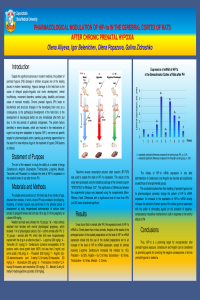
Results: It was found that in animals after PH, the expression level of HIF-1α mRNA is 0.331±0.0002 c.u., which is 3 times lower than in intact animals. Analysis of the results of the prolonged action of the studied preparations on the level of HIF-1α mRNA expression shows that the use of the studied preparations led to an increase in the level of HIF-1α mRNA expression, except for animals receiving L-arginine (0.37±0.001 c.u.). Cerebrocurin increased this indicator by 15.8 times (5.24±0.002 c.u.), piracetam – by 82% (0.603±0.0003 c.u.), angiolin – by 13.9 times (4,61 ± 0,004 c.u.), glutoredoxin – 8.5 times (2.80±0.002 c.u.), thiotriazoline – 6.2 times (2.06±0.001 c.u.), mexidol – 2, 3 times (0.77±0.006 c.u.). The indices of HIF-1α mRNA expression in rats after administration of cerebrocurin and angiolin are maximal and significantly exceed those of all experimental groups.
The conducted studies show that modeling of prenatal hypoxia and its pharmacological correction change the pattern of HIF-1α mRNA expression. An increase in the expression of HIF-1α mRNA directly indicates the activation of certain genes of the cellular genome associated with the action of stimulating signals on the activation of adaptive-compensatory intracellular mechanisms in cells in response to the harmful effects of PH.
Conclusions: Thus, HIF-1α is a promising target for neuroprotection after PH exposure. Cerebrocurin and angiolin can be considered as promising agents for correcting the negative consequences of chronic PH in newborns.
Keywords
CNS
prenatal hypoxia
endogenous neuroprotection
HIF-1a
Manuscript
sciforum-064229 .pdf
Poster
AliyevaO.pdf
Sex-dependent variations in voluntary exercise of 14-month-old 3xTgAD mice associated with novelty inhibition
Reference models for children and young people with Epidermolysis bullosa: First case report on the protective factors and challenges for psycho-social maturation and resilience.