Event submissions
Published
 10.3390/IECBS2022-12949 (registering DOI)
 This submission belongs to the session 10. Poster Session of the event The 3rd International Electronic Conference on Brain Sciences
Published date
30 Sep, 2022
Academic Editor
'%3e%3cpath%20d='M12.6657%2010.9104C12.4185%2010.325%2012.0599%209.79327%2011.6097%209.34482C11.1609%208.89508%2010.6293%208.5365%2010.0442%208.28888C10.0389%208.28626%2010.0337%208.28495%2010.0285%208.28233C10.8446%207.69279%2011.3752%206.73249%2011.3752%205.64904C11.3752%203.8542%209.92103%202.39999%208.1262%202.39999C6.33136%202.39999%204.87715%203.8542%204.87715%205.64904C4.87715%206.73249%205.40774%207.69279%206.22393%208.28364C6.21869%208.28626%206.21345%208.28757%206.20821%208.29019C5.62129%208.5378%205.09463%208.89284%204.64265%209.34613C4.1929%209.79493%203.83432%2010.3266%203.58671%2010.9117C3.34345%2011.4845%203.21226%2012.0987%203.20023%2012.7209C3.19988%2012.7349%203.20233%2012.7488%203.20744%2012.7619C3.21255%2012.7749%203.22022%2012.7867%203.22998%2012.7968C3.23975%2012.8068%203.25142%2012.8147%203.26431%2012.8202C3.2772%2012.8256%203.29105%2012.8284%203.30504%2012.8284H4.09109C4.14874%2012.8284%204.19459%2012.7825%204.1959%2012.7262C4.2221%2011.7148%204.62823%2010.7676%205.34617%2010.0497C6.08899%209.30683%207.0755%208.89808%208.1262%208.89808C9.17689%208.89808%2010.1634%209.30683%2010.9062%2010.0497C11.6242%2010.7676%2012.0303%2011.7148%2012.0565%2012.7262C12.0578%2012.7838%2012.1037%2012.8284%2012.1613%2012.8284H12.9474C12.9613%2012.8284%2012.9752%2012.8256%2012.9881%2012.8202C13.001%2012.8147%2013.0126%2012.8068%2013.0224%2012.7968C13.0322%2012.7867%2013.0398%2012.7749%2013.0449%2012.7619C13.0501%2012.7488%2013.0525%2012.7349%2013.0522%2012.7209C13.0391%2012.0947%2012.9094%2011.4855%2012.6657%2010.9104ZM8.1262%207.9024C7.52486%207.9024%206.9589%207.6679%206.53312%207.24211C6.10733%206.81633%205.87283%206.25037%205.87283%205.64904C5.87283%205.0477%206.10733%204.48174%206.53312%204.05596C6.9589%203.63018%207.52486%203.39567%208.1262%203.39567C8.72753%203.39567%209.29349%203.63018%209.71927%204.05596C10.1451%204.48174%2010.3796%205.0477%2010.3796%205.64904C10.3796%206.25037%2010.1451%206.81633%209.71927%207.24211C9.29349%207.6679%208.72753%207.9024%208.1262%207.9024Z'%20fill='%235D1EE1'/%3e%3c/g%3e%3c/svg%3e) Stephen Meriney
Stephen MerineyCitation
Kaberi Chatterjee, Papiya Mitra Mazumder, Sugato Banerjee, ROLE Of VITAMIN K2 IN ALUMINIUM CHLORIDE ASSOCIATED COGNITIVE IMPAIRMENT IN MICE, in Proceedings of The 3rd International Electronic Conference on Brain Sciences, 1 October–15 October 2022, MDPI: Basel, Switzerland, doi: 10.3390/IECBS2022-12949
Share
Email
Facebook
Twitter
LinkedIn
ROLE Of VITAMIN K2 IN ALUMINIUM CHLORIDE ASSOCIATED COGNITIVE IMPAIRMENT IN MICE
'%3e%3cpath%20d='M12.6647%2010.9104C12.4176%2010.325%2012.0589%209.7933%2011.6088%209.34485C11.16%208.89511%2010.6283%208.53653%2010.0432%208.28891C10.038%208.28629%2010.0327%208.28498%2010.0275%208.28236C10.8437%207.69282%2011.3743%206.73252%2011.3743%205.64907C11.3743%203.85423%209.92005%202.40002%208.12522%202.40002C6.33038%202.40002%204.87618%203.85423%204.87618%205.64907C4.87618%206.73252%205.40677%207.69282%206.22296%208.28367C6.21772%208.28629%206.21248%208.2876%206.20724%208.29022C5.62031%208.53783%205.09365%208.89287%204.64167%209.34616C4.19192%209.79496%203.83334%2010.3266%203.58573%2010.9117C3.34247%2011.4846%203.21128%2012.0987%203.19925%2012.721C3.1989%2012.735%203.20135%2012.7489%203.20646%2012.7619C3.21157%2012.7749%203.21924%2012.7868%203.22901%2012.7968C3.23877%2012.8068%203.25045%2012.8148%203.26334%2012.8202C3.27623%2012.8256%203.29007%2012.8284%203.30406%2012.8284H4.09012C4.14776%2012.8284%204.19362%2012.7825%204.19493%2012.7262C4.22113%2011.7148%204.62726%2010.7676%205.34519%2010.0497C6.08802%209.30686%207.07452%208.89811%208.12522%208.89811C9.17592%208.89811%2010.1624%209.30686%2010.9052%2010.0497C11.6232%2010.7676%2012.0293%2011.7148%2012.0555%2012.7262C12.0568%2012.7839%2012.1027%2012.8284%2012.1603%2012.8284H12.9464C12.9604%2012.8284%2012.9742%2012.8256%2012.9871%2012.8202C13%2012.8148%2013.0117%2012.8068%2013.0214%2012.7968C13.0312%2012.7868%2013.0389%2012.7749%2013.044%2012.7619C13.0491%2012.7489%2013.0515%2012.735%2013.0512%2012.721C13.0381%2012.0947%2012.9084%2011.4856%2012.6647%2010.9104ZM8.12522%207.90243C7.52388%207.90243%206.95792%207.66793%206.53214%207.24215C6.10636%206.81636%205.87185%206.2504%205.87185%205.64907C5.87185%205.04773%206.10636%204.48177%206.53214%204.05599C6.95792%203.63021%207.52388%203.3957%208.12522%203.3957C8.72655%203.3957%209.29252%203.63021%209.7183%204.05599C10.1441%204.48177%2010.3786%205.04773%2010.3786%205.64907C10.3786%206.2504%2010.1441%206.81636%209.7183%207.24215C9.29252%207.66793%208.72655%207.90243%208.12522%207.90243Z'%20fill='%235D1EE1'/%3e%3c/g%3e%3c/svg%3e)
Kaberi Chatterjee 1
Papiya Mitra Mazumder 1
Sugato Banerjee 2
1. Birla Institute of Technoogy, Mesra
2. National Institute of Pharmaceutical Education and Research (NIPER) Kolkata
Abstract
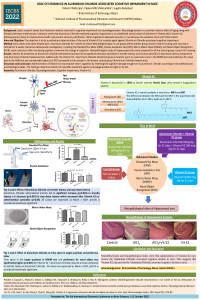
Background: Recent studies indicate that Aluminium toxicity may lead to cognitive impairment via neurodegeneration. Neurodegeneration is a common adverse effect of aging along with lifestyle and heavy metal toxicity. Literature revels that Aluminium Chloride mediated cognitive impairment is an established animal model of Alzheimer’s Disease (AD). Vitamin K2 (Menaquinones) helps to improve bone-health and prevent coronary calcification. When ingested in adequate amounts, it can decrease the oxidative stress and inflammation.
Aims and Objective: The objective of this study is to do a preliminary determination of the use of Vitamin K2 as therapeutics against Aluminium Chloride associated cognitive impairment.
Methodology: Neurodegeneration was induced in Swiss albino mice by administering Aluminium Chloride for 3 weeks. Behavioral studies including Elevated plus Maze (EPM), Passive Avoidance test, Morris water maze (MWM) and Novel object recognition (NOR) were performed to analyze the change in cognition. In the treatment group, Vitamin K2 was administered for 3 weeks in conjunction with Aluminium Chloride (3 weeks). Histopathological slides of hippocampal area were prepared for all the animal groups using H & E staining.
Results: Vitamin K2 treatment on Aluminium Chloride administered animals led to significant decrease (p<0.001) in transfer latency and increase (p<0.05) in step down latency compared to only Aluminium Chloride treated animals. Similarly time spent in the target quadrant in MWM test and preference for novel object (NOR) was significantly higher (p<0.001) for Vitamin K2 + Aluminium Chloride treated group as compared to animals in the disease control group (Aluminium Chloride treated only).
Discussion and Conclusion: Neurobehavioural and histopathological slides show that administration of Vitamin K2 may reverse the Aluminium Chloride-associated cognitive impairment in mice. This results suggest that Vitamin K2 may be protective against AD-associated neurodegeneration.
Keywords
Aluminium Chloride
Neurodegeneration
Cognitive impairment
Vitamin K2
Manuscript
sciforum-064552.pdf
Poster
MDPI edited.pdf
Reference models for children and young people with Epidermolysis bullosa: First case report on the protective factors and challenges for psycho-social maturation and resilience.
Resonance condition leading to the dumbbell-shaped aneurismal rupture