Event submissions
EventsThe 3rd International Electronic Conference on Foods: Food, Microbiome, and Health - A Celebration of the 10th Anniversary of Foods' Impact on Our Wellbeing
Published

This submission belongs to the session 6. Nutraceuticals and Functional Foods of the event The 3rd International Electronic Conference on Foods: Food, Microbiome, and Health - A Celebration of the 10th Anniversary of Foods' Impact on Our Wellbeing
Published date
30 Sep, 2022
Academic Editor
'%3e%3cpath%20d='M12.6657%2010.9104C12.4185%2010.325%2012.0599%209.79327%2011.6097%209.34482C11.1609%208.89508%2010.6293%208.5365%2010.0442%208.28888C10.0389%208.28626%2010.0337%208.28495%2010.0285%208.28233C10.8446%207.69279%2011.3752%206.73249%2011.3752%205.64904C11.3752%203.8542%209.92103%202.39999%208.1262%202.39999C6.33136%202.39999%204.87715%203.8542%204.87715%205.64904C4.87715%206.73249%205.40774%207.69279%206.22393%208.28364C6.21869%208.28626%206.21345%208.28757%206.20821%208.29019C5.62129%208.5378%205.09463%208.89284%204.64265%209.34613C4.1929%209.79493%203.83432%2010.3266%203.58671%2010.9117C3.34345%2011.4845%203.21226%2012.0987%203.20023%2012.7209C3.19988%2012.7349%203.20233%2012.7488%203.20744%2012.7619C3.21255%2012.7749%203.22022%2012.7867%203.22998%2012.7968C3.23975%2012.8068%203.25142%2012.8147%203.26431%2012.8202C3.2772%2012.8256%203.29105%2012.8284%203.30504%2012.8284H4.09109C4.14874%2012.8284%204.19459%2012.7825%204.1959%2012.7262C4.2221%2011.7148%204.62823%2010.7676%205.34617%2010.0497C6.08899%209.30683%207.0755%208.89808%208.1262%208.89808C9.17689%208.89808%2010.1634%209.30683%2010.9062%2010.0497C11.6242%2010.7676%2012.0303%2011.7148%2012.0565%2012.7262C12.0578%2012.7838%2012.1037%2012.8284%2012.1613%2012.8284H12.9474C12.9613%2012.8284%2012.9752%2012.8256%2012.9881%2012.8202C13.001%2012.8147%2013.0126%2012.8068%2013.0224%2012.7968C13.0322%2012.7867%2013.0398%2012.7749%2013.0449%2012.7619C13.0501%2012.7488%2013.0525%2012.7349%2013.0522%2012.7209C13.0391%2012.0947%2012.9094%2011.4855%2012.6657%2010.9104ZM8.1262%207.9024C7.52486%207.9024%206.9589%207.6679%206.53312%207.24211C6.10733%206.81633%205.87283%206.25037%205.87283%205.64904C5.87283%205.0477%206.10733%204.48174%206.53312%204.05596C6.9589%203.63018%207.52486%203.39567%208.1262%203.39567C8.72753%203.39567%209.29349%203.63018%209.71927%204.05596C10.1451%204.48174%2010.3796%205.0477%2010.3796%205.64904C10.3796%206.25037%2010.1451%206.81633%209.71927%207.24211C9.29349%207.6679%208.72753%207.9024%208.1262%207.9024Z'%20fill='%235D1EE1'/%3e%3c/g%3e%3c/svg%3e) Arun Bhunia
Arun BhuniaCitation
Marlene Machado, Susana Machado, Helena Ferreira, M. Beatriz P. P. Oliveira, Rita C. Alves, Chlorogenic acids profile of Coffee arabica by-products (cascara and silverskin): a comparison with green and roasted beans, in Proceedings of The 3rd International Electronic Conference on Foods: Food, Microbiome, and Health - A Celebration of the 10th Anniversary of Foods' Impact on Our Wellbeing, 1 October–15 October 2022, MDPI: Basel, Switzerland, doi: 10.3390/Foods2022-12971
Share
Email
Facebook
Twitter
LinkedIn
Chlorogenic acids profile of Coffee arabica by-products (cascara and silverskin): a comparison with green and roasted beans
'%3e%3cpath%20d='M12.6647%2010.9104C12.4176%2010.325%2012.0589%209.7933%2011.6088%209.34485C11.16%208.89511%2010.6283%208.53653%2010.0432%208.28891C10.038%208.28629%2010.0327%208.28498%2010.0275%208.28236C10.8437%207.69282%2011.3743%206.73252%2011.3743%205.64907C11.3743%203.85423%209.92005%202.40002%208.12522%202.40002C6.33038%202.40002%204.87618%203.85423%204.87618%205.64907C4.87618%206.73252%205.40677%207.69282%206.22296%208.28367C6.21772%208.28629%206.21248%208.2876%206.20724%208.29022C5.62031%208.53783%205.09365%208.89287%204.64167%209.34616C4.19192%209.79496%203.83334%2010.3266%203.58573%2010.9117C3.34247%2011.4846%203.21128%2012.0987%203.19925%2012.721C3.1989%2012.735%203.20135%2012.7489%203.20646%2012.7619C3.21157%2012.7749%203.21924%2012.7868%203.22901%2012.7968C3.23877%2012.8068%203.25045%2012.8148%203.26334%2012.8202C3.27623%2012.8256%203.29007%2012.8284%203.30406%2012.8284H4.09012C4.14776%2012.8284%204.19362%2012.7825%204.19493%2012.7262C4.22113%2011.7148%204.62726%2010.7676%205.34519%2010.0497C6.08802%209.30686%207.07452%208.89811%208.12522%208.89811C9.17592%208.89811%2010.1624%209.30686%2010.9052%2010.0497C11.6232%2010.7676%2012.0293%2011.7148%2012.0555%2012.7262C12.0568%2012.7839%2012.1027%2012.8284%2012.1603%2012.8284H12.9464C12.9604%2012.8284%2012.9742%2012.8256%2012.9871%2012.8202C13%2012.8148%2013.0117%2012.8068%2013.0214%2012.7968C13.0312%2012.7868%2013.0389%2012.7749%2013.044%2012.7619C13.0491%2012.7489%2013.0515%2012.735%2013.0512%2012.721C13.0381%2012.0947%2012.9084%2011.4856%2012.6647%2010.9104ZM8.12522%207.90243C7.52388%207.90243%206.95792%207.66793%206.53214%207.24215C6.10636%206.81636%205.87185%206.2504%205.87185%205.64907C5.87185%205.04773%206.10636%204.48177%206.53214%204.05599C6.95792%203.63021%207.52388%203.3957%208.12522%203.3957C8.72655%203.3957%209.29252%203.63021%209.7183%204.05599C10.1441%204.48177%2010.3786%205.04773%2010.3786%205.64907C10.3786%206.2504%2010.1441%206.81636%209.7183%207.24215C9.29252%207.66793%208.72655%207.90243%208.12522%207.90243Z'%20fill='%235D1EE1'/%3e%3c/g%3e%3c/svg%3e)
Marlene Machado 1
Susana Machado 2
Helena Ferreira 3

M. Beatriz P. P. Oliveira 2

Rita C. Alves 2
1. LAQV, REQUIMTE, Department of Chemical, Faculty of Pharmacy, University of Porto, Porto, Portugal
2. REQUIMTE/ LAQV, Dep. Chemical Sciences, Fac. Pharmacy, University of Porto, Porto, Portugal
3. REQUIMTE/UCIBIO, Lab of. Microbiology, Dep. Biological Sciences, Fac. Pharmacy, University of Porto, Porto, Portugal
Abstract
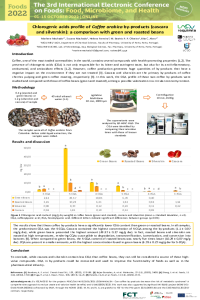
Coffee, one of the most traded commodities in the world, has several compounds with health-promoting properties [1,2]. The presence of chlorogenic acids (CGA) is not only responsible for its bitter and astringent taste, but also for its anti-inflammatory, antitumoral, and antioxidant effects [1,2]. However, coffee production generates huge quantities of by-products that have a negative effect on the environment if they are not treated [3].
Cascara and silverskin are the primary by-products of coffee cherries pulping and green coffee roasting, respectively [3]. In this work, the CGA profile of these two coffee by-products were studied and compared with those of coffee beans (green and roasted), aiming a possible valorization in a circular economy context.
The samples were all of Coffee arabica from Colombia. A solid-liquid extraction with 40 ml of ethanol: water (1:1) was performed for 30 min, using 0.4 g (roasted and green coffee) or 1.2 g (silverskin and cascara) of sample. The caffeoylquinic acids (CQA) and feruloylquinic acids (FQA) were analyzed by RP-HPLC-DAD [4].
The results show that these coffee by-products have a significantly lower CGA content than green or roasted beans. In all samples, the predominant CGA was the 5-CQA. Cascara contained the highest concentration of 5-CQA among the by-products (1.1 mg/g dw), while green beans presented the highest amount (49.57 mg/g dw). In fact, roasted beans and silverskin are roasted at high temperatures, rendering CQAs susceptible to degradation, transesterification, isomerization, and conversion into lactones [5]. FQA are present in smaller amounts, with the highest concentration found in green beans (6.78 mg/g dw).
To conclude, while cascara and silverskin contain less CGA than coffee beans, they can still be considered a source of these high-value compounds. CGA in by-products could be recovered and used to improve the functionality of foods as well as in the pharmaceutical industry.
Keywords
caffeoylquinic acids
feruloylquinic acids
RP-HPLC-DAD
Manuscript
sciforum_063800_original_Abstract_Marlene_Machado_FFUP.pdf
Poster
Marlene_Machado_Poster_Foods_Conference_2022.pdf
Characterization and biological analysis of avocado seed and peel extracts for the development of new therapeutical strategies.
Study of the antihypertensive peptides derived from alpha-lactalbumin hydrolysate after simulation of digestion