Event submissions
EventsThe 3rd International Electronic Conference on Foods: Food, Microbiome, and Health - A Celebration of the 10th Anniversary of Foods' Impact on Our Wellbeing
Published

This submission belongs to the session 3. Food Analytical Methods and Components of the event The 3rd International Electronic Conference on Foods: Food, Microbiome, and Health - A Celebration of the 10th Anniversary of Foods' Impact on Our Wellbeing
Published date
30 Sep, 2022
Academic Editor
'%3e%3cpath%20d='M12.6657%2010.9104C12.4185%2010.325%2012.0599%209.79327%2011.6097%209.34482C11.1609%208.89508%2010.6293%208.5365%2010.0442%208.28888C10.0389%208.28626%2010.0337%208.28495%2010.0285%208.28233C10.8446%207.69279%2011.3752%206.73249%2011.3752%205.64904C11.3752%203.8542%209.92103%202.39999%208.1262%202.39999C6.33136%202.39999%204.87715%203.8542%204.87715%205.64904C4.87715%206.73249%205.40774%207.69279%206.22393%208.28364C6.21869%208.28626%206.21345%208.28757%206.20821%208.29019C5.62129%208.5378%205.09463%208.89284%204.64265%209.34613C4.1929%209.79493%203.83432%2010.3266%203.58671%2010.9117C3.34345%2011.4845%203.21226%2012.0987%203.20023%2012.7209C3.19988%2012.7349%203.20233%2012.7488%203.20744%2012.7619C3.21255%2012.7749%203.22022%2012.7867%203.22998%2012.7968C3.23975%2012.8068%203.25142%2012.8147%203.26431%2012.8202C3.2772%2012.8256%203.29105%2012.8284%203.30504%2012.8284H4.09109C4.14874%2012.8284%204.19459%2012.7825%204.1959%2012.7262C4.2221%2011.7148%204.62823%2010.7676%205.34617%2010.0497C6.08899%209.30683%207.0755%208.89808%208.1262%208.89808C9.17689%208.89808%2010.1634%209.30683%2010.9062%2010.0497C11.6242%2010.7676%2012.0303%2011.7148%2012.0565%2012.7262C12.0578%2012.7838%2012.1037%2012.8284%2012.1613%2012.8284H12.9474C12.9613%2012.8284%2012.9752%2012.8256%2012.9881%2012.8202C13.001%2012.8147%2013.0126%2012.8068%2013.0224%2012.7968C13.0322%2012.7867%2013.0398%2012.7749%2013.0449%2012.7619C13.0501%2012.7488%2013.0525%2012.7349%2013.0522%2012.7209C13.0391%2012.0947%2012.9094%2011.4855%2012.6657%2010.9104ZM8.1262%207.9024C7.52486%207.9024%206.9589%207.6679%206.53312%207.24211C6.10733%206.81633%205.87283%206.25037%205.87283%205.64904C5.87283%205.0477%206.10733%204.48174%206.53312%204.05596C6.9589%203.63018%207.52486%203.39567%208.1262%203.39567C8.72753%203.39567%209.29349%203.63018%209.71927%204.05596C10.1451%204.48174%2010.3796%205.0477%2010.3796%205.64904C10.3796%206.25037%2010.1451%206.81633%209.71927%207.24211C9.29349%207.6679%208.72753%207.9024%208.1262%207.9024Z'%20fill='%235D1EE1'/%3e%3c/g%3e%3c/svg%3e) Arun Bhunia
Arun BhuniaCitation
Víctor García Seval, Clàudia Martínez-Alfaro, Javier Saurina, Oscar Núñez, Sònia Sentellas, CHARACTERIZATION, CLASSIFICATION AND AUTHENTICATION OF HONEY BY NON-TARGETED UHPLC-HRMS CHROMATOGRAPHIC FINGERPRINTS AND CHEMOMETRIC METHODS, in Proceedings of The 3rd International Electronic Conference on Foods: Food, Microbiome, and Health - A Celebration of the 10th Anniversary of Foods' Impact on Our Wellbeing, 1 October–15 October 2022, MDPI: Basel, Switzerland, doi: 10.3390/Foods2022-12994
Share
Email
Facebook
Twitter
LinkedIn
CHARACTERIZATION, CLASSIFICATION AND AUTHENTICATION OF HONEY BY NON-TARGETED UHPLC-HRMS CHROMATOGRAPHIC FINGERPRINTS AND CHEMOMETRIC METHODS
'%3e%3cpath%20d='M12.6647%2010.9104C12.4176%2010.325%2012.0589%209.7933%2011.6088%209.34485C11.16%208.89511%2010.6283%208.53653%2010.0432%208.28891C10.038%208.28629%2010.0327%208.28498%2010.0275%208.28236C10.8437%207.69282%2011.3743%206.73252%2011.3743%205.64907C11.3743%203.85423%209.92005%202.40002%208.12522%202.40002C6.33038%202.40002%204.87618%203.85423%204.87618%205.64907C4.87618%206.73252%205.40677%207.69282%206.22296%208.28367C6.21772%208.28629%206.21248%208.2876%206.20724%208.29022C5.62031%208.53783%205.09365%208.89287%204.64167%209.34616C4.19192%209.79496%203.83334%2010.3266%203.58573%2010.9117C3.34247%2011.4846%203.21128%2012.0987%203.19925%2012.721C3.1989%2012.735%203.20135%2012.7489%203.20646%2012.7619C3.21157%2012.7749%203.21924%2012.7868%203.22901%2012.7968C3.23877%2012.8068%203.25045%2012.8148%203.26334%2012.8202C3.27623%2012.8256%203.29007%2012.8284%203.30406%2012.8284H4.09012C4.14776%2012.8284%204.19362%2012.7825%204.19493%2012.7262C4.22113%2011.7148%204.62726%2010.7676%205.34519%2010.0497C6.08802%209.30686%207.07452%208.89811%208.12522%208.89811C9.17592%208.89811%2010.1624%209.30686%2010.9052%2010.0497C11.6232%2010.7676%2012.0293%2011.7148%2012.0555%2012.7262C12.0568%2012.7839%2012.1027%2012.8284%2012.1603%2012.8284H12.9464C12.9604%2012.8284%2012.9742%2012.8256%2012.9871%2012.8202C13%2012.8148%2013.0117%2012.8068%2013.0214%2012.7968C13.0312%2012.7868%2013.0389%2012.7749%2013.044%2012.7619C13.0491%2012.7489%2013.0515%2012.735%2013.0512%2012.721C13.0381%2012.0947%2012.9084%2011.4856%2012.6647%2010.9104ZM8.12522%207.90243C7.52388%207.90243%206.95792%207.66793%206.53214%207.24215C6.10636%206.81636%205.87185%206.2504%205.87185%205.64907C5.87185%205.04773%206.10636%204.48177%206.53214%204.05599C6.95792%203.63021%207.52388%203.3957%208.12522%203.3957C8.72655%203.3957%209.29252%203.63021%209.7183%204.05599C10.1441%204.48177%2010.3786%205.04773%2010.3786%205.64907C10.3786%206.2504%2010.1441%206.81636%209.7183%207.24215C9.29252%207.66793%208.72655%207.90243%208.12522%207.90243Z'%20fill='%235D1EE1'/%3e%3c/g%3e%3c/svg%3e)
Víctor García Seval 1
Clàudia Martínez-Alfaro 1

Javier Saurina 1,2

Oscar Núñez 1,2

Sònia Sentellas 1,2,3
1. Department of Chemical Engineering and Analytical Chemistry, University of Barcelona, Barcelona, Spain
2. Research Institute in Food Nutrition and Food Safety, University of Barcelona, Santa Coloma de Gramenet, Barcelona, Spain
3. Serra Húnter Lecturer, Generalitat de Catalunya, 08007 Barcelona, Spain.
Abstract
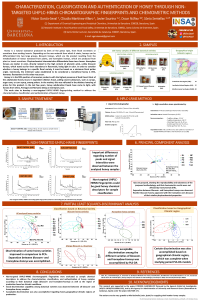
Honey is a natural substance produced by bees of the genus Apis. Depending on the raw material used for its production, honey can be classified into two large groups. Blossom honey, which results from the metabolization of nectar extracted from flowers, and honeydew honey, in which bees use plant or insect secretions for its production. Physicochemical characteristics are different between these two types of honey. For example, honeydew honey is darker and is characterized by high content of phenolic acids. On the contrary, blossom honey stands out for its abundance of flavonoids. Blossom honey can be also classified based on the pollen origin. Thus, honeys with more than 45% of the pollen coming from the same species can be considered monofloral, otherwise, they are considered multifloral.
Honey is one of the food products with the highest fraudulent practices. Most of the adulterations consist of ingredient dilution, adding sweet substances, such as syrups, sugar cane, or corn syrup, among others. In the market, this was reflected in the dubious drop in prices for this product. In the last few years, several honey frauds have come to light.
This work aimed to develop a non-targeted ultra-high-performance liquid chromatography – high-resolution mass spectrometry (UHPLC-HRMS) fingerprinting method to address the characterization, classification, and authentication of Spanish honey samples considering their botanical and geographical origin. A total of 136 honeys from different Spanish production regions belonging to different botanical varieties were analyzed, including: blossom honey (orange blossom, rosemary, thyme, eucalyptus, and heather) and honeydew honey (holm oak, forest, and mountain). A simple sample treatment was carried out, consisting of dissolving 1 g of honey in 10 mL of water, followed by a 1:1 dilution with methanol. The chromatographic separation of the obtained extracts was performed using a Kinetex® C-18 core-shell column (100 x 4.6 mm I.D., 2.6 μm), working under gradient elution, using an aqueous solution of 0.1% formic acid and acetonitrile as the mobile phase components. HRMS acquisition was performed using electrospray in negative ionization mode (-2500 V) in an LTQ-Orbitrap working in full scan MS (m/z 100 – 1000) at a resolution of 50,000 full-width at half maximum (FWHM). The obtained non-targeted UHPLC-HRMS fingerprints (peak signals as a function of retention time and m/z) were considered as chemical descriptors of the analyzed honey samples for principal component analysis (PCA) and partial least squares-discriminant analysis (PLS-DA). PLS-DA revealed a good discrimination between blossom and honeydew honeys. Furthermore, the obtained chemometric models allowed to achieve a very good classification among the different botanical varieties under study for both blossom and honeydew honeys. The discrimination of honey regarding the different Spanish climate production regions was more limited, although some trends were observed. Thus, the non-targeted UHPLC-HRMS fingerprinting approach showed to be an appropriate methodology to address honey characterization, classification, and authentication based on their different botanical origin.
Keywords
Blossom-honeys
Honeydew-honeys
UHPLC-HRMS
Fingerprinting
Chemometrics
Food Authentication.
Manuscript
sciforum_063138_original_abstract_foods_2022 --layout--.pdf
Poster
Poster presentation.pdf
Evaluation of Antioxidant Activity of Alcoholic Beverage Mead Produced from Greek Chestnut Honey
Inoculum production of Monascus purpureus with Chenopodium quinoa in submerged culture