Event submissions
EventsThe 3rd International Electronic Conference on Foods: Food, Microbiome, and Health - A Celebration of the 10th Anniversary of Foods' Impact on Our Wellbeing
Published

This submission belongs to the session 4. Food Microbiology, Microbiome and Food Biotechnology of the event The 3rd International Electronic Conference on Foods: Food, Microbiome, and Health - A Celebration of the 10th Anniversary of Foods' Impact on Our Wellbeing
Published date
30 Sep, 2022
Academic Editor
'%3e%3cpath%20d='M12.6657%2010.9104C12.4185%2010.325%2012.0599%209.79327%2011.6097%209.34482C11.1609%208.89508%2010.6293%208.5365%2010.0442%208.28888C10.0389%208.28626%2010.0337%208.28495%2010.0285%208.28233C10.8446%207.69279%2011.3752%206.73249%2011.3752%205.64904C11.3752%203.8542%209.92103%202.39999%208.1262%202.39999C6.33136%202.39999%204.87715%203.8542%204.87715%205.64904C4.87715%206.73249%205.40774%207.69279%206.22393%208.28364C6.21869%208.28626%206.21345%208.28757%206.20821%208.29019C5.62129%208.5378%205.09463%208.89284%204.64265%209.34613C4.1929%209.79493%203.83432%2010.3266%203.58671%2010.9117C3.34345%2011.4845%203.21226%2012.0987%203.20023%2012.7209C3.19988%2012.7349%203.20233%2012.7488%203.20744%2012.7619C3.21255%2012.7749%203.22022%2012.7867%203.22998%2012.7968C3.23975%2012.8068%203.25142%2012.8147%203.26431%2012.8202C3.2772%2012.8256%203.29105%2012.8284%203.30504%2012.8284H4.09109C4.14874%2012.8284%204.19459%2012.7825%204.1959%2012.7262C4.2221%2011.7148%204.62823%2010.7676%205.34617%2010.0497C6.08899%209.30683%207.0755%208.89808%208.1262%208.89808C9.17689%208.89808%2010.1634%209.30683%2010.9062%2010.0497C11.6242%2010.7676%2012.0303%2011.7148%2012.0565%2012.7262C12.0578%2012.7838%2012.1037%2012.8284%2012.1613%2012.8284H12.9474C12.9613%2012.8284%2012.9752%2012.8256%2012.9881%2012.8202C13.001%2012.8147%2013.0126%2012.8068%2013.0224%2012.7968C13.0322%2012.7867%2013.0398%2012.7749%2013.0449%2012.7619C13.0501%2012.7488%2013.0525%2012.7349%2013.0522%2012.7209C13.0391%2012.0947%2012.9094%2011.4855%2012.6657%2010.9104ZM8.1262%207.9024C7.52486%207.9024%206.9589%207.6679%206.53312%207.24211C6.10733%206.81633%205.87283%206.25037%205.87283%205.64904C5.87283%205.0477%206.10733%204.48174%206.53312%204.05596C6.9589%203.63018%207.52486%203.39567%208.1262%203.39567C8.72753%203.39567%209.29349%203.63018%209.71927%204.05596C10.1451%204.48174%2010.3796%205.0477%2010.3796%205.64904C10.3796%206.25037%2010.1451%206.81633%209.71927%207.24211C9.29349%207.6679%208.72753%207.9024%208.1262%207.9024Z'%20fill='%235D1EE1'/%3e%3c/g%3e%3c/svg%3e) Arun Bhunia
Arun BhuniaCitation
Evelyn Michelle Quispe Rivera, Franz Deyvis Tucta Huillca, Ursula Gonzales-Barron, Vasco Cadavez, Marcial Silva-Jaimes, Juan Juscamaita Morales, Effect of carbon, nitrogen and salt sources on the growth of Monascus purpureus in quinoa (Chenopodium quinoa) based culture media., in Proceedings of The 3rd International Electronic Conference on Foods: Food, Microbiome, and Health - A Celebration of the 10th Anniversary of Foods' Impact on Our Wellbeing, 1 October–15 October 2022, MDPI: Basel, Switzerland, doi: 10.3390/Foods2022-12999
Share
Email
Facebook
Twitter
LinkedIn
Effect of carbon, nitrogen and salt sources on the growth of Monascus purpureus in quinoa (Chenopodium quinoa) based culture media.

Evelyn Michelle Quispe Rivera 1
'%3e%3cpath%20d='M12.6647%2010.9104C12.4176%2010.325%2012.0589%209.7933%2011.6088%209.34485C11.16%208.89511%2010.6283%208.53653%2010.0432%208.28891C10.038%208.28629%2010.0327%208.28498%2010.0275%208.28236C10.8437%207.69282%2011.3743%206.73252%2011.3743%205.64907C11.3743%203.85423%209.92005%202.40002%208.12522%202.40002C6.33038%202.40002%204.87618%203.85423%204.87618%205.64907C4.87618%206.73252%205.40677%207.69282%206.22296%208.28367C6.21772%208.28629%206.21248%208.2876%206.20724%208.29022C5.62031%208.53783%205.09365%208.89287%204.64167%209.34616C4.19192%209.79496%203.83334%2010.3266%203.58573%2010.9117C3.34247%2011.4846%203.21128%2012.0987%203.19925%2012.721C3.1989%2012.735%203.20135%2012.7489%203.20646%2012.7619C3.21157%2012.7749%203.21924%2012.7868%203.22901%2012.7968C3.23877%2012.8068%203.25045%2012.8148%203.26334%2012.8202C3.27623%2012.8256%203.29007%2012.8284%203.30406%2012.8284H4.09012C4.14776%2012.8284%204.19362%2012.7825%204.19493%2012.7262C4.22113%2011.7148%204.62726%2010.7676%205.34519%2010.0497C6.08802%209.30686%207.07452%208.89811%208.12522%208.89811C9.17592%208.89811%2010.1624%209.30686%2010.9052%2010.0497C11.6232%2010.7676%2012.0293%2011.7148%2012.0555%2012.7262C12.0568%2012.7839%2012.1027%2012.8284%2012.1603%2012.8284H12.9464C12.9604%2012.8284%2012.9742%2012.8256%2012.9871%2012.8202C13%2012.8148%2013.0117%2012.8068%2013.0214%2012.7968C13.0312%2012.7868%2013.0389%2012.7749%2013.044%2012.7619C13.0491%2012.7489%2013.0515%2012.735%2013.0512%2012.721C13.0381%2012.0947%2012.9084%2011.4856%2012.6647%2010.9104ZM8.12522%207.90243C7.52388%207.90243%206.95792%207.66793%206.53214%207.24215C6.10636%206.81636%205.87185%206.2504%205.87185%205.64907C5.87185%205.04773%206.10636%204.48177%206.53214%204.05599C6.95792%203.63021%207.52388%203.3957%208.12522%203.3957C8.72655%203.3957%209.29252%203.63021%209.7183%204.05599C10.1441%204.48177%2010.3786%205.04773%2010.3786%205.64907C10.3786%206.2504%2010.1441%206.81636%209.7183%207.24215C9.29252%207.66793%208.72655%207.90243%208.12522%207.90243Z'%20fill='%235D1EE1'/%3e%3c/g%3e%3c/svg%3e)
Franz Deyvis Tucta Huillca 2

Ursula Gonzales-Barron 3
Vasco Cadavez 3

Marcial Silva-Jaimes 2
Juan Juscamaita Morales 2
1. Universidad Nacional Agraria La Molina (UNALM), Av. La Molina s/n La Molina, Lima, Peru
2. Universidad Nacional Agraria La Molina
3. Centro de Investigação de Montanha (CIMO), Instituto Politécnico de Bragança, Campus de Santa Apolónia, Bragança, Portugal.
Abstract
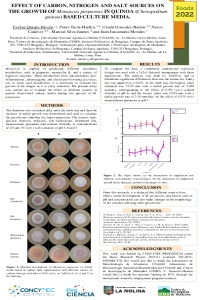
Monascus is capable of producing different secondary metabolites, such as pigments, monacolin K, and a variety of digestive enzymes. These metabolites show antimicrobial, anti-inflammatory, antimutagenic and cholesterol-lowering activities; yet, to study such metabolites, it is necessary to evaluate the growth of the fungus as it is a key indicator. The present study was carried out to evaluate the effect of different sources in quinoa flour-based culture media during the growth of M. purpureus. The diameter was evaluated daily until the tenth day and then the increase in radial growth was determined and used to calculate the growth rate (mm/day) by linear regression. The sources were: glucose, fructose, molasses, fish hydrolysate, fermented fish, monosodium glutamate and sodium chloride; at concentrations of 0.5 and 1% (w/v) with variation of pH 5, 6 and 7. To compare the data, a completely randomized statistical design was used with a 7x2x3 factorial arrangement with three replications. The analysis was done by ANOVA, and to determine significant differences between the means the Tukey test was applied (α = 0.05). At the tenth day, the highest value obtained was 72.59 mm with a radial growth rate of 3.629 mm/day, corresponding to the effect of 0.5% (w/v) sodium chloride at pH 6, and the lowest value was 42.05 mm with a radial growth rate of 2.10 mm/day for the effect of 0.5% (w/v) monosodium glutamate at pH 7. From this research, it is deduced that different sources have effects on the development of M. purpureus, and factors such as pH and concentration can also make changes in the morphology of the colonies affecting their growth rate.
Keywords
Exponential phase
kinetics
supplement
mycelium
radial measurement.
Manuscript
sciforum_063736_original_Evelyn_Monascus_Growth_minipaper.pdf
Poster
Evelyn_Quispe_Foods_poster.Radial.pdf
CHEWING TOBACCO AND MORTALITY OF LIP AND ORAL CAVITY CANCER
Investigation of dried mycelium (Pleurotus eryngii) powder as an alternative protein source for developing meat analogue