Event submissions
EventsThe 3rd International Electronic Conference on Foods: Food, Microbiome, and Health - A Celebration of the 10th Anniversary of Foods' Impact on Our Wellbeing
Published

This submission belongs to the session 2. Innovative Processing Techniques of the event The 3rd International Electronic Conference on Foods: Food, Microbiome, and Health - A Celebration of the 10th Anniversary of Foods' Impact on Our Wellbeing
Published date
30 Sep, 2022
Academic Editor
'%3e%3cpath%20d='M12.6657%2010.9104C12.4185%2010.325%2012.0599%209.79327%2011.6097%209.34482C11.1609%208.89508%2010.6293%208.5365%2010.0442%208.28888C10.0389%208.28626%2010.0337%208.28495%2010.0285%208.28233C10.8446%207.69279%2011.3752%206.73249%2011.3752%205.64904C11.3752%203.8542%209.92103%202.39999%208.1262%202.39999C6.33136%202.39999%204.87715%203.8542%204.87715%205.64904C4.87715%206.73249%205.40774%207.69279%206.22393%208.28364C6.21869%208.28626%206.21345%208.28757%206.20821%208.29019C5.62129%208.5378%205.09463%208.89284%204.64265%209.34613C4.1929%209.79493%203.83432%2010.3266%203.58671%2010.9117C3.34345%2011.4845%203.21226%2012.0987%203.20023%2012.7209C3.19988%2012.7349%203.20233%2012.7488%203.20744%2012.7619C3.21255%2012.7749%203.22022%2012.7867%203.22998%2012.7968C3.23975%2012.8068%203.25142%2012.8147%203.26431%2012.8202C3.2772%2012.8256%203.29105%2012.8284%203.30504%2012.8284H4.09109C4.14874%2012.8284%204.19459%2012.7825%204.1959%2012.7262C4.2221%2011.7148%204.62823%2010.7676%205.34617%2010.0497C6.08899%209.30683%207.0755%208.89808%208.1262%208.89808C9.17689%208.89808%2010.1634%209.30683%2010.9062%2010.0497C11.6242%2010.7676%2012.0303%2011.7148%2012.0565%2012.7262C12.0578%2012.7838%2012.1037%2012.8284%2012.1613%2012.8284H12.9474C12.9613%2012.8284%2012.9752%2012.8256%2012.9881%2012.8202C13.001%2012.8147%2013.0126%2012.8068%2013.0224%2012.7968C13.0322%2012.7867%2013.0398%2012.7749%2013.0449%2012.7619C13.0501%2012.7488%2013.0525%2012.7349%2013.0522%2012.7209C13.0391%2012.0947%2012.9094%2011.4855%2012.6657%2010.9104ZM8.1262%207.9024C7.52486%207.9024%206.9589%207.6679%206.53312%207.24211C6.10733%206.81633%205.87283%206.25037%205.87283%205.64904C5.87283%205.0477%206.10733%204.48174%206.53312%204.05596C6.9589%203.63018%207.52486%203.39567%208.1262%203.39567C8.72753%203.39567%209.29349%203.63018%209.71927%204.05596C10.1451%204.48174%2010.3796%205.0477%2010.3796%205.64904C10.3796%206.25037%2010.1451%206.81633%209.71927%207.24211C9.29349%207.6679%208.72753%207.9024%208.1262%207.9024Z'%20fill='%235D1EE1'/%3e%3c/g%3e%3c/svg%3e) Arun Bhunia
Arun BhuniaCitation
Lucia Cuesta Ramos, Joanna Jastrzębska, Katarzyna Dawidowicz, Mario Juan Simirgiotis, Yuthana Phimolsiripol, Francisco J Barba, Juan Manuel Castagnini, Green-extraction methodologies for recovering bioactive compounds from endemic fruits: Corcolen (Azara dentata), in Proceedings of The 3rd International Electronic Conference on Foods: Food, Microbiome, and Health - A Celebration of the 10th Anniversary of Foods' Impact on Our Wellbeing, 1 October–15 October 2022, MDPI: Basel, Switzerland, doi: 10.3390/Foods2022-13007
Share
Email
Facebook
Twitter
LinkedIn
Green-extraction methodologies for recovering bioactive compounds from endemic fruits: Corcolen (Azara dentata)
'%3e%3cpath%20d='M12.6647%2010.9104C12.4176%2010.325%2012.0589%209.7933%2011.6088%209.34485C11.16%208.89511%2010.6283%208.53653%2010.0432%208.28891C10.038%208.28629%2010.0327%208.28498%2010.0275%208.28236C10.8437%207.69282%2011.3743%206.73252%2011.3743%205.64907C11.3743%203.85423%209.92005%202.40002%208.12522%202.40002C6.33038%202.40002%204.87618%203.85423%204.87618%205.64907C4.87618%206.73252%205.40677%207.69282%206.22296%208.28367C6.21772%208.28629%206.21248%208.2876%206.20724%208.29022C5.62031%208.53783%205.09365%208.89287%204.64167%209.34616C4.19192%209.79496%203.83334%2010.3266%203.58573%2010.9117C3.34247%2011.4846%203.21128%2012.0987%203.19925%2012.721C3.1989%2012.735%203.20135%2012.7489%203.20646%2012.7619C3.21157%2012.7749%203.21924%2012.7868%203.22901%2012.7968C3.23877%2012.8068%203.25045%2012.8148%203.26334%2012.8202C3.27623%2012.8256%203.29007%2012.8284%203.30406%2012.8284H4.09012C4.14776%2012.8284%204.19362%2012.7825%204.19493%2012.7262C4.22113%2011.7148%204.62726%2010.7676%205.34519%2010.0497C6.08802%209.30686%207.07452%208.89811%208.12522%208.89811C9.17592%208.89811%2010.1624%209.30686%2010.9052%2010.0497C11.6232%2010.7676%2012.0293%2011.7148%2012.0555%2012.7262C12.0568%2012.7839%2012.1027%2012.8284%2012.1603%2012.8284H12.9464C12.9604%2012.8284%2012.9742%2012.8256%2012.9871%2012.8202C13%2012.8148%2013.0117%2012.8068%2013.0214%2012.7968C13.0312%2012.7868%2013.0389%2012.7749%2013.044%2012.7619C13.0491%2012.7489%2013.0515%2012.735%2013.0512%2012.721C13.0381%2012.0947%2012.9084%2011.4856%2012.6647%2010.9104ZM8.12522%207.90243C7.52388%207.90243%206.95792%207.66793%206.53214%207.24215C6.10636%206.81636%205.87185%206.2504%205.87185%205.64907C5.87185%205.04773%206.10636%204.48177%206.53214%204.05599C6.95792%203.63021%207.52388%203.3957%208.12522%203.3957C8.72655%203.3957%209.29252%203.63021%209.7183%204.05599C10.1441%204.48177%2010.3786%205.04773%2010.3786%205.64907C10.3786%206.2504%2010.1441%206.81636%209.7183%207.24215C9.29252%207.66793%208.72655%207.90243%208.12522%207.90243Z'%20fill='%235D1EE1'/%3e%3c/g%3e%3c/svg%3e)
Lucia Cuesta Ramos 1
Joanna Jastrzębska 1,2
Katarzyna Dawidowicz 1,2

Mario Juan Simirgiotis 3

Yuthana Phimolsiripol 1,4

Francisco J Barba 1

Juan Manuel Castagnini 1
1. Preventive Medicine and Public Health, Food Science, Toxicology and Forensic Medicine Department, Faculty of Pharmacy, Universitat de València, Valencia, Spain
2. Faculty of Pharmacy, Medical University of Lodz, Lodz, Poland
3. Institute of Pharmacy, Faculty of Sciences, Campus Isla Teja, Universidad Austral de Chile, Valdivia, Chile
4. Faculty of Agro-Industry, Chiang Mai University, Chiang Mai, Thailand
Abstract
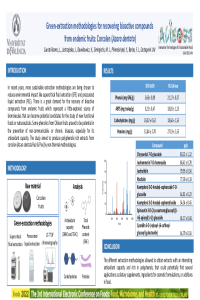
There is a great demand for the recovery of bioactive compounds from by-products and side streams in the food and cosmetic industries. More sustainable extraction methodologies are being chosen like pulsed electric field (PEF) assisted extraction, supercritical fluid extraction (SFE), pressurized liquid extraction (PLE), and ultrasound-assisted extraction. Endemic fruits represent a great and little-explored source of biomolecules that can become potential candidates for the study of new drugs and support the use of native species in functional foods or nutraceuticals. Some phenolics from Chilean fruits proved to be potential in the prevention of non-communicable- or chronic- diseases. The study aimed to produce polyphenolic-rich extracts from corcolen (Azara dentata Ruiz & Pav) by non-thermal methodologies. Two extracts were obtained by mean of SFE using CO2 and ethanol as co-solvent, and PLE using water as solvent. The total antioxidant capacity, total phenolic content, carbohydrates, and proteins of both extracts were analyzed. The resulting phenolic content of the extracts obtained by SFE and PLE was 5.37 ± 0.38 and 21.17 ± 0.57 mg GAE/g sample, respectively. The total antioxidant capacity was 3.22 ± 0.47 and 18.05 ± 1.25 mg Trolox/g sample for the SFE and PLE extracts, respectively. Moreover, corcolen composition was characterized by LC-TTOF chromatography, being Chrysoeriol 7-O-glucoside, Isorhamnetin 7-O-rhamnoside, Isorhoifolin, Rhoifolin, Kaempferol 3-O-feruloyl-sophoroside 7-O-glucoside, Kaempferol 3-O-feruloyl-sophorotrioside, Spinacetin 3-O-(2-p-coumaroylglucosyl)(1->6)-apiosyl(1->2)-glucoside, Cyanidin 3-O-(-xylosyl--(6-caffeoyl-glucosyl)-galactoside), the eight more predominant flavonoids. The different extraction methodologies allowed to obtain extracts with an interesting antioxidant capacity and rich in polyphenols, that could potentially find several applications as dietary supplements, ingredients for cosmetic formulations, or additives in food.
Keywords
Corcolen (Azara dentata)
pulsed electric field
supercritical fluid extraction
pressurized liquid extraction
antioxidants
Manuscript
sciforum_063621_original_Corcolen_abstract.pdf
Poster
Poster corcolen 2.pdf
Role of the gut microbiota in long-term dietary patterns rich in torularhodin via OSA colon-targeted delivery
Essential oils from oregano and thyme plants organically cultured in Lemnos island (Greece) present strong antimicrobial action against some important foodborne bacterial pathogens