Event submissions
EventsThe 3rd International Electronic Conference on Forests — Exploring New Discoveries and New Directions in Forests
Published

This submission belongs to the session S4. Forest Operations and Engineering of the event The 3rd International Electronic Conference on Forests — Exploring New Discoveries and New Directions in Forests
Published date
15 Oct, 2022
Academic Editor
'%3e%3cpath%20d='M12.6657%2010.9104C12.4185%2010.325%2012.0599%209.79327%2011.6097%209.34482C11.1609%208.89508%2010.6293%208.5365%2010.0442%208.28888C10.0389%208.28626%2010.0337%208.28495%2010.0285%208.28233C10.8446%207.69279%2011.3752%206.73249%2011.3752%205.64904C11.3752%203.8542%209.92103%202.39999%208.1262%202.39999C6.33136%202.39999%204.87715%203.8542%204.87715%205.64904C4.87715%206.73249%205.40774%207.69279%206.22393%208.28364C6.21869%208.28626%206.21345%208.28757%206.20821%208.29019C5.62129%208.5378%205.09463%208.89284%204.64265%209.34613C4.1929%209.79493%203.83432%2010.3266%203.58671%2010.9117C3.34345%2011.4845%203.21226%2012.0987%203.20023%2012.7209C3.19988%2012.7349%203.20233%2012.7488%203.20744%2012.7619C3.21255%2012.7749%203.22022%2012.7867%203.22998%2012.7968C3.23975%2012.8068%203.25142%2012.8147%203.26431%2012.8202C3.2772%2012.8256%203.29105%2012.8284%203.30504%2012.8284H4.09109C4.14874%2012.8284%204.19459%2012.7825%204.1959%2012.7262C4.2221%2011.7148%204.62823%2010.7676%205.34617%2010.0497C6.08899%209.30683%207.0755%208.89808%208.1262%208.89808C9.17689%208.89808%2010.1634%209.30683%2010.9062%2010.0497C11.6242%2010.7676%2012.0303%2011.7148%2012.0565%2012.7262C12.0578%2012.7838%2012.1037%2012.8284%2012.1613%2012.8284H12.9474C12.9613%2012.8284%2012.9752%2012.8256%2012.9881%2012.8202C13.001%2012.8147%2013.0126%2012.8068%2013.0224%2012.7968C13.0322%2012.7867%2013.0398%2012.7749%2013.0449%2012.7619C13.0501%2012.7488%2013.0525%2012.7349%2013.0522%2012.7209C13.0391%2012.0947%2012.9094%2011.4855%2012.6657%2010.9104ZM8.1262%207.9024C7.52486%207.9024%206.9589%207.6679%206.53312%207.24211C6.10733%206.81633%205.87283%206.25037%205.87283%205.64904C5.87283%205.0477%206.10733%204.48174%206.53312%204.05596C6.9589%203.63018%207.52486%203.39567%208.1262%203.39567C8.72753%203.39567%209.29349%203.63018%209.71927%204.05596C10.1451%204.48174%2010.3796%205.0477%2010.3796%205.64904C10.3796%206.25037%2010.1451%206.81633%209.71927%207.24211C9.29349%207.6679%208.72753%207.9024%208.1262%207.9024Z'%20fill='%235D1EE1'/%3e%3c/g%3e%3c/svg%3e) Rodolfo Picchio
Rodolfo PicchioCitation
Bruno Bernardi, Giorgio Macrì, Giacomo Falcone, Operational performance and sustainability of cutting trees with a chainsaw, in Proceedings of The 3rd International Electronic Conference on Forests — Exploring New Discoveries and New Directions in Forests, 15 October–31 October 2022, MDPI: Basel, Switzerland, doi: 10.3390/IECF2022-13039
Share
Email
Facebook
Twitter
LinkedIn
Operational performance and sustainability of cutting trees with a chainsaw

Bruno Bernardi 1
'%3e%3cpath%20d='M12.6647%2010.9104C12.4176%2010.325%2012.0589%209.7933%2011.6088%209.34485C11.16%208.89511%2010.6283%208.53653%2010.0432%208.28891C10.038%208.28629%2010.0327%208.28498%2010.0275%208.28236C10.8437%207.69282%2011.3743%206.73252%2011.3743%205.64907C11.3743%203.85423%209.92005%202.40002%208.12522%202.40002C6.33038%202.40002%204.87618%203.85423%204.87618%205.64907C4.87618%206.73252%205.40677%207.69282%206.22296%208.28367C6.21772%208.28629%206.21248%208.2876%206.20724%208.29022C5.62031%208.53783%205.09365%208.89287%204.64167%209.34616C4.19192%209.79496%203.83334%2010.3266%203.58573%2010.9117C3.34247%2011.4846%203.21128%2012.0987%203.19925%2012.721C3.1989%2012.735%203.20135%2012.7489%203.20646%2012.7619C3.21157%2012.7749%203.21924%2012.7868%203.22901%2012.7968C3.23877%2012.8068%203.25045%2012.8148%203.26334%2012.8202C3.27623%2012.8256%203.29007%2012.8284%203.30406%2012.8284H4.09012C4.14776%2012.8284%204.19362%2012.7825%204.19493%2012.7262C4.22113%2011.7148%204.62726%2010.7676%205.34519%2010.0497C6.08802%209.30686%207.07452%208.89811%208.12522%208.89811C9.17592%208.89811%2010.1624%209.30686%2010.9052%2010.0497C11.6232%2010.7676%2012.0293%2011.7148%2012.0555%2012.7262C12.0568%2012.7839%2012.1027%2012.8284%2012.1603%2012.8284H12.9464C12.9604%2012.8284%2012.9742%2012.8256%2012.9871%2012.8202C13%2012.8148%2013.0117%2012.8068%2013.0214%2012.7968C13.0312%2012.7868%2013.0389%2012.7749%2013.044%2012.7619C13.0491%2012.7489%2013.0515%2012.735%2013.0512%2012.721C13.0381%2012.0947%2012.9084%2011.4856%2012.6647%2010.9104ZM8.12522%207.90243C7.52388%207.90243%206.95792%207.66793%206.53214%207.24215C6.10636%206.81636%205.87185%206.2504%205.87185%205.64907C5.87185%205.04773%206.10636%204.48177%206.53214%204.05599C6.95792%203.63021%207.52388%203.3957%208.12522%203.3957C8.72655%203.3957%209.29252%203.63021%209.7183%204.05599C10.1441%204.48177%2010.3786%205.04773%2010.3786%205.64907C10.3786%206.2504%2010.1441%206.81636%209.7183%207.24215C9.29252%207.66793%208.72655%207.90243%208.12522%207.90243Z'%20fill='%235D1EE1'/%3e%3c/g%3e%3c/svg%3e)
Giorgio Macrì 1

Giacomo Falcone 1
1. Dipartimento di Agraria, Università degli Studi Mediterranea di Reggio Calabria, Località Feo di Vito, 89122 Reggio Calabria, Italy
Abstract
This work aims at evaluating the operational and environmental performance of a medium-sized chainsaw during a second thinning carried out on Calabrian Pine high forests. Trees, located at an altitude of 1100 m a.s.l, had on average diameter at the breast height of 30.6 cm and height of 18 m, for a density of 950 trees ha-1. The terrain roughness presents obstacles on less than 1/3 of the surface, while the slope was between I and II classes (0-40%). Chainsaw is the most widely common tool used for tree felling, so a work time study was conducted based on its employment, considering a full-tree system. Thirty operational cycles were registered: observed time was separated into working time, which included main and complementary working times, calculated as average gross productivity inclusive of all delays up to the maximum event duration of 15 minutes. Team productivity, was equal to 10.30 trees h-1, corresponding to a volume of timber of 11.2 m3 h-1. Considering a working day of 8 hours, productivity was equal to 41 trees d-1 worker-1 for a volume of timber of 44.8 m3 d-1 worker-1. The life cycle assessment (LCA) approach was adopted for environmental performance. As Functional Unit 1 m3 of round wood was chosen. The inventory data related to background processes were collected from Agribalyse 3.0.1. while data from the foreground, such as materials and fuel consumption, were directly collected. Environmental impact data were processed using OpenLCA software and the ReCiPe 2016 method at the midpoint level. The contribution analysis performed shows that emissions related to the stage of use represented the major hotspot in “Global warming”, “Ozone Formation–Human Health”, “Fine particulate matter formation”, “Ozone formation–terrestrial ecosystems” and “Terrestrial ecotoxicity” categories.
Keywords
forest mechanisation
felling
work productivity
life cycle assessment (LCA)
environmental impact
Manuscript
sciforum-061970.pdf
Poster
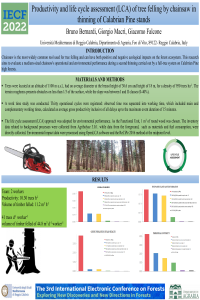
Productivity and life cycle assessment (LCA) of tree felling by chainsaw in thinning of Calabrian Pine stands POSTER.pdf
Acoustic properties of Scots Pine wood and genetic background
A new Model for Calculating the Impact of Forests and Wood Use on the Balance of С-СО2 in the Earth's Atmosphere