Event submissions
EventsThe 3rd International Electronic Conference on Forests — Exploring New Discoveries and New Directions in Forests
Published

This submission belongs to the session S3. Wood Science, Production Chains, Fuelwood and Trade of the event The 3rd International Electronic Conference on Forests — Exploring New Discoveries and New Directions in Forests
Published date
15 Oct, 2022
Academic Editor
'%3e%3cpath%20d='M12.6657%2010.9104C12.4185%2010.325%2012.0599%209.79327%2011.6097%209.34482C11.1609%208.89508%2010.6293%208.5365%2010.0442%208.28888C10.0389%208.28626%2010.0337%208.28495%2010.0285%208.28233C10.8446%207.69279%2011.3752%206.73249%2011.3752%205.64904C11.3752%203.8542%209.92103%202.39999%208.1262%202.39999C6.33136%202.39999%204.87715%203.8542%204.87715%205.64904C4.87715%206.73249%205.40774%207.69279%206.22393%208.28364C6.21869%208.28626%206.21345%208.28757%206.20821%208.29019C5.62129%208.5378%205.09463%208.89284%204.64265%209.34613C4.1929%209.79493%203.83432%2010.3266%203.58671%2010.9117C3.34345%2011.4845%203.21226%2012.0987%203.20023%2012.7209C3.19988%2012.7349%203.20233%2012.7488%203.20744%2012.7619C3.21255%2012.7749%203.22022%2012.7867%203.22998%2012.7968C3.23975%2012.8068%203.25142%2012.8147%203.26431%2012.8202C3.2772%2012.8256%203.29105%2012.8284%203.30504%2012.8284H4.09109C4.14874%2012.8284%204.19459%2012.7825%204.1959%2012.7262C4.2221%2011.7148%204.62823%2010.7676%205.34617%2010.0497C6.08899%209.30683%207.0755%208.89808%208.1262%208.89808C9.17689%208.89808%2010.1634%209.30683%2010.9062%2010.0497C11.6242%2010.7676%2012.0303%2011.7148%2012.0565%2012.7262C12.0578%2012.7838%2012.1037%2012.8284%2012.1613%2012.8284H12.9474C12.9613%2012.8284%2012.9752%2012.8256%2012.9881%2012.8202C13.001%2012.8147%2013.0126%2012.8068%2013.0224%2012.7968C13.0322%2012.7867%2013.0398%2012.7749%2013.0449%2012.7619C13.0501%2012.7488%2013.0525%2012.7349%2013.0522%2012.7209C13.0391%2012.0947%2012.9094%2011.4855%2012.6657%2010.9104ZM8.1262%207.9024C7.52486%207.9024%206.9589%207.6679%206.53312%207.24211C6.10733%206.81633%205.87283%206.25037%205.87283%205.64904C5.87283%205.0477%206.10733%204.48174%206.53312%204.05596C6.9589%203.63018%207.52486%203.39567%208.1262%203.39567C8.72753%203.39567%209.29349%203.63018%209.71927%204.05596C10.1451%204.48174%2010.3796%205.0477%2010.3796%205.64904C10.3796%206.25037%2010.1451%206.81633%209.71927%207.24211C9.29349%207.6679%208.72753%207.9024%208.1262%207.9024Z'%20fill='%235D1EE1'/%3e%3c/g%3e%3c/svg%3e) Miha Humar
Miha HumarCitation
Jorge Santos, Sandra Monteiro, Susana Oliveira, Pedro Magalhães, F.D. Magalhães, Jorge Manuel Martins, Luisa H. Carvalho, Application of Forest Byproducts in the Textile Industry: Dyeing with Pine and Eucalyptus Bark Extracts, in Proceedings of The 3rd International Electronic Conference on Forests — Exploring New Discoveries and New Directions in Forests, 15 October–31 October 2022, MDPI: Basel, Switzerland, doi: 10.3390/IECF2022-13053
Share
Email
Facebook
Twitter
LinkedIn
Application of Forest Byproducts in the Textile Industry: Dyeing with Pine and Eucalyptus Bark Extracts

Jorge Santos 1,2
'%3e%3cpath%20d='M12.6647%2010.9104C12.4176%2010.325%2012.0589%209.7933%2011.6088%209.34485C11.16%208.89511%2010.6283%208.53653%2010.0432%208.28891C10.038%208.28629%2010.0327%208.28498%2010.0275%208.28236C10.8437%207.69282%2011.3743%206.73252%2011.3743%205.64907C11.3743%203.85423%209.92005%202.40002%208.12522%202.40002C6.33038%202.40002%204.87618%203.85423%204.87618%205.64907C4.87618%206.73252%205.40677%207.69282%206.22296%208.28367C6.21772%208.28629%206.21248%208.2876%206.20724%208.29022C5.62031%208.53783%205.09365%208.89287%204.64167%209.34616C4.19192%209.79496%203.83334%2010.3266%203.58573%2010.9117C3.34247%2011.4846%203.21128%2012.0987%203.19925%2012.721C3.1989%2012.735%203.20135%2012.7489%203.20646%2012.7619C3.21157%2012.7749%203.21924%2012.7868%203.22901%2012.7968C3.23877%2012.8068%203.25045%2012.8148%203.26334%2012.8202C3.27623%2012.8256%203.29007%2012.8284%203.30406%2012.8284H4.09012C4.14776%2012.8284%204.19362%2012.7825%204.19493%2012.7262C4.22113%2011.7148%204.62726%2010.7676%205.34519%2010.0497C6.08802%209.30686%207.07452%208.89811%208.12522%208.89811C9.17592%208.89811%2010.1624%209.30686%2010.9052%2010.0497C11.6232%2010.7676%2012.0293%2011.7148%2012.0555%2012.7262C12.0568%2012.7839%2012.1027%2012.8284%2012.1603%2012.8284H12.9464C12.9604%2012.8284%2012.9742%2012.8256%2012.9871%2012.8202C13%2012.8148%2013.0117%2012.8068%2013.0214%2012.7968C13.0312%2012.7868%2013.0389%2012.7749%2013.044%2012.7619C13.0491%2012.7489%2013.0515%2012.735%2013.0512%2012.721C13.0381%2012.0947%2012.9084%2011.4856%2012.6647%2010.9104ZM8.12522%207.90243C7.52388%207.90243%206.95792%207.66793%206.53214%207.24215C6.10636%206.81636%205.87185%206.2504%205.87185%205.64907C5.87185%205.04773%206.10636%204.48177%206.53214%204.05599C6.95792%203.63021%207.52388%203.3957%208.12522%203.3957C8.72655%203.3957%209.29252%203.63021%209.7183%204.05599C10.1441%204.48177%2010.3786%205.04773%2010.3786%205.64907C10.3786%206.2504%2010.1441%206.81636%209.7183%207.24215C9.29252%207.66793%208.72655%207.90243%208.12522%207.90243Z'%20fill='%235D1EE1'/%3e%3c/g%3e%3c/svg%3e)
Sandra Monteiro 2,3
Susana Oliveira 3
Pedro Magalhães 4

F.D. Magalhães 2,5
Jorge Manuel Martins 2,5,6

Luisa H. Carvalho 2,5,6
1. ARCP-Associação Rede de Competência em Polímeros / LEPABE - Faculty of Engineering, University of Porto
2. LEPABE - Faculty of Engineering, University of Porto, Rua Dr. Roberto Frias, s/n 4200-465 Porto,Portugal
3. ARCP-Associação Rede de Competência em Polímeros, 4200-355 Porto, Portugal.
4. Tintex Textiles SA, Zona Industrial, Polo 1, Campos, 4924-909 Vila Nova de Cerveira, Portugal
5. ALiCE - Associate Laboratory in Chemical Engineering, Faculty of Engineering, University of Porto, Rua Dr. Roberto Frias, 4200-465 Porto, Portugal
6. DEMad-Department of Wood Engineering, Instituto Politécnico de Viseu, Campus Politécnico de Repeses, 3504-510 Viseu, Portugal
Abstract
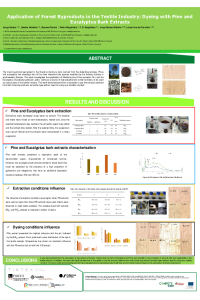
High water consumption, together with the use of synthetic dyes and metallic mordant agents, contribute to the high environmental impact of the textile industry. Numerous investigations have focused on the search for more sustainable raw materials and processes for this sector. One of the most promising solutions is to look towards forest by-products as a sustainable source of fibrous raw materials to substitute plastic fibres and replace partially cotton. In addition, forest by-products could also be a good source of natural dyes and textile additives, replacing synthetic ones. The main by-product generated in the forestry industry is bark, derived from the debarking process. Pinus and eucalyptus are nowadays two of the most important tree species exploited by the forestry industry in southwestern Europe. This work investigates the application of Maritime pine (Pinus pinaster, Ait.) and the Eucalyptus (Eucalyptus Globulus) barks as a source of high polyphenolic content extracts, to be used as natural dyes in the textile industry. Extraction was performed with water in alkali conditions. The influence of the extraction conditions to obtain the extracts used as natural colorant and the dyeing conditions (pH, time, temperature, use of mordant) on the properties of the dyed textile sample was evaluated. It was shown that the pH and the extraction conditions used were the variables with the greatest influence on the final properties of the dyed textile. In addition, this work also demonstrated that it is possible to use the extracts obtained from both forest by-products as textile dyes without need for using any metallic mordant.
Keywords
Natural dye
Bark
Pine
Eucalyptus,
Forest Byproducts
Manuscript
sciforum-064035.pdf
Poster
POSTER 3rd International Electronic Conference on Forests Jorge Santos.pdf
Work Efficiency of Battery-Powered Chainsaws During the Commercial Thinning in the Young Pine Stand
Screening synergistic interactions on essential oils for the improvement of toxicity against the pinewood nematode