Event submissions
EventsThe 3rd International Electronic Conference on Foods: Food, Microbiome, and Health - A Celebration of the 10th Anniversary of Foods' Impact on Our Wellbeing
Published

This submission belongs to the session 1. Food Formulations - Novel Ingredients and Food Additives of the event The 3rd International Electronic Conference on Foods: Food, Microbiome, and Health - A Celebration of the 10th Anniversary of Foods' Impact on Our Wellbeing
Published date
17 Oct, 2022
Academic Editor
'%3e%3cpath%20d='M12.6657%2010.9104C12.4185%2010.325%2012.0599%209.79327%2011.6097%209.34482C11.1609%208.89508%2010.6293%208.5365%2010.0442%208.28888C10.0389%208.28626%2010.0337%208.28495%2010.0285%208.28233C10.8446%207.69279%2011.3752%206.73249%2011.3752%205.64904C11.3752%203.8542%209.92103%202.39999%208.1262%202.39999C6.33136%202.39999%204.87715%203.8542%204.87715%205.64904C4.87715%206.73249%205.40774%207.69279%206.22393%208.28364C6.21869%208.28626%206.21345%208.28757%206.20821%208.29019C5.62129%208.5378%205.09463%208.89284%204.64265%209.34613C4.1929%209.79493%203.83432%2010.3266%203.58671%2010.9117C3.34345%2011.4845%203.21226%2012.0987%203.20023%2012.7209C3.19988%2012.7349%203.20233%2012.7488%203.20744%2012.7619C3.21255%2012.7749%203.22022%2012.7867%203.22998%2012.7968C3.23975%2012.8068%203.25142%2012.8147%203.26431%2012.8202C3.2772%2012.8256%203.29105%2012.8284%203.30504%2012.8284H4.09109C4.14874%2012.8284%204.19459%2012.7825%204.1959%2012.7262C4.2221%2011.7148%204.62823%2010.7676%205.34617%2010.0497C6.08899%209.30683%207.0755%208.89808%208.1262%208.89808C9.17689%208.89808%2010.1634%209.30683%2010.9062%2010.0497C11.6242%2010.7676%2012.0303%2011.7148%2012.0565%2012.7262C12.0578%2012.7838%2012.1037%2012.8284%2012.1613%2012.8284H12.9474C12.9613%2012.8284%2012.9752%2012.8256%2012.9881%2012.8202C13.001%2012.8147%2013.0126%2012.8068%2013.0224%2012.7968C13.0322%2012.7867%2013.0398%2012.7749%2013.0449%2012.7619C13.0501%2012.7488%2013.0525%2012.7349%2013.0522%2012.7209C13.0391%2012.0947%2012.9094%2011.4855%2012.6657%2010.9104ZM8.1262%207.9024C7.52486%207.9024%206.9589%207.6679%206.53312%207.24211C6.10733%206.81633%205.87283%206.25037%205.87283%205.64904C5.87283%205.0477%206.10733%204.48174%206.53312%204.05596C6.9589%203.63018%207.52486%203.39567%208.1262%203.39567C8.72753%203.39567%209.29349%203.63018%209.71927%204.05596C10.1451%204.48174%2010.3796%205.0477%2010.3796%205.64904C10.3796%206.25037%2010.1451%206.81633%209.71927%207.24211C9.29349%207.6679%208.72753%207.9024%208.1262%207.9024Z'%20fill='%235D1EE1'/%3e%3c/g%3e%3c/svg%3e) Arun Bhunia
Arun BhuniaCitation
Bartłomiej Zieniuk, Karina Jasińska, Katarzyna Wierzchowska, Agata Fabiszewska, Enzymatic Synthesis of Flavours and Fragrances, Antioxidants and Antimicrobials on the Example of Benzyl Alcohol and its Selected Derivatives, in Proceedings of The 3rd International Electronic Conference on Foods: Food, Microbiome, and Health - A Celebration of the 10th Anniversary of Foods' Impact on Our Wellbeing, 1 October–15 October 2022, MDPI: Basel, Switzerland, doi: 10.3390/Foods2022-13066
Share
Email
Facebook
Twitter
LinkedIn
Enzymatic Synthesis of Flavours and Fragrances, Antioxidants and Antimicrobials on the Example of Benzyl Alcohol and its Selected Derivatives

Bartłomiej Zieniuk 1
'%3e%3cpath%20d='M12.6647%2010.9104C12.4176%2010.325%2012.0589%209.7933%2011.6088%209.34485C11.16%208.89511%2010.6283%208.53653%2010.0432%208.28891C10.038%208.28629%2010.0327%208.28498%2010.0275%208.28236C10.8437%207.69282%2011.3743%206.73252%2011.3743%205.64907C11.3743%203.85423%209.92005%202.40002%208.12522%202.40002C6.33038%202.40002%204.87618%203.85423%204.87618%205.64907C4.87618%206.73252%205.40677%207.69282%206.22296%208.28367C6.21772%208.28629%206.21248%208.2876%206.20724%208.29022C5.62031%208.53783%205.09365%208.89287%204.64167%209.34616C4.19192%209.79496%203.83334%2010.3266%203.58573%2010.9117C3.34247%2011.4846%203.21128%2012.0987%203.19925%2012.721C3.1989%2012.735%203.20135%2012.7489%203.20646%2012.7619C3.21157%2012.7749%203.21924%2012.7868%203.22901%2012.7968C3.23877%2012.8068%203.25045%2012.8148%203.26334%2012.8202C3.27623%2012.8256%203.29007%2012.8284%203.30406%2012.8284H4.09012C4.14776%2012.8284%204.19362%2012.7825%204.19493%2012.7262C4.22113%2011.7148%204.62726%2010.7676%205.34519%2010.0497C6.08802%209.30686%207.07452%208.89811%208.12522%208.89811C9.17592%208.89811%2010.1624%209.30686%2010.9052%2010.0497C11.6232%2010.7676%2012.0293%2011.7148%2012.0555%2012.7262C12.0568%2012.7839%2012.1027%2012.8284%2012.1603%2012.8284H12.9464C12.9604%2012.8284%2012.9742%2012.8256%2012.9871%2012.8202C13%2012.8148%2013.0117%2012.8068%2013.0214%2012.7968C13.0312%2012.7868%2013.0389%2012.7749%2013.044%2012.7619C13.0491%2012.7489%2013.0515%2012.735%2013.0512%2012.721C13.0381%2012.0947%2012.9084%2011.4856%2012.6647%2010.9104ZM8.12522%207.90243C7.52388%207.90243%206.95792%207.66793%206.53214%207.24215C6.10636%206.81636%205.87185%206.2504%205.87185%205.64907C5.87185%205.04773%206.10636%204.48177%206.53214%204.05599C6.95792%203.63021%207.52388%203.3957%208.12522%203.3957C8.72655%203.3957%209.29252%203.63021%209.7183%204.05599C10.1441%204.48177%2010.3786%205.04773%2010.3786%205.64907C10.3786%206.2504%2010.1441%206.81636%209.7183%207.24215C9.29252%207.66793%208.72655%207.90243%208.12522%207.90243Z'%20fill='%235D1EE1'/%3e%3c/g%3e%3c/svg%3e)
Karina Jasińska 1,2

Katarzyna Wierzchowska 1,2

Agata Fabiszewska 1
1. Department of Chemistry, Institute of Food Sciences, Warsaw University of Life Sciences-SGGW, 159c Nowoursynowska Street, 02-776 Warsaw, Poland
2. Department of Food Engineering and Process Management, Institute of Food Sciences, Warsaw University of Life Sciences-SGGW, 159c Nowoursynowska Street, 02-776 Warsaw, Poland
Abstract
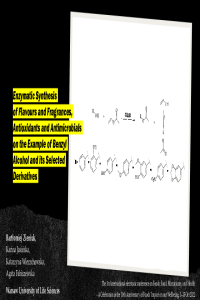
The "green" alternative to traditional chemical synthesis can be enzyme-based processes. Phenolic compounds are known to be biologically active substances but in many cases, their enzymatic modification by esterification or transesterification allows for obtaining esters with other, new features, like changed flavour properties, enhanced solubility in lipophilic media or enhanced antimicrobial activity. The aim of the work was the enzymatic synthesis of flavours and fragrances, antioxidants and antimicrobials with the use of benzyl alcohol, and its selected derivatives, namely 2-hydroxybenzyl, 4-hydroxybenzyl, 4-methoxybenzyl (anisyl), 4-hydroxy-3-methoxybenzyl (vanillyl), 4-nitrobenzyl, and 3,4-(methylenedioxy)benzyl (piperonyl) alcohols via transesterification with vinyl acetate. For obtaining the esters, Candida antarctica lipase B (10% w/w by the mass of substrates) was used and the reactions were performed in isooctane and 2 mmoles of chosen alcohol and vinyl acetate. The conversion yields of esters were dependent on the structure of alcohols and their solubility in the solvent and ranged from about 17% in the case of 4-hydroxybenzyl acetate to approximately 90% of benzyl acetate. The performed reactions allowed the creation of esters with fruity-sweet-floral odours, like benzyl acetate, 4-methoxybenzyl acetate and piperonyl acetate. Furthermore, vanillyl acetate has proven to be the best antioxidant in the DPPH· (2,2-diphenyl-1-picrylhydrazyl) assay, with the IC50 value of 0.83 ± 0.04 mM. In the reference to antimicrobial activity, the disc diffusion method was applied and the following bacteria were used: Escherichia coli PCM 2057 and Staphylococcus aureus PCM 2054. The vast majority of synthesized esters were not effective against tested bacteria, but vanillyl acetate was able to moderately inhibit the growth of the microorganisms, and the largest inhibition zone diameters were obtained for 2-hydroxybenzyl acetate and the values obtained against E. coli were 19.0 ± 1.0 mm and 20.3 ± 0.6 in the case of S. aureus.
Keywords
enzymatic synthesis
flavours
fragrances
antioxidants
antimicrobials
esters
Manuscript
ZieniukEnzymatic.pdf
Poster
ZieniukSlides.pdf
Molecular identification of lactic acid producing bacteria isolated from alheira, a traditional Portuguese fermented sausage
Development of potential functional biscuits with the incorporation of Tannat grape pomace and sweetener