Event submissions
EventsThe 3rd International Electronic Conference on Forests — Exploring New Discoveries and New Directions in Forests
Published
 10.3390/IECF2022-13082 (registering DOI)
 This submission belongs to the session S1. Forest Ecology and Management of the event The 3rd International Electronic Conference on Forests — Exploring New Discoveries and New Directions in Forests
Published date
21 Oct, 2022
Academic Editor
'%3e%3cpath%20d='M12.6657%2010.9104C12.4185%2010.325%2012.0599%209.79327%2011.6097%209.34482C11.1609%208.89508%2010.6293%208.5365%2010.0442%208.28888C10.0389%208.28626%2010.0337%208.28495%2010.0285%208.28233C10.8446%207.69279%2011.3752%206.73249%2011.3752%205.64904C11.3752%203.8542%209.92103%202.39999%208.1262%202.39999C6.33136%202.39999%204.87715%203.8542%204.87715%205.64904C4.87715%206.73249%205.40774%207.69279%206.22393%208.28364C6.21869%208.28626%206.21345%208.28757%206.20821%208.29019C5.62129%208.5378%205.09463%208.89284%204.64265%209.34613C4.1929%209.79493%203.83432%2010.3266%203.58671%2010.9117C3.34345%2011.4845%203.21226%2012.0987%203.20023%2012.7209C3.19988%2012.7349%203.20233%2012.7488%203.20744%2012.7619C3.21255%2012.7749%203.22022%2012.7867%203.22998%2012.7968C3.23975%2012.8068%203.25142%2012.8147%203.26431%2012.8202C3.2772%2012.8256%203.29105%2012.8284%203.30504%2012.8284H4.09109C4.14874%2012.8284%204.19459%2012.7825%204.1959%2012.7262C4.2221%2011.7148%204.62823%2010.7676%205.34617%2010.0497C6.08899%209.30683%207.0755%208.89808%208.1262%208.89808C9.17689%208.89808%2010.1634%209.30683%2010.9062%2010.0497C11.6242%2010.7676%2012.0303%2011.7148%2012.0565%2012.7262C12.0578%2012.7838%2012.1037%2012.8284%2012.1613%2012.8284H12.9474C12.9613%2012.8284%2012.9752%2012.8256%2012.9881%2012.8202C13.001%2012.8147%2013.0126%2012.8068%2013.0224%2012.7968C13.0322%2012.7867%2013.0398%2012.7749%2013.0449%2012.7619C13.0501%2012.7488%2013.0525%2012.7349%2013.0522%2012.7209C13.0391%2012.0947%2012.9094%2011.4855%2012.6657%2010.9104ZM8.1262%207.9024C7.52486%207.9024%206.9589%207.6679%206.53312%207.24211C6.10733%206.81633%205.87283%206.25037%205.87283%205.64904C5.87283%205.0477%206.10733%204.48174%206.53312%204.05596C6.9589%203.63018%207.52486%203.39567%208.1262%203.39567C8.72753%203.39567%209.29349%203.63018%209.71927%204.05596C10.1451%204.48174%2010.3796%205.0477%2010.3796%205.64904C10.3796%206.25037%2010.1451%206.81633%209.71927%207.24211C9.29349%207.6679%208.72753%207.9024%208.1262%207.9024Z'%20fill='%235D1EE1'/%3e%3c/g%3e%3c/svg%3e) Rodolfo Picchio
Rodolfo PicchioCitation
Ahalya Suresh, Jinsoon Park, Role of Mangrove Forests in Blue carbon in Climate Change mitigation: A case study in Sri Lanka, in Proceedings of The 3rd International Electronic Conference on Forests — Exploring New Discoveries and New Directions in Forests, 15 October–31 October 2022, MDPI: Basel, Switzerland, doi: 10.3390/IECF2022-13082
Share
Email
Facebook
Twitter
LinkedIn
Role of Mangrove Forests in Blue carbon in Climate Change mitigation: A case study in Sri Lanka
'%3e%3cpath%20d='M12.6647%2010.9104C12.4176%2010.325%2012.0589%209.7933%2011.6088%209.34485C11.16%208.89511%2010.6283%208.53653%2010.0432%208.28891C10.038%208.28629%2010.0327%208.28498%2010.0275%208.28236C10.8437%207.69282%2011.3743%206.73252%2011.3743%205.64907C11.3743%203.85423%209.92005%202.40002%208.12522%202.40002C6.33038%202.40002%204.87618%203.85423%204.87618%205.64907C4.87618%206.73252%205.40677%207.69282%206.22296%208.28367C6.21772%208.28629%206.21248%208.2876%206.20724%208.29022C5.62031%208.53783%205.09365%208.89287%204.64167%209.34616C4.19192%209.79496%203.83334%2010.3266%203.58573%2010.9117C3.34247%2011.4846%203.21128%2012.0987%203.19925%2012.721C3.1989%2012.735%203.20135%2012.7489%203.20646%2012.7619C3.21157%2012.7749%203.21924%2012.7868%203.22901%2012.7968C3.23877%2012.8068%203.25045%2012.8148%203.26334%2012.8202C3.27623%2012.8256%203.29007%2012.8284%203.30406%2012.8284H4.09012C4.14776%2012.8284%204.19362%2012.7825%204.19493%2012.7262C4.22113%2011.7148%204.62726%2010.7676%205.34519%2010.0497C6.08802%209.30686%207.07452%208.89811%208.12522%208.89811C9.17592%208.89811%2010.1624%209.30686%2010.9052%2010.0497C11.6232%2010.7676%2012.0293%2011.7148%2012.0555%2012.7262C12.0568%2012.7839%2012.1027%2012.8284%2012.1603%2012.8284H12.9464C12.9604%2012.8284%2012.9742%2012.8256%2012.9871%2012.8202C13%2012.8148%2013.0117%2012.8068%2013.0214%2012.7968C13.0312%2012.7868%2013.0389%2012.7749%2013.044%2012.7619C13.0491%2012.7489%2013.0515%2012.735%2013.0512%2012.721C13.0381%2012.0947%2012.9084%2011.4856%2012.6647%2010.9104ZM8.12522%207.90243C7.52388%207.90243%206.95792%207.66793%206.53214%207.24215C6.10636%206.81636%205.87185%206.2504%205.87185%205.64907C5.87185%205.04773%206.10636%204.48177%206.53214%204.05599C6.95792%203.63021%207.52388%203.3957%208.12522%203.3957C8.72655%203.3957%209.29252%203.63021%209.7183%204.05599C10.1441%204.48177%2010.3786%205.04773%2010.3786%205.64907C10.3786%206.2504%2010.1441%206.81636%209.7183%207.24215C9.29252%207.66793%208.72655%207.90243%208.12522%207.90243Z'%20fill='%235D1EE1'/%3e%3c/g%3e%3c/svg%3e)
Ahalya Suresh 1,2
Jinsoon Park 2
1. Department of Coastal and Marine Resources Management, Ocean University of Sri Lanka, Colombo, Sri Lanka
2. Department of Convergence Study on the Ocean Science and Technology, Korea Maritime and Ocean University, Busan, Republic of Korea
Abstract
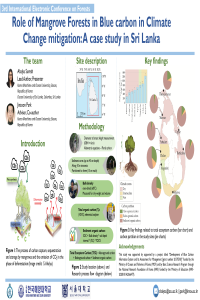
Understanding the intrinsic relationship of ecological elements to mangrove carbon sequestration is vital in promoting conservation. The study aims to quantify the blue carbon capacity of eight natural mangrove stands on the Sri Lankan coast and investigate the ecological influence on their carbon sequestration potential. We employed a combination of allometry for floral carbon and sediment core extraction for sediment carbon assessment. Diameter at breast height of mangrove stands was measured along a 10 m wide belt transect at six points in each site (n=48) and to measure edaphic influence at least three water samples by the adjoining estuary were taken. Sediment cores were extracted at the points of the survey to a depth of 45cm and subsampled to 15cm each. Floristic carbon was calculated with allometry while sediment organic carbon was measured and analyzed with the use of an elemental analyzer. Whole ecosystem carbon stocks were significantly different between the sites and different climatic zones (p<0.05) with the highest carbon content in Rekawa (1247.28.MgC ha-1) and the lowest in Mannar (307.82.MgC.ha-1). Mean carbon content was the highest in the intermediate zone (180.36.± .46.20.MgC.ha-1). On average, the sediment carbon stock was 89% of the total carbon while higher proportion of the rest was aboveground biomass. Correlation analysis revealed that the ecosystem carbon stocks are highly influenced by ecological variables such as dissolved oxygen, salinity and precipitation. If removed, they could emit an equivalent (mean ± SD) of 2584.13.± .1061.23.Mg.ha-1 of carbon dioxide. The findings from the present study will allow plans to be tailored better to the national climate change agenda and will support efforts to monitor mangrove ecosystem carbon cycles and provide a basis for the development of sustainable management programs for mangrove blue carbon Sri Lanka.
Keywords
Mangroves
Blue carbon
Climate Change Mitigation
Conservation
Sri Lanka
Manuscript
062391.pdf
Poster
sciforum_062391.pdf
Long-term dynamics of the thermal state of technogenic territories of gold deposits mining in Siberia based on satellite data
Avalanche effects on endemic pine forests in the Pirin Mountains in Bulgaria