Event submissions
EventsThe 3rd International Electronic Conference on Forests — Exploring New Discoveries and New Directions in Forests
Published

This submission belongs to the session S1. Forest Ecology and Management of the event The 3rd International Electronic Conference on Forests — Exploring New Discoveries and New Directions in Forests
Published date
21 Oct, 2022
Academic Editor
'%3e%3cpath%20d='M12.6657%2010.9104C12.4185%2010.325%2012.0599%209.79327%2011.6097%209.34482C11.1609%208.89508%2010.6293%208.5365%2010.0442%208.28888C10.0389%208.28626%2010.0337%208.28495%2010.0285%208.28233C10.8446%207.69279%2011.3752%206.73249%2011.3752%205.64904C11.3752%203.8542%209.92103%202.39999%208.1262%202.39999C6.33136%202.39999%204.87715%203.8542%204.87715%205.64904C4.87715%206.73249%205.40774%207.69279%206.22393%208.28364C6.21869%208.28626%206.21345%208.28757%206.20821%208.29019C5.62129%208.5378%205.09463%208.89284%204.64265%209.34613C4.1929%209.79493%203.83432%2010.3266%203.58671%2010.9117C3.34345%2011.4845%203.21226%2012.0987%203.20023%2012.7209C3.19988%2012.7349%203.20233%2012.7488%203.20744%2012.7619C3.21255%2012.7749%203.22022%2012.7867%203.22998%2012.7968C3.23975%2012.8068%203.25142%2012.8147%203.26431%2012.8202C3.2772%2012.8256%203.29105%2012.8284%203.30504%2012.8284H4.09109C4.14874%2012.8284%204.19459%2012.7825%204.1959%2012.7262C4.2221%2011.7148%204.62823%2010.7676%205.34617%2010.0497C6.08899%209.30683%207.0755%208.89808%208.1262%208.89808C9.17689%208.89808%2010.1634%209.30683%2010.9062%2010.0497C11.6242%2010.7676%2012.0303%2011.7148%2012.0565%2012.7262C12.0578%2012.7838%2012.1037%2012.8284%2012.1613%2012.8284H12.9474C12.9613%2012.8284%2012.9752%2012.8256%2012.9881%2012.8202C13.001%2012.8147%2013.0126%2012.8068%2013.0224%2012.7968C13.0322%2012.7867%2013.0398%2012.7749%2013.0449%2012.7619C13.0501%2012.7488%2013.0525%2012.7349%2013.0522%2012.7209C13.0391%2012.0947%2012.9094%2011.4855%2012.6657%2010.9104ZM8.1262%207.9024C7.52486%207.9024%206.9589%207.6679%206.53312%207.24211C6.10733%206.81633%205.87283%206.25037%205.87283%205.64904C5.87283%205.0477%206.10733%204.48174%206.53312%204.05596C6.9589%203.63018%207.52486%203.39567%208.1262%203.39567C8.72753%203.39567%209.29349%203.63018%209.71927%204.05596C10.1451%204.48174%2010.3796%205.0477%2010.3796%205.64904C10.3796%206.25037%2010.1451%206.81633%209.71927%207.24211C9.29349%207.6679%208.72753%207.9024%208.1262%207.9024Z'%20fill='%235D1EE1'/%3e%3c/g%3e%3c/svg%3e) Rodolfo Picchio
Rodolfo PicchioCitation
Swetha Purushotham, Sundararaj Ramachandran, Kandan Aravindaram, Ananda Kulal, Kirana Mugaranja P, Identification of pathogens in seedlings of Indian sandalwood and screening of fungal endophytes against the plant pathogenic fungi, in Proceedings of The 3rd International Electronic Conference on Forests — Exploring New Discoveries and New Directions in Forests, 15 October–31 October 2022, MDPI: Basel, Switzerland, doi: 10.3390/IECF2022-13086
Share
Email
Facebook
Twitter
LinkedIn
Identification of pathogens in seedlings of Indian sandalwood and screening of fungal endophytes against the plant pathogenic fungi
'%3e%3cpath%20d='M12.6647%2010.9104C12.4176%2010.325%2012.0589%209.7933%2011.6088%209.34485C11.16%208.89511%2010.6283%208.53653%2010.0432%208.28891C10.038%208.28629%2010.0327%208.28498%2010.0275%208.28236C10.8437%207.69282%2011.3743%206.73252%2011.3743%205.64907C11.3743%203.85423%209.92005%202.40002%208.12522%202.40002C6.33038%202.40002%204.87618%203.85423%204.87618%205.64907C4.87618%206.73252%205.40677%207.69282%206.22296%208.28367C6.21772%208.28629%206.21248%208.2876%206.20724%208.29022C5.62031%208.53783%205.09365%208.89287%204.64167%209.34616C4.19192%209.79496%203.83334%2010.3266%203.58573%2010.9117C3.34247%2011.4846%203.21128%2012.0987%203.19925%2012.721C3.1989%2012.735%203.20135%2012.7489%203.20646%2012.7619C3.21157%2012.7749%203.21924%2012.7868%203.22901%2012.7968C3.23877%2012.8068%203.25045%2012.8148%203.26334%2012.8202C3.27623%2012.8256%203.29007%2012.8284%203.30406%2012.8284H4.09012C4.14776%2012.8284%204.19362%2012.7825%204.19493%2012.7262C4.22113%2011.7148%204.62726%2010.7676%205.34519%2010.0497C6.08802%209.30686%207.07452%208.89811%208.12522%208.89811C9.17592%208.89811%2010.1624%209.30686%2010.9052%2010.0497C11.6232%2010.7676%2012.0293%2011.7148%2012.0555%2012.7262C12.0568%2012.7839%2012.1027%2012.8284%2012.1603%2012.8284H12.9464C12.9604%2012.8284%2012.9742%2012.8256%2012.9871%2012.8202C13%2012.8148%2013.0117%2012.8068%2013.0214%2012.7968C13.0312%2012.7868%2013.0389%2012.7749%2013.044%2012.7619C13.0491%2012.7489%2013.0515%2012.735%2013.0512%2012.721C13.0381%2012.0947%2012.9084%2011.4856%2012.6647%2010.9104ZM8.12522%207.90243C7.52388%207.90243%206.95792%207.66793%206.53214%207.24215C6.10636%206.81636%205.87185%206.2504%205.87185%205.64907C5.87185%205.04773%206.10636%204.48177%206.53214%204.05599C6.95792%203.63021%207.52388%203.3957%208.12522%203.3957C8.72655%203.3957%209.29252%203.63021%209.7183%204.05599C10.1441%204.48177%2010.3786%205.04773%2010.3786%205.64907C10.3786%206.2504%2010.1441%206.81636%209.7183%207.24215C9.29252%207.66793%208.72655%207.90243%208.12522%207.90243Z'%20fill='%235D1EE1'/%3e%3c/g%3e%3c/svg%3e)
Swetha Purushotham 1
Sundararaj Ramachandran 2
Kandan Aravindaram 3
Ananda Kulal 4
Kirana Mugaranja P 5
1. PhD research scholar, Institute of wood science and technology
2. Scientist-G and Head, Forest Protection division, Institute of wood science and technology
3. Principle scientist, Division of Germplasm Conservation and Utilization, ICAR-National Bureau of Agricultural Insect Resources
4. Associate Professor, Biological Sciences, Poornaprajna Institute of Scientific Research
5. PhD scholar, Biological Sciences, Poornaprajna Institute of Scientific Research
Abstract
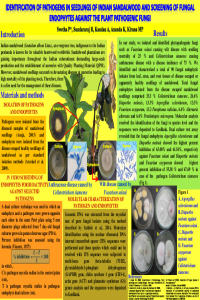
Indian sandalwood (Santalum album Linn.), an evergreen tree, indigenous to the Indian peninsula is known for its fragrant heartwood worldwide. Sandalwood plantations are gaining importance throughout the Indian subcontinent demanding large-scale production and the establishment of nurseries with Quality Planting Material (QPM). However, sandalwood seedlings succumb to devastating diseases at nurseries leading to high mortality of the planting stock. Therefore, there is a dire need for the effective management of these diseases. In our study, we isolated and identified phytopathogenic fungi such as Fusarium solani causing wilt disease with seedling mortality of 25 % and Colletotrichum siamense causing anthracnose disease with a disease incidence of 75 %.We identified and characterized a total of 90 fungal endophytic isolates from leaf, stem, and root tissues of disease escaped or apparently healthy seedlings of sandalwood. Total fungal endophytes isolated from the disease escaped sandalwood seedlings comprised 33.3 % Colletotrichum siamense, 26.6% Diaporthe melonis, 13.3% Aspergillus sclerotiorum, 13.3% Fusarium oxysporum, 13.3 Paraphoma radicina, 6.6% Alternaria alternata and 6.6% Pestalotiopsis microspora. Molecular identification using the nuclear ribosomal DNA internal transcribed spacer (ITS) sequences were performed and those species which could not be resolved with ITS sequence were subjected to multi-locus gene (beta-tubulin (TUB2), glyceraldehyde‐3‐phosphate dehydrogenase (GAPDH) gene, chitin synthase 1 gene (CHS‐1), actin gene (ACT) and glutamine synthetase (GS) genes) analysis and the sequences were deposited to GenBank. Dual culture test assay revealed that the fungal endophytes Aspergillus sclerotiorum and Diaporthe melonis showed the highest percent inhibition of 63.08% and 61.54%, respectively against Fusarium solani and Diaporthe melonis and Fusarium oxysporum showed highest percent inhibition of 55.38 % and 67.69 % in case of the pathogen Colletotrichum siamense. This study will be useful for the management of seed, soil and airborne pathogens of Indian sandalwood.
Keywords
Indian sandalwood
endophytes
pathogen
management
Manuscript
064399.pdf
Poster
Conference poster.pdf
Qualitative and quantitative characterization of deadwood related to the accessibility of managed beech forests of the Abruzzo, Lazio and Molise National Park.
The management of invasive non-native trees in the Mediterranean protected areas: Sicily as a case study