Event submissions
EventsThe 3rd International Electronic Conference on Forests — Exploring New Discoveries and New Directions in Forests
Published

This submission belongs to the session S7. Forest Wildfires and Other Natural Hazards of the event The 3rd International Electronic Conference on Forests — Exploring New Discoveries and New Directions in Forests
Published date
27 Oct, 2022
Academic Editor
'%3e%3cpath%20d='M12.6657%2010.9104C12.4185%2010.325%2012.0599%209.79327%2011.6097%209.34482C11.1609%208.89508%2010.6293%208.5365%2010.0442%208.28888C10.0389%208.28626%2010.0337%208.28495%2010.0285%208.28233C10.8446%207.69279%2011.3752%206.73249%2011.3752%205.64904C11.3752%203.8542%209.92103%202.39999%208.1262%202.39999C6.33136%202.39999%204.87715%203.8542%204.87715%205.64904C4.87715%206.73249%205.40774%207.69279%206.22393%208.28364C6.21869%208.28626%206.21345%208.28757%206.20821%208.29019C5.62129%208.5378%205.09463%208.89284%204.64265%209.34613C4.1929%209.79493%203.83432%2010.3266%203.58671%2010.9117C3.34345%2011.4845%203.21226%2012.0987%203.20023%2012.7209C3.19988%2012.7349%203.20233%2012.7488%203.20744%2012.7619C3.21255%2012.7749%203.22022%2012.7867%203.22998%2012.7968C3.23975%2012.8068%203.25142%2012.8147%203.26431%2012.8202C3.2772%2012.8256%203.29105%2012.8284%203.30504%2012.8284H4.09109C4.14874%2012.8284%204.19459%2012.7825%204.1959%2012.7262C4.2221%2011.7148%204.62823%2010.7676%205.34617%2010.0497C6.08899%209.30683%207.0755%208.89808%208.1262%208.89808C9.17689%208.89808%2010.1634%209.30683%2010.9062%2010.0497C11.6242%2010.7676%2012.0303%2011.7148%2012.0565%2012.7262C12.0578%2012.7838%2012.1037%2012.8284%2012.1613%2012.8284H12.9474C12.9613%2012.8284%2012.9752%2012.8256%2012.9881%2012.8202C13.001%2012.8147%2013.0126%2012.8068%2013.0224%2012.7968C13.0322%2012.7867%2013.0398%2012.7749%2013.0449%2012.7619C13.0501%2012.7488%2013.0525%2012.7349%2013.0522%2012.7209C13.0391%2012.0947%2012.9094%2011.4855%2012.6657%2010.9104ZM8.1262%207.9024C7.52486%207.9024%206.9589%207.6679%206.53312%207.24211C6.10733%206.81633%205.87283%206.25037%205.87283%205.64904C5.87283%205.0477%206.10733%204.48174%206.53312%204.05596C6.9589%203.63018%207.52486%203.39567%208.1262%203.39567C8.72753%203.39567%209.29349%203.63018%209.71927%204.05596C10.1451%204.48174%2010.3796%205.0477%2010.3796%205.64904C10.3796%206.25037%2010.1451%206.81633%209.71927%207.24211C9.29349%207.6679%208.72753%207.9024%208.1262%207.9024Z'%20fill='%235D1EE1'/%3e%3c/g%3e%3c/svg%3e) Olga Viedma
Olga ViedmaCitation
Aleksandr Ageev, Anna Golovina, Sergey Astapenko, Iuliia Achikolova, Natural and anthropogenic risks hindering successful natural reforestation in former Polygraphus proximus Blandford outbreak areas, in Proceedings of The 3rd International Electronic Conference on Forests — Exploring New Discoveries and New Directions in Forests, 15 October–31 October 2022, MDPI: Basel, Switzerland, doi: 10.3390/IECF2022-13110
Share
Email
Facebook
Twitter
LinkedIn
Natural and anthropogenic risks hindering successful natural reforestation in former Polygraphus proximus Blandford outbreak areas
'%3e%3cpath%20d='M12.6647%2010.9104C12.4176%2010.325%2012.0589%209.7933%2011.6088%209.34485C11.16%208.89511%2010.6283%208.53653%2010.0432%208.28891C10.038%208.28629%2010.0327%208.28498%2010.0275%208.28236C10.8437%207.69282%2011.3743%206.73252%2011.3743%205.64907C11.3743%203.85423%209.92005%202.40002%208.12522%202.40002C6.33038%202.40002%204.87618%203.85423%204.87618%205.64907C4.87618%206.73252%205.40677%207.69282%206.22296%208.28367C6.21772%208.28629%206.21248%208.2876%206.20724%208.29022C5.62031%208.53783%205.09365%208.89287%204.64167%209.34616C4.19192%209.79496%203.83334%2010.3266%203.58573%2010.9117C3.34247%2011.4846%203.21128%2012.0987%203.19925%2012.721C3.1989%2012.735%203.20135%2012.7489%203.20646%2012.7619C3.21157%2012.7749%203.21924%2012.7868%203.22901%2012.7968C3.23877%2012.8068%203.25045%2012.8148%203.26334%2012.8202C3.27623%2012.8256%203.29007%2012.8284%203.30406%2012.8284H4.09012C4.14776%2012.8284%204.19362%2012.7825%204.19493%2012.7262C4.22113%2011.7148%204.62726%2010.7676%205.34519%2010.0497C6.08802%209.30686%207.07452%208.89811%208.12522%208.89811C9.17592%208.89811%2010.1624%209.30686%2010.9052%2010.0497C11.6232%2010.7676%2012.0293%2011.7148%2012.0555%2012.7262C12.0568%2012.7839%2012.1027%2012.8284%2012.1603%2012.8284H12.9464C12.9604%2012.8284%2012.9742%2012.8256%2012.9871%2012.8202C13%2012.8148%2013.0117%2012.8068%2013.0214%2012.7968C13.0312%2012.7868%2013.0389%2012.7749%2013.044%2012.7619C13.0491%2012.7489%2013.0515%2012.735%2013.0512%2012.721C13.0381%2012.0947%2012.9084%2011.4856%2012.6647%2010.9104ZM8.12522%207.90243C7.52388%207.90243%206.95792%207.66793%206.53214%207.24215C6.10636%206.81636%205.87185%206.2504%205.87185%205.64907C5.87185%205.04773%206.10636%204.48177%206.53214%204.05599C6.95792%203.63021%207.52388%203.3957%208.12522%203.3957C8.72655%203.3957%209.29252%203.63021%209.7183%204.05599C10.1441%204.48177%2010.3786%205.04773%2010.3786%205.64907C10.3786%206.2504%2010.1441%206.81636%209.7183%207.24215C9.29252%207.66793%208.72655%207.90243%208.12522%207.90243Z'%20fill='%235D1EE1'/%3e%3c/g%3e%3c/svg%3e)
Aleksandr Ageev 1

Anna Golovina 1
Sergey Astapenko 1
Iuliia Achikolova 2
1. Center of Forest Pyrology, Development of Forest Ecosystem Conservation, Forest Protection and Regeneration Technologies, Branch of the All-Russia Research Institute of Silviculture and Mechanization of Forestry
2. All-Russian Research Institute for Silviculture and Mechanization of Forestry (VNIILM)
Abstract
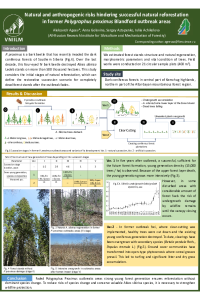
Polygraphus proximus Blandford is a bark beetle that has recently invaded the dark coniferous forests of Southern Siberia. Over the last decade, this four-eyed fir bark beetle destroyed Abies sibirica Ledeb stands on more than 500 thousand hectares. This study considers the initial stages of natural reforestation, which can define the restorative succession scenario for completely dead forest stands after the outbreak fades. Areas disturbed by outbreaks have a strong potential for natural coniferous regeneration when the young generation of Abies sibirica dominates in species composition. As early as 5 years after the outbreak, a successful, sufficient for the future forest formation, young generation density (13,000 trees / ha) is observed. Intensive undergrowth development is noted. The high density of young stands in some areas ensures the canopy closure and forms a shady ground cover vegetation type. At the same time, in some disturbed areas there are threats to undergrowth. In open places with thin undergrowth a considerable amount of forest fuels represented by large wood residues and dead grass accumulates and can cause high-intensity fire emergence and development. Another risk is human activity. In former outbreak foci, where clear-cutting was implemented, healthy trees were cut down and the existing young coniferous generation destroyed. To date, clearings have been overgrown with secondary species (Betula pendula Roth., Populus tremula L.). Ground cover communities have transformed into open-type phytocenosis where cereal grasses prevail. This led to turfing and significant litter and dry grass accumulation. To sum up, in faded Polygraphus Proximus outbreaks areas strong young forest generation ensures reforestation without dominant species change. To reduce risks of species change and conserve valuable Abies sibirica species, it is necessary to strengthen wildfire protection.
Keywords
Siberia
dark coniferous forests
natural reforestation
secondary succession
insect outbreak
Polygraphus Proximus
Abies sibirica
Manuscript
062524.pdf
Poster
1.pdf
TRENDS ON EUCALYPTUS WOOD DENSITY IN SITES WITH DIFFERENT WATER AVAILABILITY
The digitalization framework of the National Forest System at 2020