Event submissions
EventsThe 3rd International Electronic Conference on Forests — Exploring New Discoveries and New Directions in Forests
Published

This submission belongs to the session S9. Forest Water and Climate Regulation of the event The 3rd International Electronic Conference on Forests — Exploring New Discoveries and New Directions in Forests
Published date
31 Oct, 2022
Academic Editor
'%3e%3cpath%20d='M12.6657%2010.9104C12.4185%2010.325%2012.0599%209.79327%2011.6097%209.34482C11.1609%208.89508%2010.6293%208.5365%2010.0442%208.28888C10.0389%208.28626%2010.0337%208.28495%2010.0285%208.28233C10.8446%207.69279%2011.3752%206.73249%2011.3752%205.64904C11.3752%203.8542%209.92103%202.39999%208.1262%202.39999C6.33136%202.39999%204.87715%203.8542%204.87715%205.64904C4.87715%206.73249%205.40774%207.69279%206.22393%208.28364C6.21869%208.28626%206.21345%208.28757%206.20821%208.29019C5.62129%208.5378%205.09463%208.89284%204.64265%209.34613C4.1929%209.79493%203.83432%2010.3266%203.58671%2010.9117C3.34345%2011.4845%203.21226%2012.0987%203.20023%2012.7209C3.19988%2012.7349%203.20233%2012.7488%203.20744%2012.7619C3.21255%2012.7749%203.22022%2012.7867%203.22998%2012.7968C3.23975%2012.8068%203.25142%2012.8147%203.26431%2012.8202C3.2772%2012.8256%203.29105%2012.8284%203.30504%2012.8284H4.09109C4.14874%2012.8284%204.19459%2012.7825%204.1959%2012.7262C4.2221%2011.7148%204.62823%2010.7676%205.34617%2010.0497C6.08899%209.30683%207.0755%208.89808%208.1262%208.89808C9.17689%208.89808%2010.1634%209.30683%2010.9062%2010.0497C11.6242%2010.7676%2012.0303%2011.7148%2012.0565%2012.7262C12.0578%2012.7838%2012.1037%2012.8284%2012.1613%2012.8284H12.9474C12.9613%2012.8284%2012.9752%2012.8256%2012.9881%2012.8202C13.001%2012.8147%2013.0126%2012.8068%2013.0224%2012.7968C13.0322%2012.7867%2013.0398%2012.7749%2013.0449%2012.7619C13.0501%2012.7488%2013.0525%2012.7349%2013.0522%2012.7209C13.0391%2012.0947%2012.9094%2011.4855%2012.6657%2010.9104ZM8.1262%207.9024C7.52486%207.9024%206.9589%207.6679%206.53312%207.24211C6.10733%206.81633%205.87283%206.25037%205.87283%205.64904C5.87283%205.0477%206.10733%204.48174%206.53312%204.05596C6.9589%203.63018%207.52486%203.39567%208.1262%203.39567C8.72753%203.39567%209.29349%203.63018%209.71927%204.05596C10.1451%204.48174%2010.3796%205.0477%2010.3796%205.64904C10.3796%206.25037%2010.1451%206.81633%209.71927%207.24211C9.29349%207.6679%208.72753%207.9024%208.1262%207.9024Z'%20fill='%235D1EE1'/%3e%3c/g%3e%3c/svg%3e) Rodolfo Picchio
Rodolfo PicchioCitation
Rodrigo Balaguer-Romano, Ruben Diaz-Sierra, Victor Resco de Dios, Fuel moisture content dynamics under climate change in Spanish forests., in Proceedings of The 3rd International Electronic Conference on Forests — Exploring New Discoveries and New Directions in Forests, 15 October–31 October 2022, MDPI: Basel, Switzerland, doi: 10.3390/IECF2022-13121
Share
Email
Facebook
Twitter
LinkedIn
Fuel moisture content dynamics under climate change in Spanish forests.

Rodrigo Balaguer-Romano 1

Ruben Diaz-Sierra 1

Victor Resco de Dios 2,3
1. Mathematical and Fluid Physics Department, Faculty of Sciences, Universidad Nacional de Educación a Distancia (UNED), 28040 Madrid, Spain
2. School of Life Science and Engineering, Southwest University of Science and Technology, Mianyang, 621010, China
3. Department of Crop and Forest Sciences, Universitat de Lleida, 25198 Lleida, Spain
Abstract
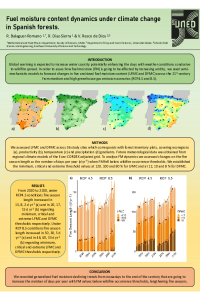
Monitoring live and dead fuels moisture content (LFMC and DFMC) dynamics plays a crucial role in wildfire management and prevention actions. In this study we estimate LFMC and DFMC across the 21st century, considering the meteorological conditions derived from medium and high greenhouse gas emission scenarios (RCP 4.5 and 8.5) by selecting a representative subset of global and regional climate models combination. A stable atmospheric CO2 concentration was also considered to assess possible CO2 mitigation effects. We applied semi-mechanistic models to infer moisture content dynamics across 36 study sites located in peninsular Spain, which corresponds with monospecific stands of twelve tree species. Overall, our results indicate that both, live and dead fuels moisture content dynamics, are going to experience generalized declining trends in the coming decades. Furthermore, increases in the number of days per year when fuels moisture content falls below wildfire occurrence thresholds is going to extend fire seasons lengths. Besides we observe a significative CO2 mitigation effect, is not enough to offset LFMC declining trends induced by climate change. Finally, results suggest that, in ecosystems where plant biomass is abundant enough to sustain a fire, moisture content of live fuels is going to be the main limiting factor for future large wildfire occurrence.
Keywords
Climate Change
Wildfire
Modelling
Moisture Content
Fire Season
Phyrophysiology.
Manuscript
062546.pdf
Poster
Poster_Balaguer-Romano_2022-1.pdf
Calculation of the annual permissible rate of forest burnability in the Russian Federation.
Shading effects needle xylem traits and leaf gas exchange parameters in Scots pine