Event submissions
EventsThe 3rd International Electronic Conference on Forests — Exploring New Discoveries and New Directions in Forests
Published

This submission belongs to the session S2. Forest Ecophysiology and Genetics of the event The 3rd International Electronic Conference on Forests — Exploring New Discoveries and New Directions in Forests
Published date
31 Oct, 2022
Academic Editor
'%3e%3cpath%20d='M12.6657%2010.9104C12.4185%2010.325%2012.0599%209.79327%2011.6097%209.34482C11.1609%208.89508%2010.6293%208.5365%2010.0442%208.28888C10.0389%208.28626%2010.0337%208.28495%2010.0285%208.28233C10.8446%207.69279%2011.3752%206.73249%2011.3752%205.64904C11.3752%203.8542%209.92103%202.39999%208.1262%202.39999C6.33136%202.39999%204.87715%203.8542%204.87715%205.64904C4.87715%206.73249%205.40774%207.69279%206.22393%208.28364C6.21869%208.28626%206.21345%208.28757%206.20821%208.29019C5.62129%208.5378%205.09463%208.89284%204.64265%209.34613C4.1929%209.79493%203.83432%2010.3266%203.58671%2010.9117C3.34345%2011.4845%203.21226%2012.0987%203.20023%2012.7209C3.19988%2012.7349%203.20233%2012.7488%203.20744%2012.7619C3.21255%2012.7749%203.22022%2012.7867%203.22998%2012.7968C3.23975%2012.8068%203.25142%2012.8147%203.26431%2012.8202C3.2772%2012.8256%203.29105%2012.8284%203.30504%2012.8284H4.09109C4.14874%2012.8284%204.19459%2012.7825%204.1959%2012.7262C4.2221%2011.7148%204.62823%2010.7676%205.34617%2010.0497C6.08899%209.30683%207.0755%208.89808%208.1262%208.89808C9.17689%208.89808%2010.1634%209.30683%2010.9062%2010.0497C11.6242%2010.7676%2012.0303%2011.7148%2012.0565%2012.7262C12.0578%2012.7838%2012.1037%2012.8284%2012.1613%2012.8284H12.9474C12.9613%2012.8284%2012.9752%2012.8256%2012.9881%2012.8202C13.001%2012.8147%2013.0126%2012.8068%2013.0224%2012.7968C13.0322%2012.7867%2013.0398%2012.7749%2013.0449%2012.7619C13.0501%2012.7488%2013.0525%2012.7349%2013.0522%2012.7209C13.0391%2012.0947%2012.9094%2011.4855%2012.6657%2010.9104ZM8.1262%207.9024C7.52486%207.9024%206.9589%207.6679%206.53312%207.24211C6.10733%206.81633%205.87283%206.25037%205.87283%205.64904C5.87283%205.0477%206.10733%204.48174%206.53312%204.05596C6.9589%203.63018%207.52486%203.39567%208.1262%203.39567C8.72753%203.39567%209.29349%203.63018%209.71927%204.05596C10.1451%204.48174%2010.3796%205.0477%2010.3796%205.64904C10.3796%206.25037%2010.1451%206.81633%209.71927%207.24211C9.29349%207.6679%208.72753%207.9024%208.1262%207.9024Z'%20fill='%235D1EE1'/%3e%3c/g%3e%3c/svg%3e) Rodolfo Picchio
Rodolfo PicchioCitation
Filippos A. Aravanopoulos, Despina-Eleni Politi, Maria-Irini Antoniadou, Nikolaos Tourvas, A study on the diversity of natural Arbutus unedo Hellenic populations, in Proceedings of The 3rd International Electronic Conference on Forests — Exploring New Discoveries and New Directions in Forests, 15 October–31 October 2022, MDPI: Basel, Switzerland, doi: 10.3390/IECF2022-13128
Share
Email
Facebook
Twitter
LinkedIn
A study on the diversity of natural Arbutus unedo Hellenic populations

Filippos A. Aravanopoulos 1,2
'%3e%3cpath%20d='M12.6647%2010.9104C12.4176%2010.325%2012.0589%209.7933%2011.6088%209.34485C11.16%208.89511%2010.6283%208.53653%2010.0432%208.28891C10.038%208.28629%2010.0327%208.28498%2010.0275%208.28236C10.8437%207.69282%2011.3743%206.73252%2011.3743%205.64907C11.3743%203.85423%209.92005%202.40002%208.12522%202.40002C6.33038%202.40002%204.87618%203.85423%204.87618%205.64907C4.87618%206.73252%205.40677%207.69282%206.22296%208.28367C6.21772%208.28629%206.21248%208.2876%206.20724%208.29022C5.62031%208.53783%205.09365%208.89287%204.64167%209.34616C4.19192%209.79496%203.83334%2010.3266%203.58573%2010.9117C3.34247%2011.4846%203.21128%2012.0987%203.19925%2012.721C3.1989%2012.735%203.20135%2012.7489%203.20646%2012.7619C3.21157%2012.7749%203.21924%2012.7868%203.22901%2012.7968C3.23877%2012.8068%203.25045%2012.8148%203.26334%2012.8202C3.27623%2012.8256%203.29007%2012.8284%203.30406%2012.8284H4.09012C4.14776%2012.8284%204.19362%2012.7825%204.19493%2012.7262C4.22113%2011.7148%204.62726%2010.7676%205.34519%2010.0497C6.08802%209.30686%207.07452%208.89811%208.12522%208.89811C9.17592%208.89811%2010.1624%209.30686%2010.9052%2010.0497C11.6232%2010.7676%2012.0293%2011.7148%2012.0555%2012.7262C12.0568%2012.7839%2012.1027%2012.8284%2012.1603%2012.8284H12.9464C12.9604%2012.8284%2012.9742%2012.8256%2012.9871%2012.8202C13%2012.8148%2013.0117%2012.8068%2013.0214%2012.7968C13.0312%2012.7868%2013.0389%2012.7749%2013.044%2012.7619C13.0491%2012.7489%2013.0515%2012.735%2013.0512%2012.721C13.0381%2012.0947%2012.9084%2011.4856%2012.6647%2010.9104ZM8.12522%207.90243C7.52388%207.90243%206.95792%207.66793%206.53214%207.24215C6.10636%206.81636%205.87185%206.2504%205.87185%205.64907C5.87185%205.04773%206.10636%204.48177%206.53214%204.05599C6.95792%203.63021%207.52388%203.3957%208.12522%203.3957C8.72655%203.3957%209.29252%203.63021%209.7183%204.05599C10.1441%204.48177%2010.3786%205.04773%2010.3786%205.64907C10.3786%206.2504%2010.1441%206.81636%209.7183%207.24215C9.29252%207.66793%208.72655%207.90243%208.12522%207.90243Z'%20fill='%235D1EE1'/%3e%3c/g%3e%3c/svg%3e)
Despina-Eleni Politi 3
Maria-Irini Antoniadou 3
Nikolaos Tourvas 1
1. Laboratory of Forest Genetics, Faculty of Agriculture, Forestry and Natural Environment, Aristotle University of Thessaloniki, Greece
2. Hellenic Agricultural Academy, Athens, Greece
3. Laboratory of Forest Genetics, Faculty of Agriculture, Forestry and Natural Environment, Aristotle University of Thessaloniki, Thessaloniki Greece
Abstract
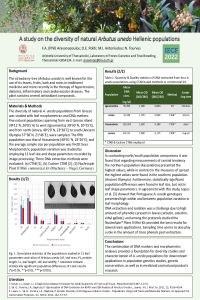
The strawberry tree (Arbutus unedo) is well known for the use of its leaves, fruits, bark and roots in traditional medicine and more recently in the therapy of hypertension, diabetes, inflammatory and cardiovascular diseases. The plant contains several antioxidant compounds. The diversity of natural A. unedo populations from Greece is studied with leaf morphometrics and DNA markers. Five natural populations spanning from east (Lesvos island 39o12΄N, 26o05΄A) to west (Igoumenitsa 39o30΄N, 20o15΄E), and from north (Arnea, 40o29΄N, 23o38΄E) to south (Ancient Olympia 37ο38΄Ν, 21ο46΄Ε), were sampled. The fifth population was that of Kassandreia (40o01΄N, 23o26΄E), and the average sample size per population was N=20 trees. DNA extraction and isolation was a challenge due to high amounts of phenolics present in leaves (arbutin, catechin, ethyl gallate), and among many protocols studied the NucleoSpin® Plant II Mini Kit provided the best results for downstream applications. Morphometric population variation was studied by employing 11 leaf size and shape parameters recorded by image processing and analysing software. In contrasting north/south population comparisons it was found that regarding measurements of central tendency the northern population (Kassandreia) presented the highest values, while in contrast in the measures of spread the highest values were found in the southern population (Ancient Olympia). Furthermore, statistically significant population differences were found in leaf size, but not in leaf shape parameters. The combination of DNA markers and morphometric analyses provides a foundation for diversity studies and characterization of A. unedo populations for downstream applications in population genetics studies, genetic conservation, as well as in medicinal and natural products research.
Keywords
Strawberry tree
DNA quality
population variation
leaf morphometrics
Manuscript
603404.pdf
Poster
Aravanopoulos et al A study on the diversity of Arbutus.pdf
Forest genetic monitoring in a biodiveristy hotspot
Genetic diversity of silver fir (Abies alba) and European beech (Fagus sylvatica) populations from the south-eastern limits of their natural distribution