Event submissions
Published
This submission belongs to the session S3. General of the event 8th International Electronic Conference on Medicinal Chemistry
Published date
01 Nov, 2022
Academic Editor
'%3e%3cpath%20d='M12.6657%2010.9104C12.4185%2010.325%2012.0599%209.79327%2011.6097%209.34482C11.1609%208.89508%2010.6293%208.5365%2010.0442%208.28888C10.0389%208.28626%2010.0337%208.28495%2010.0285%208.28233C10.8446%207.69279%2011.3752%206.73249%2011.3752%205.64904C11.3752%203.8542%209.92103%202.39999%208.1262%202.39999C6.33136%202.39999%204.87715%203.8542%204.87715%205.64904C4.87715%206.73249%205.40774%207.69279%206.22393%208.28364C6.21869%208.28626%206.21345%208.28757%206.20821%208.29019C5.62129%208.5378%205.09463%208.89284%204.64265%209.34613C4.1929%209.79493%203.83432%2010.3266%203.58671%2010.9117C3.34345%2011.4845%203.21226%2012.0987%203.20023%2012.7209C3.19988%2012.7349%203.20233%2012.7488%203.20744%2012.7619C3.21255%2012.7749%203.22022%2012.7867%203.22998%2012.7968C3.23975%2012.8068%203.25142%2012.8147%203.26431%2012.8202C3.2772%2012.8256%203.29105%2012.8284%203.30504%2012.8284H4.09109C4.14874%2012.8284%204.19459%2012.7825%204.1959%2012.7262C4.2221%2011.7148%204.62823%2010.7676%205.34617%2010.0497C6.08899%209.30683%207.0755%208.89808%208.1262%208.89808C9.17689%208.89808%2010.1634%209.30683%2010.9062%2010.0497C11.6242%2010.7676%2012.0303%2011.7148%2012.0565%2012.7262C12.0578%2012.7838%2012.1037%2012.8284%2012.1613%2012.8284H12.9474C12.9613%2012.8284%2012.9752%2012.8256%2012.9881%2012.8202C13.001%2012.8147%2013.0126%2012.8068%2013.0224%2012.7968C13.0322%2012.7867%2013.0398%2012.7749%2013.0449%2012.7619C13.0501%2012.7488%2013.0525%2012.7349%2013.0522%2012.7209C13.0391%2012.0947%2012.9094%2011.4855%2012.6657%2010.9104ZM8.1262%207.9024C7.52486%207.9024%206.9589%207.6679%206.53312%207.24211C6.10733%206.81633%205.87283%206.25037%205.87283%205.64904C5.87283%205.0477%206.10733%204.48174%206.53312%204.05596C6.9589%203.63018%207.52486%203.39567%208.1262%203.39567C8.72753%203.39567%209.29349%203.63018%209.71927%204.05596C10.1451%204.48174%2010.3796%205.0477%2010.3796%205.64904C10.3796%206.25037%2010.1451%206.81633%209.71927%207.24211C9.29349%207.6679%208.72753%207.9024%208.1262%207.9024Z'%20fill='%235D1EE1'/%3e%3c/g%3e%3c/svg%3e) Maria Emília Sousa
Maria Emília SousaCitation
Fatima NAS, Nadia AISSAOUI, Amina Nour Elhouda SAIBI, Nihel KLOUCHE KHELIL, Halotolerant Bacillus spp. strains isolated from the Great Sebkha of Oran (Algeria): a source of antimicrobial secondary metabolites, in Proceedings of 8th International Electronic Conference on Medicinal Chemistry, 1 November–30 November 2022, MDPI: Basel, Switzerland
Share
Email
Facebook
Twitter
LinkedIn
Halotolerant Bacillus spp. strains isolated from the Great Sebkha of Oran (Algeria): a source of antimicrobial secondary metabolites
'%3e%3cpath%20d='M12.6647%2010.9104C12.4176%2010.325%2012.0589%209.7933%2011.6088%209.34485C11.16%208.89511%2010.6283%208.53653%2010.0432%208.28891C10.038%208.28629%2010.0327%208.28498%2010.0275%208.28236C10.8437%207.69282%2011.3743%206.73252%2011.3743%205.64907C11.3743%203.85423%209.92005%202.40002%208.12522%202.40002C6.33038%202.40002%204.87618%203.85423%204.87618%205.64907C4.87618%206.73252%205.40677%207.69282%206.22296%208.28367C6.21772%208.28629%206.21248%208.2876%206.20724%208.29022C5.62031%208.53783%205.09365%208.89287%204.64167%209.34616C4.19192%209.79496%203.83334%2010.3266%203.58573%2010.9117C3.34247%2011.4846%203.21128%2012.0987%203.19925%2012.721C3.1989%2012.735%203.20135%2012.7489%203.20646%2012.7619C3.21157%2012.7749%203.21924%2012.7868%203.22901%2012.7968C3.23877%2012.8068%203.25045%2012.8148%203.26334%2012.8202C3.27623%2012.8256%203.29007%2012.8284%203.30406%2012.8284H4.09012C4.14776%2012.8284%204.19362%2012.7825%204.19493%2012.7262C4.22113%2011.7148%204.62726%2010.7676%205.34519%2010.0497C6.08802%209.30686%207.07452%208.89811%208.12522%208.89811C9.17592%208.89811%2010.1624%209.30686%2010.9052%2010.0497C11.6232%2010.7676%2012.0293%2011.7148%2012.0555%2012.7262C12.0568%2012.7839%2012.1027%2012.8284%2012.1603%2012.8284H12.9464C12.9604%2012.8284%2012.9742%2012.8256%2012.9871%2012.8202C13%2012.8148%2013.0117%2012.8068%2013.0214%2012.7968C13.0312%2012.7868%2013.0389%2012.7749%2013.044%2012.7619C13.0491%2012.7489%2013.0515%2012.735%2013.0512%2012.721C13.0381%2012.0947%2012.9084%2011.4856%2012.6647%2010.9104ZM8.12522%207.90243C7.52388%207.90243%206.95792%207.66793%206.53214%207.24215C6.10636%206.81636%205.87185%206.2504%205.87185%205.64907C5.87185%205.04773%206.10636%204.48177%206.53214%204.05599C6.95792%203.63021%207.52388%203.3957%208.12522%203.3957C8.72655%203.3957%209.29252%203.63021%209.7183%204.05599C10.1441%204.48177%2010.3786%205.04773%2010.3786%205.64907C10.3786%206.2504%2010.1441%206.81636%209.7183%207.24215C9.29252%207.66793%208.72655%207.90243%208.12522%207.90243Z'%20fill='%235D1EE1'/%3e%3c/g%3e%3c/svg%3e)
Fatima NAS 1

Nadia AISSAOUI 2
Amina Nour Elhouda SAIBI 3
Nihel KLOUCHE KHELIL 4,5
1. Laboratory of Applied Microbiology in Food, Biomedical and Environment (LAMAABE), Faculty of Nature and Life, Earth and Universe Sciences, Department of Biology, Aboubekr Belkaïd University of Tlemcen, Tlemcen, Algeria
2. Laboratory for the Sustainable Management of Natural Resources in Arid and Semi Arid Areas, University center Salhi Ahmed Naâma, Naâma, Algeria
3. Laboratory of Applied Microbiology in Food, Biomedical and Environment (LAMAABE), Department of Biology, Faculty of Nature and Life,
Earth and Universe Sciences, Abou Bekr Belkaïd University of Tlemcen, Tlemcen, Algeria
4. Laboratory of Applied Microbiology in Food, Biomedical and Environment (LAMAABE), Department of Biology, Faculty of Nature and Life, Earth and Universe Sciences, Abou Bekr Belkaïd University of Tlemcen, Tlemcen, Algeria
5. Laboratory of Experimental Surgery, Dental Surgery Department, Medical Faculty, Abou bekr Belkaïd University of Tlemcen, Tlemcen, Algeria
Abstract
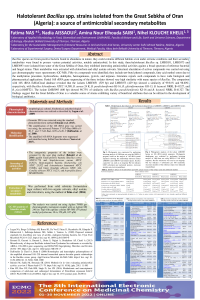
Bacillus species are Gram-positive bacteria found in abundance in nature, they could colonize different habitats even under extreme conditions and their secondary metabolites were found to possess various potential activities, notably antimicrobial. In this study, three-halotolerant Bacillus sp. LMB3051, LMB3073 and LMB3093 were isolated from water of the Great Sebkha of Oran, they exhibited interesting antimicrobial activities against a broad spectrum of reference bacterial and fungal strains. Their metabolites were extracted with chloroform and ethyl acetate solvents. Structural elucidation of actives compounds was carried out using gas chromatography–mass spectrometry (GC-MS). Fifty-six compounds were identified; they include tert-butyl phenol compounds, fatty acid methyl esters due to the methylation procedure, hydrocarbons, aldehydes, benzoquinones, pyrrols, and terpenes. Literature reports such compounds to have wide biological and pharmaceutical applications. Partial 16S rRNA gene sequencing of the three isolates showed very high similarity with many species of Bacillus. The comparison with 16S rRNA EzBioCloud database revealed that the isolates LMB3051 (529 bp) and LMB3073 (429 bp) showed a similarity of 99.81% and 98.60%, respectively, with Bacillus licheniformis ATCC 14,580, B. aureus 24 K, B. paralicheniformis KJ-16, B. glicinifermentans GO-13, B. haynesii NRRL B-41327, and B. piscis16MFT21. The isolate LMB3093 (400 bp) showed 98.75% of similarity with Bacillus paralicheniformis KJ-16 and B. haynesii NRRL B-41327. The findings suggest that the Great Sebkha of Oran is a valuable source of strains exhibiting variety of beneficial attributes that can be utilized in the development of biological antibiotics.
Keywords
Halotolerant bacteria
Secondary metabolite
Bacillus genus
Antimicrobial activity.
Poster
sciforum-063177.pdf
Hepatopathological assessment of rats exposed to alkaloids of Vitex doniana
N-benzyl derivatives of 2-amino-8-methoxy-4H-chromene-3-carbonitrile: synthesis via reductive amination, in silico ADME profiling & exploration of their effects against protein kinases.