Event submissions
Published
 10.3390/ECMC2022-13151 (registering DOI)
 This submission belongs to the session S4. Small molecules as drug candidates of the event 8th International Electronic Conference on Medicinal Chemistry
Published date
01 Nov, 2022
Academic Editor
'%3e%3cpath%20d='M12.6657%2010.9104C12.4185%2010.325%2012.0599%209.79327%2011.6097%209.34482C11.1609%208.89508%2010.6293%208.5365%2010.0442%208.28888C10.0389%208.28626%2010.0337%208.28495%2010.0285%208.28233C10.8446%207.69279%2011.3752%206.73249%2011.3752%205.64904C11.3752%203.8542%209.92103%202.39999%208.1262%202.39999C6.33136%202.39999%204.87715%203.8542%204.87715%205.64904C4.87715%206.73249%205.40774%207.69279%206.22393%208.28364C6.21869%208.28626%206.21345%208.28757%206.20821%208.29019C5.62129%208.5378%205.09463%208.89284%204.64265%209.34613C4.1929%209.79493%203.83432%2010.3266%203.58671%2010.9117C3.34345%2011.4845%203.21226%2012.0987%203.20023%2012.7209C3.19988%2012.7349%203.20233%2012.7488%203.20744%2012.7619C3.21255%2012.7749%203.22022%2012.7867%203.22998%2012.7968C3.23975%2012.8068%203.25142%2012.8147%203.26431%2012.8202C3.2772%2012.8256%203.29105%2012.8284%203.30504%2012.8284H4.09109C4.14874%2012.8284%204.19459%2012.7825%204.1959%2012.7262C4.2221%2011.7148%204.62823%2010.7676%205.34617%2010.0497C6.08899%209.30683%207.0755%208.89808%208.1262%208.89808C9.17689%208.89808%2010.1634%209.30683%2010.9062%2010.0497C11.6242%2010.7676%2012.0303%2011.7148%2012.0565%2012.7262C12.0578%2012.7838%2012.1037%2012.8284%2012.1613%2012.8284H12.9474C12.9613%2012.8284%2012.9752%2012.8256%2012.9881%2012.8202C13.001%2012.8147%2013.0126%2012.8068%2013.0224%2012.7968C13.0322%2012.7867%2013.0398%2012.7749%2013.0449%2012.7619C13.0501%2012.7488%2013.0525%2012.7349%2013.0522%2012.7209C13.0391%2012.0947%2012.9094%2011.4855%2012.6657%2010.9104ZM8.1262%207.9024C7.52486%207.9024%206.9589%207.6679%206.53312%207.24211C6.10733%206.81633%205.87283%206.25037%205.87283%205.64904C5.87283%205.0477%206.10733%204.48174%206.53312%204.05596C6.9589%203.63018%207.52486%203.39567%208.1262%203.39567C8.72753%203.39567%209.29349%203.63018%209.71927%204.05596C10.1451%204.48174%2010.3796%205.0477%2010.3796%205.64904C10.3796%206.25037%2010.1451%206.81633%209.71927%207.24211C9.29349%207.6679%208.72753%207.9024%208.1262%207.9024Z'%20fill='%235D1EE1'/%3e%3c/g%3e%3c/svg%3e) Maria Emília Sousa
Maria Emília SousaCitation
Ki Kwang Oh, Uncovering of bioactives and mechanisms of garlic (Allium sativum L.) husk for the amelioration of type 2 diabetes mellitus via network pharmacology, in Proceedings of 8th International Electronic Conference on Medicinal Chemistry, 1 November–30 November 2022, MDPI: Basel, Switzerland, doi: 10.3390/ECMC2022-13151
Share
Email
Facebook
Twitter
LinkedIn
Uncovering of bioactives and mechanisms of garlic (Allium sativum L.) husk for the amelioration of type 2 diabetes mellitus via network pharmacology

Ki Kwang Oh 1
1. Department of Bio-Health Convergence, College of Biomedical Science, Kangwon National University, Chuncheon, 24341, Korea
Abstract
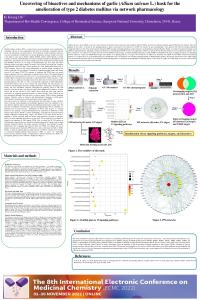
Allium sativum L. husk (ASLH) extracts have been used as a reliever against type 2 diabetes mellitus (T2DM). Currently, its significant mechanisms against T2DM remain unclear. Thus, the aim of this study is to investigate the characteristics of its key signaling pathways, targets, and compounds. The compounds in ASLH were analyzed by gas chromatography-mass spectrum (GC–MS) and confirmed drug-like compounds (DLCs) in silico. Then, protein-protein interaction (PPI) networks and signaling pathways, targets, and compounds are constructed, and visualized by using RStudio. Finally, we performed a molecular docking test (MDT) to identify the key mechanism(s), target(s), and compound(s) of ASLH on T2DM. A total of 23 compounds in ASLH were identified by GC–MS, and all compounds were accepted by Lipinski’s rule. The 23 compounds were associated with 521 targets and retrieved 4,736 T2DM-related targets by Online Mendelian Inheritance in Man (OMIM) and DisGeNET. The final overlapping 87 targets were obtained between compounds–targets and T2DM-related targets. The number of 13 signaling pathways, 33 targets, and 19 compounds of ASLH were associated with T2DM. In parallel, MDT revealed four potential compounds: (1) 9-hexacosene, (2) 2-(([2-ethylhexyl]oxy)carbonyl)benzoic acid, (3) clionasterol, (4) 4-methyl-2-phenylpyrimidine on PPAR signaling pathway. Overall, the four compounds from ASLH might show an anti-T2DM synergistic effect by activating the PPAR signaling pathway or inactivating the phospholipase D signaling pathway. In this study, we suggest that ASLH might be considered a health-promising resource from both nutraceutical and pharmaceutical perspectives.
Keywords
Allium sativum L. husk
network pharmacology
phospholipase D signaling pathway
PPAR signaling pathway
type 2 diabetes mellitus
Poster
sciforum-065017.pdf
Green Synthesis of Silver Nanoparticles Using A. eupatoria extract in certain conditions
Hepatoprotective effect of the N-alkylated isobornylamine against CCl4-induced chronic liver damage in mice