Event submissions
Published

This submission belongs to the session S2. Invited lectures of the event 8th International Electronic Conference on Medicinal Chemistry
Published date
01 Nov, 2022
Academic Editor
'%3e%3cpath%20d='M12.6657%2010.9104C12.4185%2010.325%2012.0599%209.79327%2011.6097%209.34482C11.1609%208.89508%2010.6293%208.5365%2010.0442%208.28888C10.0389%208.28626%2010.0337%208.28495%2010.0285%208.28233C10.8446%207.69279%2011.3752%206.73249%2011.3752%205.64904C11.3752%203.8542%209.92103%202.39999%208.1262%202.39999C6.33136%202.39999%204.87715%203.8542%204.87715%205.64904C4.87715%206.73249%205.40774%207.69279%206.22393%208.28364C6.21869%208.28626%206.21345%208.28757%206.20821%208.29019C5.62129%208.5378%205.09463%208.89284%204.64265%209.34613C4.1929%209.79493%203.83432%2010.3266%203.58671%2010.9117C3.34345%2011.4845%203.21226%2012.0987%203.20023%2012.7209C3.19988%2012.7349%203.20233%2012.7488%203.20744%2012.7619C3.21255%2012.7749%203.22022%2012.7867%203.22998%2012.7968C3.23975%2012.8068%203.25142%2012.8147%203.26431%2012.8202C3.2772%2012.8256%203.29105%2012.8284%203.30504%2012.8284H4.09109C4.14874%2012.8284%204.19459%2012.7825%204.1959%2012.7262C4.2221%2011.7148%204.62823%2010.7676%205.34617%2010.0497C6.08899%209.30683%207.0755%208.89808%208.1262%208.89808C9.17689%208.89808%2010.1634%209.30683%2010.9062%2010.0497C11.6242%2010.7676%2012.0303%2011.7148%2012.0565%2012.7262C12.0578%2012.7838%2012.1037%2012.8284%2012.1613%2012.8284H12.9474C12.9613%2012.8284%2012.9752%2012.8256%2012.9881%2012.8202C13.001%2012.8147%2013.0126%2012.8068%2013.0224%2012.7968C13.0322%2012.7867%2013.0398%2012.7749%2013.0449%2012.7619C13.0501%2012.7488%2013.0525%2012.7349%2013.0522%2012.7209C13.0391%2012.0947%2012.9094%2011.4855%2012.6657%2010.9104ZM8.1262%207.9024C7.52486%207.9024%206.9589%207.6679%206.53312%207.24211C6.10733%206.81633%205.87283%206.25037%205.87283%205.64904C5.87283%205.0477%206.10733%204.48174%206.53312%204.05596C6.9589%203.63018%207.52486%203.39567%208.1262%203.39567C8.72753%203.39567%209.29349%203.63018%209.71927%204.05596C10.1451%204.48174%2010.3796%205.0477%2010.3796%205.64904C10.3796%206.25037%2010.1451%206.81633%209.71927%207.24211C9.29349%207.6679%208.72753%207.9024%208.1262%207.9024Z'%20fill='%235D1EE1'/%3e%3c/g%3e%3c/svg%3e) Maria Emília Sousa
Maria Emília SousaCitation
Vera Marisa Costa, In the heart of cardio-oncology: the targets and biomarkers of anticancer drugs cardiotoxicity, in Proceedings of 8th International Electronic Conference on Medicinal Chemistry, 1 November–30 November 2022, MDPI: Basel, Switzerland, doi: 10.3390/ECMC2022-13157
Share
Email
Facebook
Twitter
LinkedIn
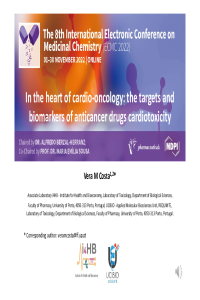
In the heart of cardio-oncology: the targets and biomarkers of anticancer drugs cardiotoxicity

Vera Marisa Costa 1,2
1. Associate Laboratory i4HB - Institute for Health and Bioeconomy, Laboratory of Toxicology, Department of Biological Sciences, Faculty of Pharmacy, University of Porto, 4050-313 Porto, Portugal
2. UCIBIO - Applied Molecular Biosciences Unit, REQUIMTE, Laboratory of Toxicology, Department of Biological Sciences, Faculty of Pharmacy, University of Porto, 4050‐313 Porto, Portugal
Abstract
The cardiotoxicity of anticancer drugs is the second leading cause of death in cancer patients. Among other adverse effects, left ventricular ejection fraction decrease or heart failure emerge after anticancer treatments comprising old or new targeted therapies. In the last few years, our group has been trying to unveil the cardiac adverse outcome pathways of classic chemotherapeutic agents, mainly focusing on two topoisomerase inhibitors, mitoxantrone and doxorubicin.
Mitoxantrone and doxorubicin both cause cumulative dose cardiotoxicity and were tested in in vitro and in pre-clinical models. Results obtained in mice and rats, following a clinical relevant dosing scheme, were mimicked in vitro and demonstrated that those drugs change cellular redox homeostasis and promote inflammation, although in different biomarkers. Moreover, autophagy and energetic pathways were affected, the first mainly after mitoxantrone treatments and the latter when doxorubicin was used. Thus, distinct cardiac fingerprints for these two drugs exist.
In conclusion, although their clinical cardiac effects are similar in humans, mitoxantrone and doxorubicin have different initiating cardiotoxic events. These were revealed taking into account the use of proper experimental models, clinical relevant concentrations and Omics methods. These data are of the essence to promote drug specific cardioprotective measures in the future, for patients treated with these drugs.
VMC acknowledges funding of Fundação para a Ciência e Tecnologia (FCT), IP, under Norma Transitória DL57/2016/CP1334/CT0006. This work is funded by project UIDP/04378/2020 of UCIBIO and project LA/P/0140/2020 of i4HB.
Keywords
cardio-oncology
mitoxantrone
doxorubicin
adverse outcome pathways
Poster
sciforum-066932.pdf
Selected biomarkers of oxidative stress in ischemic stroke.
Resveratrol-loaded glycosylated liposomes for targeting bacteria