Event submissions
Published

This submission belongs to the session S2. Invited lectures of the event 8th International Electronic Conference on Medicinal Chemistry
Published date
01 Nov, 2022
Academic Editor
'%3e%3cpath%20d='M12.6657%2010.9104C12.4185%2010.325%2012.0599%209.79327%2011.6097%209.34482C11.1609%208.89508%2010.6293%208.5365%2010.0442%208.28888C10.0389%208.28626%2010.0337%208.28495%2010.0285%208.28233C10.8446%207.69279%2011.3752%206.73249%2011.3752%205.64904C11.3752%203.8542%209.92103%202.39999%208.1262%202.39999C6.33136%202.39999%204.87715%203.8542%204.87715%205.64904C4.87715%206.73249%205.40774%207.69279%206.22393%208.28364C6.21869%208.28626%206.21345%208.28757%206.20821%208.29019C5.62129%208.5378%205.09463%208.89284%204.64265%209.34613C4.1929%209.79493%203.83432%2010.3266%203.58671%2010.9117C3.34345%2011.4845%203.21226%2012.0987%203.20023%2012.7209C3.19988%2012.7349%203.20233%2012.7488%203.20744%2012.7619C3.21255%2012.7749%203.22022%2012.7867%203.22998%2012.7968C3.23975%2012.8068%203.25142%2012.8147%203.26431%2012.8202C3.2772%2012.8256%203.29105%2012.8284%203.30504%2012.8284H4.09109C4.14874%2012.8284%204.19459%2012.7825%204.1959%2012.7262C4.2221%2011.7148%204.62823%2010.7676%205.34617%2010.0497C6.08899%209.30683%207.0755%208.89808%208.1262%208.89808C9.17689%208.89808%2010.1634%209.30683%2010.9062%2010.0497C11.6242%2010.7676%2012.0303%2011.7148%2012.0565%2012.7262C12.0578%2012.7838%2012.1037%2012.8284%2012.1613%2012.8284H12.9474C12.9613%2012.8284%2012.9752%2012.8256%2012.9881%2012.8202C13.001%2012.8147%2013.0126%2012.8068%2013.0224%2012.7968C13.0322%2012.7867%2013.0398%2012.7749%2013.0449%2012.7619C13.0501%2012.7488%2013.0525%2012.7349%2013.0522%2012.7209C13.0391%2012.0947%2012.9094%2011.4855%2012.6657%2010.9104ZM8.1262%207.9024C7.52486%207.9024%206.9589%207.6679%206.53312%207.24211C6.10733%206.81633%205.87283%206.25037%205.87283%205.64904C5.87283%205.0477%206.10733%204.48174%206.53312%204.05596C6.9589%203.63018%207.52486%203.39567%208.1262%203.39567C8.72753%203.39567%209.29349%203.63018%209.71927%204.05596C10.1451%204.48174%2010.3796%205.0477%2010.3796%205.64904C10.3796%206.25037%2010.1451%206.81633%209.71927%207.24211C9.29349%207.6679%208.72753%207.9024%208.1262%207.9024Z'%20fill='%235D1EE1'/%3e%3c/g%3e%3c/svg%3e) Alfredo Berzal-Herranz
Alfredo Berzal-HerranzCitation
Cecilia Bombelli, Livia Pagano, Stefano Aiello, Foteini Gkartziou, Beatrice Simonis, Francesca Ceccacci, Simona Sennato, Alessia Ciogli, Francesca Bugli, Cecilia Martini, Maurizio Sanguinetti, Riccardo Torelli, Spyridon Mourtas, Iris Spiliopoulou, Sophia G Antimisiaris, Giovanna Mancini, Resveratrol-loaded glycosylated liposomes for targeting bacteria, in Proceedings of 8th International Electronic Conference on Medicinal Chemistry, 1 November–30 November 2022, MDPI: Basel, Switzerland, doi: 10.3390/ECMC2022-13158
Share
Email
Facebook
Twitter
LinkedIn
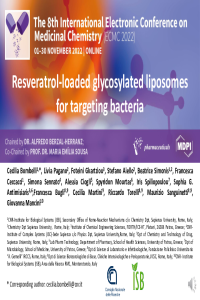
Resveratrol-loaded glycosylated liposomes for targeting bacteria

Cecilia Bombelli 1
'%3e%3cpath%20d='M12.6647%2010.9104C12.4176%2010.325%2012.0589%209.7933%2011.6088%209.34485C11.16%208.89511%2010.6283%208.53653%2010.0432%208.28891C10.038%208.28629%2010.0327%208.28498%2010.0275%208.28236C10.8437%207.69282%2011.3743%206.73252%2011.3743%205.64907C11.3743%203.85423%209.92005%202.40002%208.12522%202.40002C6.33038%202.40002%204.87618%203.85423%204.87618%205.64907C4.87618%206.73252%205.40677%207.69282%206.22296%208.28367C6.21772%208.28629%206.21248%208.2876%206.20724%208.29022C5.62031%208.53783%205.09365%208.89287%204.64167%209.34616C4.19192%209.79496%203.83334%2010.3266%203.58573%2010.9117C3.34247%2011.4846%203.21128%2012.0987%203.19925%2012.721C3.1989%2012.735%203.20135%2012.7489%203.20646%2012.7619C3.21157%2012.7749%203.21924%2012.7868%203.22901%2012.7968C3.23877%2012.8068%203.25045%2012.8148%203.26334%2012.8202C3.27623%2012.8256%203.29007%2012.8284%203.30406%2012.8284H4.09012C4.14776%2012.8284%204.19362%2012.7825%204.19493%2012.7262C4.22113%2011.7148%204.62726%2010.7676%205.34519%2010.0497C6.08802%209.30686%207.07452%208.89811%208.12522%208.89811C9.17592%208.89811%2010.1624%209.30686%2010.9052%2010.0497C11.6232%2010.7676%2012.0293%2011.7148%2012.0555%2012.7262C12.0568%2012.7839%2012.1027%2012.8284%2012.1603%2012.8284H12.9464C12.9604%2012.8284%2012.9742%2012.8256%2012.9871%2012.8202C13%2012.8148%2013.0117%2012.8068%2013.0214%2012.7968C13.0312%2012.7868%2013.0389%2012.7749%2013.044%2012.7619C13.0491%2012.7489%2013.0515%2012.735%2013.0512%2012.721C13.0381%2012.0947%2012.9084%2011.4856%2012.6647%2010.9104ZM8.12522%207.90243C7.52388%207.90243%206.95792%207.66793%206.53214%207.24215C6.10636%206.81636%205.87185%206.2504%205.87185%205.64907C5.87185%205.04773%206.10636%204.48177%206.53214%204.05599C6.95792%203.63021%207.52388%203.3957%208.12522%203.3957C8.72655%203.3957%209.29252%203.63021%209.7183%204.05599C10.1441%204.48177%2010.3786%205.04773%2010.3786%205.64907C10.3786%206.2504%2010.1441%206.81636%209.7183%207.24215C9.29252%207.66793%208.72655%207.90243%208.12522%207.90243Z'%20fill='%235D1EE1'/%3e%3c/g%3e%3c/svg%3e)
Livia Pagano 2
Stefano Aiello 2
Foteini Gkartziou 3
Beatrice Simonis 1,2
Francesca Ceccacci 1
Simona Sennato 4

Alessia Ciogli 5
Francesca Bugli 6,7
Cecilia Martini 7

Maurizio Sanguinetti 6,7
Riccardo Torelli 6,7

Spyridon Mourtas 8
Iris Spiliopoulou 9

Sophia G Antimisiaris 3,8
Giovanna Mancini 10
1. CNR-Institute for Biological Systems (ISB) Secondary Office of Rome-Reaction Mechanisms c/o Department of Chemistry, Sapienza University, P.le A. Moro 5, Rome, Italy
2. Sapienza University, Department of Chemistry, P.Le A. Moro 5, Rome, Italy
3. Institute of Chemical Engineering Sciences, FORTH/ICE-HT, Platani, 26504 Patras, Greece
4. CNR-Institute of Complex Systems (ISC)- Sede Sapienza c/o Physics Department, Sapienza University, P.le A. Moro 5, Rome, Italy
5. Sapienza University, Department of Chemistry and Technology of Drug, P.le A. Moro 5, Rome, Italy
6. Dipartimento di Scienze di Laboratorio e Infettivologiche, Fondazione Policlinico Universitario “A. Gemelli” IRCCS, 00168, Rome, Italy
7. Dipartimento di Scienze Biotecnologiche di Base, Cliniche Intensivologiche e Perioperatorie, Università Cattolica del Sacro Cuore, Rome, Italy
8. Lab Pharm Technology, Department of Pharmacy, School of Health Sciences, University of Patras, 26504 Rio-Patras, Greece
9. Department of Microbiology, School of Medicine, University of Patras, Rio, 26504 Patras, Greece
10. CNR-Institute for Biological Systems (ISB), Area della Ricerca di Roma 1, Via Salaria Km 29,300, 00015 Monterotondo, Italy
Abstract
Biofilm-associated bacterial diseases are a major health problem due to the high antibiotic resistance of biofilm infections. In recent years, several methods, some of which relying on nanotechnology, have been developed to tackle this problem. The search for non-antibiotic strategies has renewed interest in natural molecules that exploit alternative bacterial-fighting mechanisms and, above all, do not induce resistance. In this context, we have developed two sets of cationic glycosylated liposomes for the targeted delivery of trans-resveratrol (RSV), a secondary plant metabolite with antimicrobial properties, to bacteria that express carbohydrate-specific proteins able to recognize monosaccharides, namely Staphylococcus epidermidis and Methicillin Resistant Staphylococcus Aureus (MRSA). Liposome physico-chemical properties (diameter, PDI, charge, RSV entrapment efficiency) were measured by DLS, electrophoretic mobility, and HPLC.
Liposomes used in the experiments on MRSA were composed of 1,2-dioleoyl-sn-glycero-3-phosphocholine, cholesterol (Chol) and glycoamphiphiles featuring a galactosyl, mannosyl or glucosyl moiety. The objective was to identify the best sugar moiety to target MRSA biofilm. Microbiological tests carried out to monitor the demolition effect of RSV-loaded liposome on MRSA mature biofilm showed that RSV-galactosylated liposomes are the most effective at a RSV concentration sixty times below the MIC.
Liposomes used in the experiments on S. epidermidis were formulated with 1,2-dipalmitoyl-sn-glycero-3-phosphocholine, Chol, and the glycoamphiphile featuring the glucose residue. The ability of RSV-loaded liposomes to inhibit the growth of a slime positive and a slime negative strain of S. epidermidis was evaluated. Glucosylated liposomes, non-toxic in itself, kill bacteria at concentration tenfold under the MIC of RSV.
Keywords
glycoliposomes
trans-Resveratrol
cationic liposomes
MRSA biofilm
S. epidermidis
galactosylamphiphile
glucosylamphiphile
mannosylamphiphile
Poster
sciforum-066928.pdf
In the heart of cardio-oncology: the targets and biomarkers of anticancer drugs cardiotoxicity
Phytochemical and pharmacological profile of four Malagasy medicinal plants used in different chronic diseases: strategies for the sustainable use of natural resources in the Malagasy health system