Event submissions
Published
 10.3390/ECMC2022-13161 (registering DOI)
 This submission belongs to the session S4. Small molecules as drug candidates of the event 8th International Electronic Conference on Medicinal Chemistry
Published date
01 Nov, 2022
Academic Editor
'%3e%3cpath%20d='M12.6657%2010.9104C12.4185%2010.325%2012.0599%209.79327%2011.6097%209.34482C11.1609%208.89508%2010.6293%208.5365%2010.0442%208.28888C10.0389%208.28626%2010.0337%208.28495%2010.0285%208.28233C10.8446%207.69279%2011.3752%206.73249%2011.3752%205.64904C11.3752%203.8542%209.92103%202.39999%208.1262%202.39999C6.33136%202.39999%204.87715%203.8542%204.87715%205.64904C4.87715%206.73249%205.40774%207.69279%206.22393%208.28364C6.21869%208.28626%206.21345%208.28757%206.20821%208.29019C5.62129%208.5378%205.09463%208.89284%204.64265%209.34613C4.1929%209.79493%203.83432%2010.3266%203.58671%2010.9117C3.34345%2011.4845%203.21226%2012.0987%203.20023%2012.7209C3.19988%2012.7349%203.20233%2012.7488%203.20744%2012.7619C3.21255%2012.7749%203.22022%2012.7867%203.22998%2012.7968C3.23975%2012.8068%203.25142%2012.8147%203.26431%2012.8202C3.2772%2012.8256%203.29105%2012.8284%203.30504%2012.8284H4.09109C4.14874%2012.8284%204.19459%2012.7825%204.1959%2012.7262C4.2221%2011.7148%204.62823%2010.7676%205.34617%2010.0497C6.08899%209.30683%207.0755%208.89808%208.1262%208.89808C9.17689%208.89808%2010.1634%209.30683%2010.9062%2010.0497C11.6242%2010.7676%2012.0303%2011.7148%2012.0565%2012.7262C12.0578%2012.7838%2012.1037%2012.8284%2012.1613%2012.8284H12.9474C12.9613%2012.8284%2012.9752%2012.8256%2012.9881%2012.8202C13.001%2012.8147%2013.0126%2012.8068%2013.0224%2012.7968C13.0322%2012.7867%2013.0398%2012.7749%2013.0449%2012.7619C13.0501%2012.7488%2013.0525%2012.7349%2013.0522%2012.7209C13.0391%2012.0947%2012.9094%2011.4855%2012.6657%2010.9104ZM8.1262%207.9024C7.52486%207.9024%206.9589%207.6679%206.53312%207.24211C6.10733%206.81633%205.87283%206.25037%205.87283%205.64904C5.87283%205.0477%206.10733%204.48174%206.53312%204.05596C6.9589%203.63018%207.52486%203.39567%208.1262%203.39567C8.72753%203.39567%209.29349%203.63018%209.71927%204.05596C10.1451%204.48174%2010.3796%205.0477%2010.3796%205.64904C10.3796%206.25037%2010.1451%206.81633%209.71927%207.24211C9.29349%207.6679%208.72753%207.9024%208.1262%207.9024Z'%20fill='%235D1EE1'/%3e%3c/g%3e%3c/svg%3e) Maria Emília Sousa
Maria Emília SousaCitation
Jean Guillon, Anita Cohen, Clotilde Boudot, Sarah Monic, Solène Savrimoutou, Stéphane Moreau, Sandra Albenque-Rubio, Alexandra Dassonville-Klimpt, Jean-Louis Mergny, Luisa Ronga, Mikel Bernabeu de Maria, Eric Largy, Valérie Gabelica, Serge Moukha, Pascale Dozolme, Patrice Agnamey, Catherine Mullié, Bertrand Courtioux, Pascal Sonnet, Design, synthesis, biophysical and antiprotozoal evaluation of new promising 2,9-bis[(substituted-aminomethyl)]-4,7-phenyl-1,10-phenanthroline derivatives by targeting G-quadruplex, in Proceedings of 8th International Electronic Conference on Medicinal Chemistry, 1 November–30 November 2022, MDPI: Basel, Switzerland, doi: 10.3390/ECMC2022-13161
Share
Email
Facebook
Twitter
LinkedIn
Design, synthesis, biophysical and antiprotozoal evaluation of new promising 2,9-bis[(substituted-aminomethyl)]-4,7-phenyl-1,10-phenanthroline derivatives by targeting G-quadruplex

Jean Guillon 1

Anita Cohen 2
'%3e%3cpath%20d='M12.6647%2010.9104C12.4176%2010.325%2012.0589%209.7933%2011.6088%209.34485C11.16%208.89511%2010.6283%208.53653%2010.0432%208.28891C10.038%208.28629%2010.0327%208.28498%2010.0275%208.28236C10.8437%207.69282%2011.3743%206.73252%2011.3743%205.64907C11.3743%203.85423%209.92005%202.40002%208.12522%202.40002C6.33038%202.40002%204.87618%203.85423%204.87618%205.64907C4.87618%206.73252%205.40677%207.69282%206.22296%208.28367C6.21772%208.28629%206.21248%208.2876%206.20724%208.29022C5.62031%208.53783%205.09365%208.89287%204.64167%209.34616C4.19192%209.79496%203.83334%2010.3266%203.58573%2010.9117C3.34247%2011.4846%203.21128%2012.0987%203.19925%2012.721C3.1989%2012.735%203.20135%2012.7489%203.20646%2012.7619C3.21157%2012.7749%203.21924%2012.7868%203.22901%2012.7968C3.23877%2012.8068%203.25045%2012.8148%203.26334%2012.8202C3.27623%2012.8256%203.29007%2012.8284%203.30406%2012.8284H4.09012C4.14776%2012.8284%204.19362%2012.7825%204.19493%2012.7262C4.22113%2011.7148%204.62726%2010.7676%205.34519%2010.0497C6.08802%209.30686%207.07452%208.89811%208.12522%208.89811C9.17592%208.89811%2010.1624%209.30686%2010.9052%2010.0497C11.6232%2010.7676%2012.0293%2011.7148%2012.0555%2012.7262C12.0568%2012.7839%2012.1027%2012.8284%2012.1603%2012.8284H12.9464C12.9604%2012.8284%2012.9742%2012.8256%2012.9871%2012.8202C13%2012.8148%2013.0117%2012.8068%2013.0214%2012.7968C13.0312%2012.7868%2013.0389%2012.7749%2013.044%2012.7619C13.0491%2012.7489%2013.0515%2012.735%2013.0512%2012.721C13.0381%2012.0947%2012.9084%2011.4856%2012.6647%2010.9104ZM8.12522%207.90243C7.52388%207.90243%206.95792%207.66793%206.53214%207.24215C6.10636%206.81636%205.87185%206.2504%205.87185%205.64907C5.87185%205.04773%206.10636%204.48177%206.53214%204.05599C6.95792%203.63021%207.52388%203.3957%208.12522%203.3957C8.72655%203.3957%209.29252%203.63021%209.7183%204.05599C10.1441%204.48177%2010.3786%205.04773%2010.3786%205.64907C10.3786%206.2504%2010.1441%206.81636%209.7183%207.24215C9.29252%207.66793%208.72655%207.90243%208.12522%207.90243Z'%20fill='%235D1EE1'/%3e%3c/g%3e%3c/svg%3e)
Clotilde Boudot 3
Sarah Monic 1
Solène Savrimoutou 1
Stéphane Moreau 1
Sandra Albenque-Rubio 1

Alexandra Dassonville-Klimpt 4
Jean-Louis Mergny 5
Luisa Ronga 6
Mikel Bernabeu de Maria 6
Eric Largy 7
Valérie Gabelica 7
Serge Moukha 8,9
Pascale Dozolme 8,9
Patrice Agnamey 4
Catherine Mullié 4
Bertrand Courtioux 3
Pascal Sonnet 4
1. Univ. Bordeaux, CNRS, INSERM, ARNA, UMR 5320, U1212, F-33000 Bordeaux, France
2. Aix-Marseille Univ., IRD, AP-HM, SSA, VITROME, Marseille, France
3. INSERM U1094, Université de Limoges, Institute of Neuroepidemiology and Tropical Neurology, Limoges, France
4. Université de Picardie Jules Verne, Agents Infectieux, Résistance et Chimiothérapie (AGIR), UR 4294, UFR de Pharmacie, Amiens, France
5. Ecole Polytechnique, Laboratoire d’Optique et Biosciences, CNRS, INSERM, Institut Polytechnique de Paris, Palaiseau, France
6. Université de Pau et des Pays de l'Adour, E2S UPPA, CNRS, IPREM, Pau, France
7. Univ. Bordeaux, CNRS, INSERM, ARNA, UMR 5320, U1212, IECB, F-33600 Pessac, France
8. Centre de Recherche Cardio-thoracique de Bordeaux (CRCTB), UMR U1045 INSERM, PTIB - Hôpital Xavier Arnozan, F-33600 Pessac, France
9. INRAE Bordeaux Aquitaine, France
Abstract
A series of new 2,9-bis[(substituted-aminomethyl)]-4,7-phenyl-1,10-phenanthroline derivatives was designed, synthesized, and evaluated in vitro against three protozoan parasites (Plasmodium falciparum, Leishmania donovani and Trypanosoma brucei brucei). Biological results showed antiprotozoal activity with IC50 values in the sub and mM range. In addition, the in vitro cytotoxicity of these original molecules was assessed with human HepG2 cells. The substituted diphenylphenanthroline 1l was identified as the most potent antiplasmodial candidate with a ratio of cytotoxic to antiparasitic activities of 505.7 against the P. falciparum CQ-resistant strain W2. Against the promastigote forms of L. donovani, the phenanthrolines 1h, 1j, 1n and 1o were found the most active compounds with IC50 from 2.52 to 4.50 mM. The phenanthroline derivative 1o was also identified as the most potent trypanosomal candidate with a selectivity index (SI) of 91 on T. brucei brucei strain. Moreover, as the telomeres of the parasites P. falciparum and Trypanosoma could be considered as possible targets of this kind of nitrogen heterocyclic derivatives, their ability to stabilize the parasitic telomeric G-quadruplexes have been determined through the FRET melting assay and by native mass spectrometry.
Keywords
antiplasmodial activity
phenanthroline
G-quadruplex
antileishmanial activity
antitrypanosomal activity
Poster
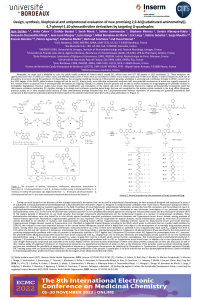
ECMC 2022 - sciforum-065155-3.pdf
Phytochemical and pharmacological profile of four Malagasy medicinal plants used in different chronic diseases: strategies for the sustainable use of natural resources in the Malagasy health system
Novel anti-HMGB1 aptamers as potential drugs in anti-inflammatory and cancer therapies