Event submissions
Published
 10.3390/ECMC2022-13173 (registering DOI)
 This submission belongs to the session S3. General of the event 8th International Electronic Conference on Medicinal Chemistry
Published date
01 Nov, 2022
Academic Editor
'%3e%3cpath%20d='M12.6657%2010.9104C12.4185%2010.325%2012.0599%209.79327%2011.6097%209.34482C11.1609%208.89508%2010.6293%208.5365%2010.0442%208.28888C10.0389%208.28626%2010.0337%208.28495%2010.0285%208.28233C10.8446%207.69279%2011.3752%206.73249%2011.3752%205.64904C11.3752%203.8542%209.92103%202.39999%208.1262%202.39999C6.33136%202.39999%204.87715%203.8542%204.87715%205.64904C4.87715%206.73249%205.40774%207.69279%206.22393%208.28364C6.21869%208.28626%206.21345%208.28757%206.20821%208.29019C5.62129%208.5378%205.09463%208.89284%204.64265%209.34613C4.1929%209.79493%203.83432%2010.3266%203.58671%2010.9117C3.34345%2011.4845%203.21226%2012.0987%203.20023%2012.7209C3.19988%2012.7349%203.20233%2012.7488%203.20744%2012.7619C3.21255%2012.7749%203.22022%2012.7867%203.22998%2012.7968C3.23975%2012.8068%203.25142%2012.8147%203.26431%2012.8202C3.2772%2012.8256%203.29105%2012.8284%203.30504%2012.8284H4.09109C4.14874%2012.8284%204.19459%2012.7825%204.1959%2012.7262C4.2221%2011.7148%204.62823%2010.7676%205.34617%2010.0497C6.08899%209.30683%207.0755%208.89808%208.1262%208.89808C9.17689%208.89808%2010.1634%209.30683%2010.9062%2010.0497C11.6242%2010.7676%2012.0303%2011.7148%2012.0565%2012.7262C12.0578%2012.7838%2012.1037%2012.8284%2012.1613%2012.8284H12.9474C12.9613%2012.8284%2012.9752%2012.8256%2012.9881%2012.8202C13.001%2012.8147%2013.0126%2012.8068%2013.0224%2012.7968C13.0322%2012.7867%2013.0398%2012.7749%2013.0449%2012.7619C13.0501%2012.7488%2013.0525%2012.7349%2013.0522%2012.7209C13.0391%2012.0947%2012.9094%2011.4855%2012.6657%2010.9104ZM8.1262%207.9024C7.52486%207.9024%206.9589%207.6679%206.53312%207.24211C6.10733%206.81633%205.87283%206.25037%205.87283%205.64904C5.87283%205.0477%206.10733%204.48174%206.53312%204.05596C6.9589%203.63018%207.52486%203.39567%208.1262%203.39567C8.72753%203.39567%209.29349%203.63018%209.71927%204.05596C10.1451%204.48174%2010.3796%205.0477%2010.3796%205.64904C10.3796%206.25037%2010.1451%206.81633%209.71927%207.24211C9.29349%207.6679%208.72753%207.9024%208.1262%207.9024Z'%20fill='%235D1EE1'/%3e%3c/g%3e%3c/svg%3e) Alfredo Berzal-Herranz
Alfredo Berzal-HerranzCitation
Sofia Reis Brandão, Ana Reis-Mendes, Margarida Duarte-Araújo, Maria João Neuparth, Félix Carvalho, Rita Ferreira, Vera Marisa Costa, Mitoxantrone disrupts cardiac metabolism along with proteolysis and regeneration in aged mice, in Proceedings of 8th International Electronic Conference on Medicinal Chemistry, 1 November–30 November 2022, MDPI: Basel, Switzerland, doi: 10.3390/ECMC2022-13173
Share
Email
Facebook
Twitter
LinkedIn
Mitoxantrone disrupts cardiac metabolism along with proteolysis and regeneration in aged mice
'%3e%3cpath%20d='M12.6647%2010.9104C12.4176%2010.325%2012.0589%209.7933%2011.6088%209.34485C11.16%208.89511%2010.6283%208.53653%2010.0432%208.28891C10.038%208.28629%2010.0327%208.28498%2010.0275%208.28236C10.8437%207.69282%2011.3743%206.73252%2011.3743%205.64907C11.3743%203.85423%209.92005%202.40002%208.12522%202.40002C6.33038%202.40002%204.87618%203.85423%204.87618%205.64907C4.87618%206.73252%205.40677%207.69282%206.22296%208.28367C6.21772%208.28629%206.21248%208.2876%206.20724%208.29022C5.62031%208.53783%205.09365%208.89287%204.64167%209.34616C4.19192%209.79496%203.83334%2010.3266%203.58573%2010.9117C3.34247%2011.4846%203.21128%2012.0987%203.19925%2012.721C3.1989%2012.735%203.20135%2012.7489%203.20646%2012.7619C3.21157%2012.7749%203.21924%2012.7868%203.22901%2012.7968C3.23877%2012.8068%203.25045%2012.8148%203.26334%2012.8202C3.27623%2012.8256%203.29007%2012.8284%203.30406%2012.8284H4.09012C4.14776%2012.8284%204.19362%2012.7825%204.19493%2012.7262C4.22113%2011.7148%204.62726%2010.7676%205.34519%2010.0497C6.08802%209.30686%207.07452%208.89811%208.12522%208.89811C9.17592%208.89811%2010.1624%209.30686%2010.9052%2010.0497C11.6232%2010.7676%2012.0293%2011.7148%2012.0555%2012.7262C12.0568%2012.7839%2012.1027%2012.8284%2012.1603%2012.8284H12.9464C12.9604%2012.8284%2012.9742%2012.8256%2012.9871%2012.8202C13%2012.8148%2013.0117%2012.8068%2013.0214%2012.7968C13.0312%2012.7868%2013.0389%2012.7749%2013.044%2012.7619C13.0491%2012.7489%2013.0515%2012.735%2013.0512%2012.721C13.0381%2012.0947%2012.9084%2011.4856%2012.6647%2010.9104ZM8.12522%207.90243C7.52388%207.90243%206.95792%207.66793%206.53214%207.24215C6.10636%206.81636%205.87185%206.2504%205.87185%205.64907C5.87185%205.04773%206.10636%204.48177%206.53214%204.05599C6.95792%203.63021%207.52388%203.3957%208.12522%203.3957C8.72655%203.3957%209.29252%203.63021%209.7183%204.05599C10.1441%204.48177%2010.3786%205.04773%2010.3786%205.64907C10.3786%206.2504%2010.1441%206.81636%209.7183%207.24215C9.29252%207.66793%208.72655%207.90243%208.12522%207.90243Z'%20fill='%235D1EE1'/%3e%3c/g%3e%3c/svg%3e)
Sofia Reis Brandão 1,2,3
Ana Reis-Mendes 1,2
Margarida Duarte-Araújo 4,5
Maria João Neuparth 6,7,8

Félix Carvalho 1,2
Rita Ferreira 3

Vera Marisa Costa 1,2
1. Associate Laboratory i4HB - Institute for Health and Bioeconomy, Faculty of Pharmacy, University of Porto, Porto, Portugal
2. UCIBIO-Applied Molecular Biosciences Unit, REQUIMTE, Laboratory of Toxicology, Department of Biological Sciences, Faculty of Pharmacy, University of Porto, Porto, Portugal
3. LAQV-REQUIMTE, Department of Chemistry, University of Aveiro, Aveiro, Portugal
4. LAQV-REQUIMTE, Faculty of Pharmacy, University of Porto, Porto, Portugal
5. Department of Immuno-Physiology and Pharmacology, Institute of Biomedical Sciences Abel Salazar, University of Porto, Porto, Portugal
6. Research Centre in Physical Activity, Health and Leisure (CIAFEL), Faculty of Sports, University of Porto, Porto, Portugal
7. Laboratory for Integrative and Translational Research in Population Health (ITR), Porto, Portugal
8. TOXRUN - Toxicology Research Unit, University Institute of Health Sciences, CESPU, CRL, Gandra, Portugal
Abstract
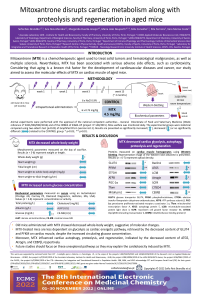
Mitoxantrone (MTX) is a chemotherapeutic agent used to treat solid tumors and hematological malignancies, as well as multiple sclerosis. Nevertheless, MTX has been associated with serious adverse side effects, such as cardiotoxicity. Considering that aging is a known risk factor for the development of cardiovascular diseases and cancer, our study aimed to assess the molecular effects of MTX on cardiac muscle of aged mice. Old male CD-1 mice (19 months) received a pharmacologically relevant dose of MTX, consisting of 6 intraperitoneal administrations for three weeks (biweekly) to achieve a cumulative dose of 4.5 mg/kg of MTX (MTX group) or saline (CTRL group). Animal experiments were performed with the approval of the national competent authorities - General Directorate of Food and Veterinary Medicine (DGAV), and mice welfare was monitored daily. Mice were sacrificed two months after the last administration for collection of blood and heart. MTX group showed an increase in serum glucose levels, despite no other differences. Regarding the heart, MTX decreased the content of glucose transporter GLUT4 (GLUT4) and phosphofructokinase (PFKM), suggesting a lower use of glycolysis. Despite no major differences for the mitochondrial biogenesis markers evaluated, the content of autophagy protein 5 (ATG5), atrogin, and CCAAT-enhancer-binding proteins β (CEBPβ) was decreased in the MTX group, highlighting the influence of this drug on cardiac autophagy, proteolysis, and regeneration, respectively. These results suggest that MTX impacts unexplored pathways, so further studies are needed to find new molecular mechanisms that explain the cardiotoxicity induced by this anticancer agent.
Keywords
mitoxantrone
cardiotoxicity
adverse outcome pathways
autophagy
proteolysis
regeneration
Poster
sciforum-065484.pdf
Synthesis of novel 2-phenylindole analogues as antifungal and antibacterial agents
Chemiluminescent self-activating photosensitizers for a selective anticancer therapy