Event submissions
Published
 10.3390/ecsa-9-13201 (registering DOI)
 This submission belongs to the session H. Posters of the event 9th International Electronic Conference on Sensors and Applications
Published date
01 Nov, 2022
Academic Editor
'%3e%3cpath%20d='M12.6657%2010.9104C12.4185%2010.325%2012.0599%209.79327%2011.6097%209.34482C11.1609%208.89508%2010.6293%208.5365%2010.0442%208.28888C10.0389%208.28626%2010.0337%208.28495%2010.0285%208.28233C10.8446%207.69279%2011.3752%206.73249%2011.3752%205.64904C11.3752%203.8542%209.92103%202.39999%208.1262%202.39999C6.33136%202.39999%204.87715%203.8542%204.87715%205.64904C4.87715%206.73249%205.40774%207.69279%206.22393%208.28364C6.21869%208.28626%206.21345%208.28757%206.20821%208.29019C5.62129%208.5378%205.09463%208.89284%204.64265%209.34613C4.1929%209.79493%203.83432%2010.3266%203.58671%2010.9117C3.34345%2011.4845%203.21226%2012.0987%203.20023%2012.7209C3.19988%2012.7349%203.20233%2012.7488%203.20744%2012.7619C3.21255%2012.7749%203.22022%2012.7867%203.22998%2012.7968C3.23975%2012.8068%203.25142%2012.8147%203.26431%2012.8202C3.2772%2012.8256%203.29105%2012.8284%203.30504%2012.8284H4.09109C4.14874%2012.8284%204.19459%2012.7825%204.1959%2012.7262C4.2221%2011.7148%204.62823%2010.7676%205.34617%2010.0497C6.08899%209.30683%207.0755%208.89808%208.1262%208.89808C9.17689%208.89808%2010.1634%209.30683%2010.9062%2010.0497C11.6242%2010.7676%2012.0303%2011.7148%2012.0565%2012.7262C12.0578%2012.7838%2012.1037%2012.8284%2012.1613%2012.8284H12.9474C12.9613%2012.8284%2012.9752%2012.8256%2012.9881%2012.8202C13.001%2012.8147%2013.0126%2012.8068%2013.0224%2012.7968C13.0322%2012.7867%2013.0398%2012.7749%2013.0449%2012.7619C13.0501%2012.7488%2013.0525%2012.7349%2013.0522%2012.7209C13.0391%2012.0947%2012.9094%2011.4855%2012.6657%2010.9104ZM8.1262%207.9024C7.52486%207.9024%206.9589%207.6679%206.53312%207.24211C6.10733%206.81633%205.87283%206.25037%205.87283%205.64904C5.87283%205.0477%206.10733%204.48174%206.53312%204.05596C6.9589%203.63018%207.52486%203.39567%208.1262%203.39567C8.72753%203.39567%209.29349%203.63018%209.71927%204.05596C10.1451%204.48174%2010.3796%205.0477%2010.3796%205.64904C10.3796%206.25037%2010.1451%206.81633%209.71927%207.24211C9.29349%207.6679%208.72753%207.9024%208.1262%207.9024Z'%20fill='%235D1EE1'/%3e%3c/g%3e%3c/svg%3e) Francisco Falcone
Francisco FalconeCitation
Jose Manuel Plaza Bravo, Manuel Mateo-March, Roberto Sanchis-Sanchis, Pedro Pérez-Soriano, Mikel Zabala Díaz, Alberto Encarnación-Martínez, Validation of a low cost sensor for kinematic assessment in cyclists, in Proceedings of 9th International Electronic Conference on Sensors and Applications, 1 November–15 November 2022, MDPI: Basel, Switzerland, doi: 10.3390/ecsa-9-13201
Share
Email
Facebook
Twitter
LinkedIn
Validation of a low cost sensor for kinematic assessment in cyclists
'%3e%3cpath%20d='M12.6647%2010.9104C12.4176%2010.325%2012.0589%209.7933%2011.6088%209.34485C11.16%208.89511%2010.6283%208.53653%2010.0432%208.28891C10.038%208.28629%2010.0327%208.28498%2010.0275%208.28236C10.8437%207.69282%2011.3743%206.73252%2011.3743%205.64907C11.3743%203.85423%209.92005%202.40002%208.12522%202.40002C6.33038%202.40002%204.87618%203.85423%204.87618%205.64907C4.87618%206.73252%205.40677%207.69282%206.22296%208.28367C6.21772%208.28629%206.21248%208.2876%206.20724%208.29022C5.62031%208.53783%205.09365%208.89287%204.64167%209.34616C4.19192%209.79496%203.83334%2010.3266%203.58573%2010.9117C3.34247%2011.4846%203.21128%2012.0987%203.19925%2012.721C3.1989%2012.735%203.20135%2012.7489%203.20646%2012.7619C3.21157%2012.7749%203.21924%2012.7868%203.22901%2012.7968C3.23877%2012.8068%203.25045%2012.8148%203.26334%2012.8202C3.27623%2012.8256%203.29007%2012.8284%203.30406%2012.8284H4.09012C4.14776%2012.8284%204.19362%2012.7825%204.19493%2012.7262C4.22113%2011.7148%204.62726%2010.7676%205.34519%2010.0497C6.08802%209.30686%207.07452%208.89811%208.12522%208.89811C9.17592%208.89811%2010.1624%209.30686%2010.9052%2010.0497C11.6232%2010.7676%2012.0293%2011.7148%2012.0555%2012.7262C12.0568%2012.7839%2012.1027%2012.8284%2012.1603%2012.8284H12.9464C12.9604%2012.8284%2012.9742%2012.8256%2012.9871%2012.8202C13%2012.8148%2013.0117%2012.8068%2013.0214%2012.7968C13.0312%2012.7868%2013.0389%2012.7749%2013.044%2012.7619C13.0491%2012.7489%2013.0515%2012.735%2013.0512%2012.721C13.0381%2012.0947%2012.9084%2011.4856%2012.6647%2010.9104ZM8.12522%207.90243C7.52388%207.90243%206.95792%207.66793%206.53214%207.24215C6.10636%206.81636%205.87185%206.2504%205.87185%205.64907C5.87185%205.04773%206.10636%204.48177%206.53214%204.05599C6.95792%203.63021%207.52388%203.3957%208.12522%203.3957C8.72655%203.3957%209.29252%203.63021%209.7183%204.05599C10.1441%204.48177%2010.3786%205.04773%2010.3786%205.64907C10.3786%206.2504%2010.1441%206.81636%209.7183%207.24215C9.29252%207.66793%208.72655%207.90243%208.12522%207.90243Z'%20fill='%235D1EE1'/%3e%3c/g%3e%3c/svg%3e)
Jose Manuel Plaza Bravo 1
Manuel Mateo-March 2,3
Roberto Sanchis-Sanchis 4,5
Pedro Pérez-Soriano 4,5

Mikel Zabala Díaz 1

Alberto Encarnación-Martínez 4,5
1. Department of Physical Education and Sports, University of Granada, 18071 Granada, Spain
2. Sport Science Department, Universidad Miguel Hernández de Elche, 03202 Elche, Spain
3. Faculty of Sport Sciences, Universidad Europea de Madrid, 28670 Madrid, Spain
4. Research Group in Sports Biomechanics (GIBD), University of Valencia, 46010 Valencia, Spain
5. Department of Physical Education and Sports, University of Valencia, 46010 Valencia, Spain
Abstract
Knowing the relationship between the movements of the ankle, knee, and hip joints is presented as necessary as it could help us to better understand the mechanisms of power production and how the adjustment of these different variables can condition sports performance or comfort in cycling (1,2).
Due to this need, biomechanics applied to cycling has undergone great evolution in recent decades, both in the analysis techniques and in the technological systems used. But the majority of the techniques used until today start from an important limitation, because isolate the cyclist from the ecological context of their sports practice and leading them to develop their capabilities under laboratory conditions.
Recently, the advancement in the technology of different wearables has allowed us to capture and analyze human movement in an ecological way with hardly any interference in it (3,4).
The use of inertial measurement sensors (IMUs), in the search for a more ecological measure, is spreading among sports professionals with the aim of improving the sports performance of cyclists. The kinematic evaluation using the IMU sensors has become popular.
These new devices are promising and open a wide range of possibilities, and although there are already several studies that have demonstrated the strength of IMU technology to measure joint kinematics, the validity and reliability of each device must be individually contrasted.
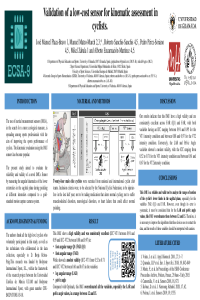
The present study aimed to evaluate the reliability and validity of a novel IMUs Sensor by measuring the angular kinematics of the lower extremities in the sagittal plane during pedaling at different intensities compared to a gold-standard motion capture camera system (OptiTrack, Natural Point, Inc., Corvallis, OR, USA).
Twenty-four elite cyclists recruited from national and international cycling teams performed two 6-min cycles of cycling on a cycle ergometer at two different intensities (first ventilatory threshold (VT1) and second ventilatory threshold (VT2)) in random order, with a 5 min rest between intensity conditions. The reliability and validity of the novel IMUs Sensor versus the motion capture system were evaluated.
Both systems showed high validity and were consistently excellent in foot angular range Q1 (FAR (Q1)) and foot angular range (FAR) (ICC-VT1 between 0.91 and 0.95 and ICC-VT2 between 0.88 and 0.97), while the variables leg angular range (LAR) and pelvic angle showed a modest validity (ICC-VT1 from 0.52 to 0.71 and ICC-VT2 between 0.61 and 0.67). Compared with Optitrack, the novel IMUs Sensor overestimated all the variables, especially the LAR and pelvic angle values, in a range between 12 and 15º.
This novel IMUs Sensors a reliable and valid tool for analyzing the ranges of motion of the cyclist’s lower limbs in the sagittal plane, especially for the variables FAR (Q1) and FAR. However, its systematic error for FAR and Pelvic Angle values must be considered in sports performance analysis.
- Vrints, J.; Koninckx, E.; Van Leemputte, M.; Jonkers, Y.I. The Effect of Saddle Position on Maximal Power Output and Moment Generating Capacity of Lower Limb Muscles during Isokinetic Cycling. J. Appl. Biomech. 2011, 27, 1–7. [CrossRef]
- Quesada, J.I.P.; Kerr, Z.Y.; Bertucci, W.M.; Carpes, Y.F.P. The association of bike fitting with injury, comfort, and pain during cycling: An international retrospective survey. Eur. J. Sport Sci. 2018, 19, 842–849
- Marin, F.; Fradet, L.; Lepetit, K.; Hansen, C.; Ben Mansour, Y.K. Inertial measurement unit in biomechanics and sport biomechanics: Past, present, future. In Proceedings of the ISBS-Conference Proceedings Archive, Poitiers, France, 29 June–3 July 2015.
- Camomilla, V.; Bergamini, E.; Fantozzi, S.; Vannozzi, Y.G. Trends Supporting the In-Field Use of Wearable Inertial Sensors for Sport Performance Evaluation: A Systematic Review. Sensors 2018, 18, 873.
- Kobsar, D.; Charlton, J.M.; Tse, C.T.F.; Esculier, J.-F.; Graffos, A.; Krowchuk, N.M.; Thatcher, D.; Hunt, M.A. Validity and reliability of wearable inertial sensors in healthy adult walking: A systematic review and meta-analysis. J. Neuroeng. Rehabil. 2020, 17, 62.
- Poitras, I.; Dupuis, F.; Bielmann, M.; Campeau-Lecours, A.; Mercier, C.; Bouyer, L.; Roy, J.-S. Validity and Reliability of Wearable Sensors for Joint Angle Estimation: A Systematic Review. Sensors 2019, 19, 1555.
Keywords
motion analysis
cycling
kinematics
range of movement
IMU
Manuscript
sciforum_065452_original_Poster_9th_International_Electronic_Conference_on_Sensors_and_Applications-done.pdf
Poster
Poster IMU - ECSA-9 2.0 QR.pdf
3D porous plasmonic nanoarchitectures for SERS-based chemical sensing
Instrumented Treadmill with an Accelerometry System: a Valid and Reliable Tool for Running Analysis