Event submissions
Published

This submission belongs to the session H. Posters of the event 9th International Electronic Conference on Sensors and Applications
Published date
01 Nov, 2022
Academic Editor
'%3e%3cpath%20d='M12.6657%2010.9104C12.4185%2010.325%2012.0599%209.79327%2011.6097%209.34482C11.1609%208.89508%2010.6293%208.5365%2010.0442%208.28888C10.0389%208.28626%2010.0337%208.28495%2010.0285%208.28233C10.8446%207.69279%2011.3752%206.73249%2011.3752%205.64904C11.3752%203.8542%209.92103%202.39999%208.1262%202.39999C6.33136%202.39999%204.87715%203.8542%204.87715%205.64904C4.87715%206.73249%205.40774%207.69279%206.22393%208.28364C6.21869%208.28626%206.21345%208.28757%206.20821%208.29019C5.62129%208.5378%205.09463%208.89284%204.64265%209.34613C4.1929%209.79493%203.83432%2010.3266%203.58671%2010.9117C3.34345%2011.4845%203.21226%2012.0987%203.20023%2012.7209C3.19988%2012.7349%203.20233%2012.7488%203.20744%2012.7619C3.21255%2012.7749%203.22022%2012.7867%203.22998%2012.7968C3.23975%2012.8068%203.25142%2012.8147%203.26431%2012.8202C3.2772%2012.8256%203.29105%2012.8284%203.30504%2012.8284H4.09109C4.14874%2012.8284%204.19459%2012.7825%204.1959%2012.7262C4.2221%2011.7148%204.62823%2010.7676%205.34617%2010.0497C6.08899%209.30683%207.0755%208.89808%208.1262%208.89808C9.17689%208.89808%2010.1634%209.30683%2010.9062%2010.0497C11.6242%2010.7676%2012.0303%2011.7148%2012.0565%2012.7262C12.0578%2012.7838%2012.1037%2012.8284%2012.1613%2012.8284H12.9474C12.9613%2012.8284%2012.9752%2012.8256%2012.9881%2012.8202C13.001%2012.8147%2013.0126%2012.8068%2013.0224%2012.7968C13.0322%2012.7867%2013.0398%2012.7749%2013.0449%2012.7619C13.0501%2012.7488%2013.0525%2012.7349%2013.0522%2012.7209C13.0391%2012.0947%2012.9094%2011.4855%2012.6657%2010.9104ZM8.1262%207.9024C7.52486%207.9024%206.9589%207.6679%206.53312%207.24211C6.10733%206.81633%205.87283%206.25037%205.87283%205.64904C5.87283%205.0477%206.10733%204.48174%206.53312%204.05596C6.9589%203.63018%207.52486%203.39567%208.1262%203.39567C8.72753%203.39567%209.29349%203.63018%209.71927%204.05596C10.1451%204.48174%2010.3796%205.0477%2010.3796%205.64904C10.3796%206.25037%2010.1451%206.81633%209.71927%207.24211C9.29349%207.6679%208.72753%207.9024%208.1262%207.9024Z'%20fill='%235D1EE1'/%3e%3c/g%3e%3c/svg%3e) Jean-marc Laheurte
Jean-marc LaheurteCitation
Noelia Felipe Montiel, Marc Parrilla, Victoria Beltrán, Gert Nuyts, Filip Van Durme, Karolien De Wael, Highly selective electrochemical profiling of heroin in street samples, in Proceedings of 9th International Electronic Conference on Sensors and Applications, 1 November–15 November 2022, MDPI: Basel, Switzerland, doi: 10.3390/ecsa-9-13222
Share
Email
Facebook
Twitter
LinkedIn
Highly selective electrochemical profiling of heroin in street samples
'%3e%3cpath%20d='M12.6647%2010.9104C12.4176%2010.325%2012.0589%209.7933%2011.6088%209.34485C11.16%208.89511%2010.6283%208.53653%2010.0432%208.28891C10.038%208.28629%2010.0327%208.28498%2010.0275%208.28236C10.8437%207.69282%2011.3743%206.73252%2011.3743%205.64907C11.3743%203.85423%209.92005%202.40002%208.12522%202.40002C6.33038%202.40002%204.87618%203.85423%204.87618%205.64907C4.87618%206.73252%205.40677%207.69282%206.22296%208.28367C6.21772%208.28629%206.21248%208.2876%206.20724%208.29022C5.62031%208.53783%205.09365%208.89287%204.64167%209.34616C4.19192%209.79496%203.83334%2010.3266%203.58573%2010.9117C3.34247%2011.4846%203.21128%2012.0987%203.19925%2012.721C3.1989%2012.735%203.20135%2012.7489%203.20646%2012.7619C3.21157%2012.7749%203.21924%2012.7868%203.22901%2012.7968C3.23877%2012.8068%203.25045%2012.8148%203.26334%2012.8202C3.27623%2012.8256%203.29007%2012.8284%203.30406%2012.8284H4.09012C4.14776%2012.8284%204.19362%2012.7825%204.19493%2012.7262C4.22113%2011.7148%204.62726%2010.7676%205.34519%2010.0497C6.08802%209.30686%207.07452%208.89811%208.12522%208.89811C9.17592%208.89811%2010.1624%209.30686%2010.9052%2010.0497C11.6232%2010.7676%2012.0293%2011.7148%2012.0555%2012.7262C12.0568%2012.7839%2012.1027%2012.8284%2012.1603%2012.8284H12.9464C12.9604%2012.8284%2012.9742%2012.8256%2012.9871%2012.8202C13%2012.8148%2013.0117%2012.8068%2013.0214%2012.7968C13.0312%2012.7868%2013.0389%2012.7749%2013.044%2012.7619C13.0491%2012.7489%2013.0515%2012.735%2013.0512%2012.721C13.0381%2012.0947%2012.9084%2011.4856%2012.6647%2010.9104ZM8.12522%207.90243C7.52388%207.90243%206.95792%207.66793%206.53214%207.24215C6.10636%206.81636%205.87185%206.2504%205.87185%205.64907C5.87185%205.04773%206.10636%204.48177%206.53214%204.05599C6.95792%203.63021%207.52388%203.3957%208.12522%203.3957C8.72655%203.3957%209.29252%203.63021%209.7183%204.05599C10.1441%204.48177%2010.3786%205.04773%2010.3786%205.64907C10.3786%206.2504%2010.1441%206.81636%209.7183%207.24215C9.29252%207.66793%208.72655%207.90243%208.12522%207.90243Z'%20fill='%235D1EE1'/%3e%3c/g%3e%3c/svg%3e)
Noelia Felipe Montiel 1,2

Marc Parrilla 1,2
Victoria Beltrán 1,2
Gert Nuyts 1,2
Filip Van Durme 3
Karolien De Wael 1,2
1. A-Sense Lab, Department of Bioscience Engineering, University of Antwerp, Antwerp, Belgium
2. NANOlab Center of Excellence, University of Antwerp, Antwerp, Belgium
3. Drugs and Toxicology Department, National Institute for Criminalistics and Criminology (NICC), Brussels, Belgium
Abstract
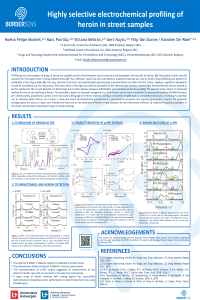
Trafficking and consumption of drugs of abuse are a global concern that threatens social structures and jeopardizes the security of nations [1]. Particularly, heroin use still accounts for the largest share of drug-related harms [2]. Thus, effective, rapid, low-cost and selective analytical methods are vital to hinder drug trafficking, and prevent its availability in the drug market [3]. This way, chemical color tests and sophisticated spectroscopic instrumentation are often the first choice. However, significant drawbacks should be considered e.g. the inaccuracy of the color tests or the high cost and low portability of the spectroscopic devices. Interestingly, electrochemical sensors proved to be the solution for the on-site detection of illicit drugs due to their balance between affordability and analytical performance [4,5].
The present study reports on an improved method for the on-site profiling of heroin. The principle is based on two-peak recognition i.e. from heroin and its main metabolite 6-monoacetylmorphine (6-MAM) at basic pH. Unfortunately, paracetamol, which is the most used cutting agent in heroin seizures, overlaps completely 6-MAM peak at unmodified electrodes, hindering its potential use to selective detect heroin. As a result, a rapid and smart electrochemical pretreatment is presented to overcome this masking phenomena. Besides, a customized script is integrated to enhance peak-to-peak separation and enlighten the full composition of heroin samples.
Overall, the proposed strategy paves the way to a rapid, user-friendly and low-cost on-site detection of heroin in real scenarios by law enforcement officers: (i) analysis of suspicious powders in the street; and (ii) rapid screening of cargos in border settings (e.g. airports, harbors).
References
[1] European Monitoring Centre for Drugs and Drug Addiction, EU Drug Markets Report 2020, 2020.
[2] European Monitoring Centre for Drugs and Drug Addiction, EU Drug Markets Report 2019, 2019.
[3] W.R. de Araujo, T.M.G. Cardoso, R.G. da Rocha, M.H.P. Santana, R.A.A. Muñoz, E.M. Richter, T.R.L.C. Paixão, W.K.T. Coltro, Anal. Chim. Acta. 2018, 1034, 1.
[4] H. Teymourian, M. Parrilla, J.R. Sempionatto, N. Felipe Montiel, A. Barfidokht, R. Van Echelpoel, K. De Wael, J. Wang, ACS Sensors. 2020, 5, 2679.
[5] F. Truta, A. Florea, A. Cernat, M. Tertis, O. Hosu, K. de Wael, C. Cristea, Front. Chem. 2020, 8.
Acknowledgements
This project has received funding from the European Union's Horizon 2020 research and innovation programme under grant agreement No 833787, BorderSens.
Keywords
Heroin
6-monoacetylmorphine
forensics
screen-printed electrodes
Manuscript
sciforum_064248_original_Abstract_ECSA2022-done.pdf
Poster
Poster_NFM.pdf
Success and Failure in Antibody Recognition by Surface-type Sensors: Essential Prerequisites
An optimized methodology to achieve irreversible bonding between PDMS and Polyimides for biomedical sensors