Event submissions
Published
 10.3390/ECMC2022-13234 (registering DOI)
 This submission belongs to the session S4. Small molecules as drug candidates of the event 8th International Electronic Conference on Medicinal Chemistry
Published date
01 Nov, 2022
Academic Editor
'%3e%3cpath%20d='M12.6657%2010.9104C12.4185%2010.325%2012.0599%209.79327%2011.6097%209.34482C11.1609%208.89508%2010.6293%208.5365%2010.0442%208.28888C10.0389%208.28626%2010.0337%208.28495%2010.0285%208.28233C10.8446%207.69279%2011.3752%206.73249%2011.3752%205.64904C11.3752%203.8542%209.92103%202.39999%208.1262%202.39999C6.33136%202.39999%204.87715%203.8542%204.87715%205.64904C4.87715%206.73249%205.40774%207.69279%206.22393%208.28364C6.21869%208.28626%206.21345%208.28757%206.20821%208.29019C5.62129%208.5378%205.09463%208.89284%204.64265%209.34613C4.1929%209.79493%203.83432%2010.3266%203.58671%2010.9117C3.34345%2011.4845%203.21226%2012.0987%203.20023%2012.7209C3.19988%2012.7349%203.20233%2012.7488%203.20744%2012.7619C3.21255%2012.7749%203.22022%2012.7867%203.22998%2012.7968C3.23975%2012.8068%203.25142%2012.8147%203.26431%2012.8202C3.2772%2012.8256%203.29105%2012.8284%203.30504%2012.8284H4.09109C4.14874%2012.8284%204.19459%2012.7825%204.1959%2012.7262C4.2221%2011.7148%204.62823%2010.7676%205.34617%2010.0497C6.08899%209.30683%207.0755%208.89808%208.1262%208.89808C9.17689%208.89808%2010.1634%209.30683%2010.9062%2010.0497C11.6242%2010.7676%2012.0303%2011.7148%2012.0565%2012.7262C12.0578%2012.7838%2012.1037%2012.8284%2012.1613%2012.8284H12.9474C12.9613%2012.8284%2012.9752%2012.8256%2012.9881%2012.8202C13.001%2012.8147%2013.0126%2012.8068%2013.0224%2012.7968C13.0322%2012.7867%2013.0398%2012.7749%2013.0449%2012.7619C13.0501%2012.7488%2013.0525%2012.7349%2013.0522%2012.7209C13.0391%2012.0947%2012.9094%2011.4855%2012.6657%2010.9104ZM8.1262%207.9024C7.52486%207.9024%206.9589%207.6679%206.53312%207.24211C6.10733%206.81633%205.87283%206.25037%205.87283%205.64904C5.87283%205.0477%206.10733%204.48174%206.53312%204.05596C6.9589%203.63018%207.52486%203.39567%208.1262%203.39567C8.72753%203.39567%209.29349%203.63018%209.71927%204.05596C10.1451%204.48174%2010.3796%205.0477%2010.3796%205.64904C10.3796%206.25037%2010.1451%206.81633%209.71927%207.24211C9.29349%207.6679%208.72753%207.9024%208.1262%207.9024Z'%20fill='%235D1EE1'/%3e%3c/g%3e%3c/svg%3e) Alfredo Berzal-Herranz
Alfredo Berzal-HerranzCitation
Efterpi Athanasios Korakaki, Yannis Simos, Niki Κarouta, Κonstantinos Spyrou, Dimitrios Gournis, Κonstantinos Τsamis, Patra Vezyraki, Haralambos Stamatis, Εvangelia Dounousi, Dimitrios Peschos, In vitro immunotoxicity of superhydrophilic superparamagnetic iron oxide nanoparticles, in Proceedings of 8th International Electronic Conference on Medicinal Chemistry, 1 November–30 November 2022, MDPI: Basel, Switzerland, doi: 10.3390/ECMC2022-13234
Share
Email
Facebook
Twitter
LinkedIn
In vitro immunotoxicity of superhydrophilic superparamagnetic iron oxide nanoparticles
'%3e%3cpath%20d='M12.6647%2010.9104C12.4176%2010.325%2012.0589%209.7933%2011.6088%209.34485C11.16%208.89511%2010.6283%208.53653%2010.0432%208.28891C10.038%208.28629%2010.0327%208.28498%2010.0275%208.28236C10.8437%207.69282%2011.3743%206.73252%2011.3743%205.64907C11.3743%203.85423%209.92005%202.40002%208.12522%202.40002C6.33038%202.40002%204.87618%203.85423%204.87618%205.64907C4.87618%206.73252%205.40677%207.69282%206.22296%208.28367C6.21772%208.28629%206.21248%208.2876%206.20724%208.29022C5.62031%208.53783%205.09365%208.89287%204.64167%209.34616C4.19192%209.79496%203.83334%2010.3266%203.58573%2010.9117C3.34247%2011.4846%203.21128%2012.0987%203.19925%2012.721C3.1989%2012.735%203.20135%2012.7489%203.20646%2012.7619C3.21157%2012.7749%203.21924%2012.7868%203.22901%2012.7968C3.23877%2012.8068%203.25045%2012.8148%203.26334%2012.8202C3.27623%2012.8256%203.29007%2012.8284%203.30406%2012.8284H4.09012C4.14776%2012.8284%204.19362%2012.7825%204.19493%2012.7262C4.22113%2011.7148%204.62726%2010.7676%205.34519%2010.0497C6.08802%209.30686%207.07452%208.89811%208.12522%208.89811C9.17592%208.89811%2010.1624%209.30686%2010.9052%2010.0497C11.6232%2010.7676%2012.0293%2011.7148%2012.0555%2012.7262C12.0568%2012.7839%2012.1027%2012.8284%2012.1603%2012.8284H12.9464C12.9604%2012.8284%2012.9742%2012.8256%2012.9871%2012.8202C13%2012.8148%2013.0117%2012.8068%2013.0214%2012.7968C13.0312%2012.7868%2013.0389%2012.7749%2013.044%2012.7619C13.0491%2012.7489%2013.0515%2012.735%2013.0512%2012.721C13.0381%2012.0947%2012.9084%2011.4856%2012.6647%2010.9104ZM8.12522%207.90243C7.52388%207.90243%206.95792%207.66793%206.53214%207.24215C6.10636%206.81636%205.87185%206.2504%205.87185%205.64907C5.87185%205.04773%206.10636%204.48177%206.53214%204.05599C6.95792%203.63021%207.52388%203.3957%208.12522%203.3957C8.72655%203.3957%209.29252%203.63021%209.7183%204.05599C10.1441%204.48177%2010.3786%205.04773%2010.3786%205.64907C10.3786%206.2504%2010.1441%206.81636%209.7183%207.24215C9.29252%207.66793%208.72655%207.90243%208.12522%207.90243Z'%20fill='%235D1EE1'/%3e%3c/g%3e%3c/svg%3e)
Efterpi Athanasios Korakaki 1,2

Yannis Simos 1,2
Niki Κarouta 2,3

Κonstantinos Spyrou 2,3

Dimitrios Gournis 2,3
Κonstantinos Τsamis 1,2
Patra Vezyraki 1
_Stamatis.png)
Haralambos Stamatis 2,4
Εvangelia Dounousi 1,5
Dimitrios Peschos 1,2
1. Laboratory of Physiology, Faculty of Medicine, University of Ioannina
2. Nanomedicine and Nanobiotechnology Research Group, University of Ioannina
3. Department of Materials Science and Engineering, University of Ioannina
4. Laboratory of Biotechnology, Department of Biological Applications and Technologies, University of Ioannina
5. Department of Nephrology, Faculty of Medicine, School of Health Sciences, University of Ioannina
Abstract
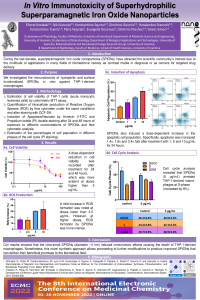
During the last decade, superparamagnetic iron oxide nanoparticles (SPIONs) have attracted the scientific community’s interest due to the multitude of applications in many fields of biomedicine namely as contrast media in diagnosis or as carriers for targeted drug delivery. We investigated the immunotoxicity of hydrophilic and surface functionalized SPIONs in vitro against THP-1-derived macrophages. Superhydrophilic ultra-small SPIONs (diameter ~4 nm) were produced by "trimming" the surface coating of the as-prepared nanoparticles. Cytotoxicity was assessed using the 3-(4,5-dimethylthiazol-2-yl)-2,5-diphenyltetrazolium bromide (MTT). Flow cytometry was employed to study the effect of SPIONs on the redox stage of the cells through the detection of reactive oxygen species (ROS) generation using 2',7'-dichlorofluorescin-diacetate (DCF-DA), the induction of apoptosis using Annexin V-FITC/Propidium Iodide (PI) staining and the estimation of the percentages of cell population in different phases of the cell cycle (PI staining). A dose-dependent reduction in cell viability was recorded after treatment for 24 hours, which was more evident at doses higher than 5 μg/ml. The cytotoxicity of SPIONs was accompanied by a steep increase in ROS production and apoptotic cell population. Cell cycle analysis revealed that SPIONS (5 μg/ml) arrested THP-1-derived macrophages at G0/G1 phase. Our results showed that the ultra-small SPIONs induced immunotoxic effects causing the death of THP-1-derived macrophages. Nonetheless, this novel synthetic approach allows proceeding to further modifications to produce improved SPIONs that can deliver their beneficial promises to the biomedical field.
Keywords
superparamagnetic iron oxide nanoparticles
THP-1
immunotoxicity
Poster
sciforum-066824.pdf
FORCED DEGRADATION STUDIES ON AGENTS OF THERAPEUTIC INTEREST
Synthesis, structural characterization, and in silico ADMET testing of novel 17β-acetoxy-17α-(pyridin-2-yl) estrane derivate