Event submissions
Published

This submission belongs to the session S4. Small molecules as drug candidates of the event 8th International Electronic Conference on Medicinal Chemistry
Published date
01 Nov, 2022
Academic Editor
'%3e%3cpath%20d='M12.6657%2010.9104C12.4185%2010.325%2012.0599%209.79327%2011.6097%209.34482C11.1609%208.89508%2010.6293%208.5365%2010.0442%208.28888C10.0389%208.28626%2010.0337%208.28495%2010.0285%208.28233C10.8446%207.69279%2011.3752%206.73249%2011.3752%205.64904C11.3752%203.8542%209.92103%202.39999%208.1262%202.39999C6.33136%202.39999%204.87715%203.8542%204.87715%205.64904C4.87715%206.73249%205.40774%207.69279%206.22393%208.28364C6.21869%208.28626%206.21345%208.28757%206.20821%208.29019C5.62129%208.5378%205.09463%208.89284%204.64265%209.34613C4.1929%209.79493%203.83432%2010.3266%203.58671%2010.9117C3.34345%2011.4845%203.21226%2012.0987%203.20023%2012.7209C3.19988%2012.7349%203.20233%2012.7488%203.20744%2012.7619C3.21255%2012.7749%203.22022%2012.7867%203.22998%2012.7968C3.23975%2012.8068%203.25142%2012.8147%203.26431%2012.8202C3.2772%2012.8256%203.29105%2012.8284%203.30504%2012.8284H4.09109C4.14874%2012.8284%204.19459%2012.7825%204.1959%2012.7262C4.2221%2011.7148%204.62823%2010.7676%205.34617%2010.0497C6.08899%209.30683%207.0755%208.89808%208.1262%208.89808C9.17689%208.89808%2010.1634%209.30683%2010.9062%2010.0497C11.6242%2010.7676%2012.0303%2011.7148%2012.0565%2012.7262C12.0578%2012.7838%2012.1037%2012.8284%2012.1613%2012.8284H12.9474C12.9613%2012.8284%2012.9752%2012.8256%2012.9881%2012.8202C13.001%2012.8147%2013.0126%2012.8068%2013.0224%2012.7968C13.0322%2012.7867%2013.0398%2012.7749%2013.0449%2012.7619C13.0501%2012.7488%2013.0525%2012.7349%2013.0522%2012.7209C13.0391%2012.0947%2012.9094%2011.4855%2012.6657%2010.9104ZM8.1262%207.9024C7.52486%207.9024%206.9589%207.6679%206.53312%207.24211C6.10733%206.81633%205.87283%206.25037%205.87283%205.64904C5.87283%205.0477%206.10733%204.48174%206.53312%204.05596C6.9589%203.63018%207.52486%203.39567%208.1262%203.39567C8.72753%203.39567%209.29349%203.63018%209.71927%204.05596C10.1451%204.48174%2010.3796%205.0477%2010.3796%205.64904C10.3796%206.25037%2010.1451%206.81633%209.71927%207.24211C9.29349%207.6679%208.72753%207.9024%208.1262%207.9024Z'%20fill='%235D1EE1'/%3e%3c/g%3e%3c/svg%3e) Alfredo Berzal-Herranz
Alfredo Berzal-HerranzCitation
Aneta Pogorzelska, Jarosław Sławiński, Anna Kawiak, New N-benzenesulfonylguanidine derivatives and their selective growth inhibition of human breast cancer cell line MCF-7 and colon carcinoma HCT-116, in Proceedings of 8th International Electronic Conference on Medicinal Chemistry, 1 November–30 November 2022, MDPI: Basel, Switzerland, doi: 10.3390/ECMC2022-13281
Share
Email
Facebook
Twitter
LinkedIn
New N-benzenesulfonylguanidine derivatives and their selective growth inhibition of human breast cancer cell line MCF-7 and colon carcinoma HCT-116
'%3e%3cpath%20d='M12.6647%2010.9104C12.4176%2010.325%2012.0589%209.7933%2011.6088%209.34485C11.16%208.89511%2010.6283%208.53653%2010.0432%208.28891C10.038%208.28629%2010.0327%208.28498%2010.0275%208.28236C10.8437%207.69282%2011.3743%206.73252%2011.3743%205.64907C11.3743%203.85423%209.92005%202.40002%208.12522%202.40002C6.33038%202.40002%204.87618%203.85423%204.87618%205.64907C4.87618%206.73252%205.40677%207.69282%206.22296%208.28367C6.21772%208.28629%206.21248%208.2876%206.20724%208.29022C5.62031%208.53783%205.09365%208.89287%204.64167%209.34616C4.19192%209.79496%203.83334%2010.3266%203.58573%2010.9117C3.34247%2011.4846%203.21128%2012.0987%203.19925%2012.721C3.1989%2012.735%203.20135%2012.7489%203.20646%2012.7619C3.21157%2012.7749%203.21924%2012.7868%203.22901%2012.7968C3.23877%2012.8068%203.25045%2012.8148%203.26334%2012.8202C3.27623%2012.8256%203.29007%2012.8284%203.30406%2012.8284H4.09012C4.14776%2012.8284%204.19362%2012.7825%204.19493%2012.7262C4.22113%2011.7148%204.62726%2010.7676%205.34519%2010.0497C6.08802%209.30686%207.07452%208.89811%208.12522%208.89811C9.17592%208.89811%2010.1624%209.30686%2010.9052%2010.0497C11.6232%2010.7676%2012.0293%2011.7148%2012.0555%2012.7262C12.0568%2012.7839%2012.1027%2012.8284%2012.1603%2012.8284H12.9464C12.9604%2012.8284%2012.9742%2012.8256%2012.9871%2012.8202C13%2012.8148%2013.0117%2012.8068%2013.0214%2012.7968C13.0312%2012.7868%2013.0389%2012.7749%2013.044%2012.7619C13.0491%2012.7489%2013.0515%2012.735%2013.0512%2012.721C13.0381%2012.0947%2012.9084%2011.4856%2012.6647%2010.9104ZM8.12522%207.90243C7.52388%207.90243%206.95792%207.66793%206.53214%207.24215C6.10636%206.81636%205.87185%206.2504%205.87185%205.64907C5.87185%205.04773%206.10636%204.48177%206.53214%204.05599C6.95792%203.63021%207.52388%203.3957%208.12522%203.3957C8.72655%203.3957%209.29252%203.63021%209.7183%204.05599C10.1441%204.48177%2010.3786%205.04773%2010.3786%205.64907C10.3786%206.2504%2010.1441%206.81636%209.7183%207.24215C9.29252%207.66793%208.72655%207.90243%208.12522%207.90243Z'%20fill='%235D1EE1'/%3e%3c/g%3e%3c/svg%3e)
Aneta Pogorzelska 1
Jarosław Sławiński 1

Anna Kawiak 2
1. Medical University of Gdansk, Department of Organic Chemistry
2. Intercollegiate Faculty of Biotechnology UG-MUG, Department of Biotechnology
Abstract
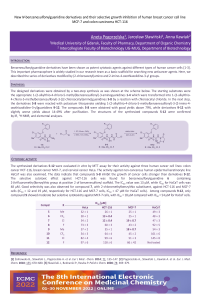
Our previous research proved that benzenesulfonylguanidine derivatives display significant cytotoxic activity against human cancer cells. Here, we describe new 1-(2-alkylthio-4-chloro-5-methylbenzenesulfonyl)guanidines with cytotoxic activity against HCT-116 and MCF-7 cells. The planned derivatives were obtained by a two-step synthesis. The starting substrates were 1-(2-alkylthio-4-chloro-5-methyl)benzenesulfonyl)-3-aminoguanidines 1-4 which were transformed into 1-(2-alkylthio-4-chloro-5-methylbenzenesulfonyl)-3-[(2-chloroacetyl)amino]guanidines 5-8 by a reaction with chloroacetyl chloride. In the next step, the derivatives 5-8 were reacted with potassium thiocyanate yielding 1-(2-alkylthio-4-chloro-5-methylbenzenesulfonyl)-3-(2-imino-4-oxothiazolidine-3-yl)guanidines 9-12.
The synthesized derivatives 5−12 were evaluated in vitro by MTT assays for their activity against three human cancer cell lines: colon cancer HCT-116, breast cancer MCF-7, and cervical cancer HeLa. The activity against non-cancerous human epidermal keratinocyte line HaCaT was also examined. The data indicate that compounds 5-8 inhibit the growth of cancer cells stronger than derivatives 9-12. The selective cytotoxic effect against HCT-116 cells was found for benzenesulfonylguanidine 6 containing 2-(trifluoromethyl)benzylthio group at position 2 of benzenesulfonyl scaffold. The IC50 value was 13 μM, while IC50 for HaCaT cells was 48 μM. Good selectivity was also observed for compound 7, with 2-chloromethylbenzylthio substituent, against HCT-116 and MCF-7 cells (IC50 = 12 and 19 μM, respectively for HCT-116 and MCF-7 cells, IC50 = 47 μM for HaCaT cells). Among compounds 9-12, only compound 9 showed moderate but selective cytotoxicity against MCF-7 cells, with IC50 = 18 μM compared with IC50 = 54 μM for HaCaT cells.
Keywords
sulfonamides
benzenesulfonylguanidines
cytotoxic activity
anticancer
Poster
sciforum-066076.pdf
Anticancer evaluation of 4-substituted-N-(quinolin-8-yl)pyridine-3-sulfonamides
Encapsulating Fenretinide into Nanoparticles: Where we are and Where we are going