Event submissions
Published
 10.3390/ECMC2022-13287 (registering DOI)
 This submission belongs to the session S4. Small molecules as drug candidates of the event 8th International Electronic Conference on Medicinal Chemistry
Published date
01 Nov, 2022
Academic Editor
'%3e%3cpath%20d='M12.6657%2010.9104C12.4185%2010.325%2012.0599%209.79327%2011.6097%209.34482C11.1609%208.89508%2010.6293%208.5365%2010.0442%208.28888C10.0389%208.28626%2010.0337%208.28495%2010.0285%208.28233C10.8446%207.69279%2011.3752%206.73249%2011.3752%205.64904C11.3752%203.8542%209.92103%202.39999%208.1262%202.39999C6.33136%202.39999%204.87715%203.8542%204.87715%205.64904C4.87715%206.73249%205.40774%207.69279%206.22393%208.28364C6.21869%208.28626%206.21345%208.28757%206.20821%208.29019C5.62129%208.5378%205.09463%208.89284%204.64265%209.34613C4.1929%209.79493%203.83432%2010.3266%203.58671%2010.9117C3.34345%2011.4845%203.21226%2012.0987%203.20023%2012.7209C3.19988%2012.7349%203.20233%2012.7488%203.20744%2012.7619C3.21255%2012.7749%203.22022%2012.7867%203.22998%2012.7968C3.23975%2012.8068%203.25142%2012.8147%203.26431%2012.8202C3.2772%2012.8256%203.29105%2012.8284%203.30504%2012.8284H4.09109C4.14874%2012.8284%204.19459%2012.7825%204.1959%2012.7262C4.2221%2011.7148%204.62823%2010.7676%205.34617%2010.0497C6.08899%209.30683%207.0755%208.89808%208.1262%208.89808C9.17689%208.89808%2010.1634%209.30683%2010.9062%2010.0497C11.6242%2010.7676%2012.0303%2011.7148%2012.0565%2012.7262C12.0578%2012.7838%2012.1037%2012.8284%2012.1613%2012.8284H12.9474C12.9613%2012.8284%2012.9752%2012.8256%2012.9881%2012.8202C13.001%2012.8147%2013.0126%2012.8068%2013.0224%2012.7968C13.0322%2012.7867%2013.0398%2012.7749%2013.0449%2012.7619C13.0501%2012.7488%2013.0525%2012.7349%2013.0522%2012.7209C13.0391%2012.0947%2012.9094%2011.4855%2012.6657%2010.9104ZM8.1262%207.9024C7.52486%207.9024%206.9589%207.6679%206.53312%207.24211C6.10733%206.81633%205.87283%206.25037%205.87283%205.64904C5.87283%205.0477%206.10733%204.48174%206.53312%204.05596C6.9589%203.63018%207.52486%203.39567%208.1262%203.39567C8.72753%203.39567%209.29349%203.63018%209.71927%204.05596C10.1451%204.48174%2010.3796%205.0477%2010.3796%205.64904C10.3796%206.25037%2010.1451%206.81633%209.71927%207.24211C9.29349%207.6679%208.72753%207.9024%208.1262%207.9024Z'%20fill='%235D1EE1'/%3e%3c/g%3e%3c/svg%3e) Alfredo Berzal-Herranz
Alfredo Berzal-HerranzCitation
Jelena Bošković, Vladimir Dobričić, Marija Mihajlović, Jelena Kotur Stevuljević, Olivera Čudina, Synthesis, evaluation of enzyme inhibition and redox properties of potential dual COX-2 and 5-LOX inhibitors, in Proceedings of 8th International Electronic Conference on Medicinal Chemistry, 1 November–30 November 2022, MDPI: Basel, Switzerland, doi: 10.3390/ECMC2022-13287
Share
Email
Facebook
Twitter
LinkedIn
Synthesis, evaluation of enzyme inhibition and redox properties of potential dual COX-2 and 5-LOX inhibitors
'%3e%3cpath%20d='M12.6647%2010.9104C12.4176%2010.325%2012.0589%209.7933%2011.6088%209.34485C11.16%208.89511%2010.6283%208.53653%2010.0432%208.28891C10.038%208.28629%2010.0327%208.28498%2010.0275%208.28236C10.8437%207.69282%2011.3743%206.73252%2011.3743%205.64907C11.3743%203.85423%209.92005%202.40002%208.12522%202.40002C6.33038%202.40002%204.87618%203.85423%204.87618%205.64907C4.87618%206.73252%205.40677%207.69282%206.22296%208.28367C6.21772%208.28629%206.21248%208.2876%206.20724%208.29022C5.62031%208.53783%205.09365%208.89287%204.64167%209.34616C4.19192%209.79496%203.83334%2010.3266%203.58573%2010.9117C3.34247%2011.4846%203.21128%2012.0987%203.19925%2012.721C3.1989%2012.735%203.20135%2012.7489%203.20646%2012.7619C3.21157%2012.7749%203.21924%2012.7868%203.22901%2012.7968C3.23877%2012.8068%203.25045%2012.8148%203.26334%2012.8202C3.27623%2012.8256%203.29007%2012.8284%203.30406%2012.8284H4.09012C4.14776%2012.8284%204.19362%2012.7825%204.19493%2012.7262C4.22113%2011.7148%204.62726%2010.7676%205.34519%2010.0497C6.08802%209.30686%207.07452%208.89811%208.12522%208.89811C9.17592%208.89811%2010.1624%209.30686%2010.9052%2010.0497C11.6232%2010.7676%2012.0293%2011.7148%2012.0555%2012.7262C12.0568%2012.7839%2012.1027%2012.8284%2012.1603%2012.8284H12.9464C12.9604%2012.8284%2012.9742%2012.8256%2012.9871%2012.8202C13%2012.8148%2013.0117%2012.8068%2013.0214%2012.7968C13.0312%2012.7868%2013.0389%2012.7749%2013.044%2012.7619C13.0491%2012.7489%2013.0515%2012.735%2013.0512%2012.721C13.0381%2012.0947%2012.9084%2011.4856%2012.6647%2010.9104ZM8.12522%207.90243C7.52388%207.90243%206.95792%207.66793%206.53214%207.24215C6.10636%206.81636%205.87185%206.2504%205.87185%205.64907C5.87185%205.04773%206.10636%204.48177%206.53214%204.05599C6.95792%203.63021%207.52388%203.3957%208.12522%203.3957C8.72655%203.3957%209.29252%203.63021%209.7183%204.05599C10.1441%204.48177%2010.3786%205.04773%2010.3786%205.64907C10.3786%206.2504%2010.1441%206.81636%209.7183%207.24215C9.29252%207.66793%208.72655%207.90243%208.12522%207.90243Z'%20fill='%235D1EE1'/%3e%3c/g%3e%3c/svg%3e)
Jelena Bošković 1

Vladimir Dobričić 1
Marija Mihajlović 2
Jelena Kotur Stevuljević 2
Olivera Čudina 1
1. Department of Pharmaceutical Chemistry, University of Belgrade - Faculty of Pharmacy, Belgrade, Serbia
2. Department of Medical Biochemistry, University of Belgrade - Faculty of Pharmacy, Belgrade, Serbia
Abstract
Prolonged production of inflammatory mediators derived from arachidonic acid through the enzymes cyclooxygenase (COX) and lipoxygenase (LOX) is responsible for various inflammatory diseases. It was shown that inhibition of any of these pathways could potentiate the other one, so inhibition of both pathways represents a rational approach to the design and development of more effective and safer anti-inflammatory drugs. The aim of this study was synthesis, investigation of enzyme inhibition and redox properties of five N-hydroxyurea and hydroxamic acid derivatives (IND-NHU, FLU-NHU, DIKLO-NHU, IBU-Ac and NAP-Ac), designed as potential dual COX-2 and 5-LOX inhibitors, according to the structure-activity relationship (SAR) analysis of literature data. N-hydroxyurea analogs IND-NHU, FLU-NHU and DIKLO-NHU were synthesized in two steps reactions, while compounds IBU-Ac and NAP-Ac were synthesized in four steps reactions, according to previously published procedures. Effects of various concentrations of synthesized compounds were monitored on oxidative stress parameters (TOS, TAS, PAB and SHG) and calculated oxy scores (OS) had low values, which indicates good antioxidant potency. The ability of compounds to inhibit COX-2 and 5-LOX enzymes was determined using COX-2 and 5-LOX enzyme immunoassay kits. Derivatives FLU-NHU (IC50 = 1.93 µmol), DIKLO-NHU (IC50 = 0.91 µmol), IBU-Ac (IC50 = 1.05 µmol) and NAP-Ac (IC50 = 1.27 µmol) showed comparable 5-LOX inhibitory activity to commercially available 5-LOX inhibitor zileuton (IC50 = 0.61 µmol). Derivative IND-NHU showed significant COX-2 inhibitory activity (IC50 = 10 µmol), while investigation of COX-2 inhibitory activity of remaining compounds is in progress.
Keywords
N-hydroxyurea
hydroxamic acid
COX-2
5-LOX
synthesis
Poster
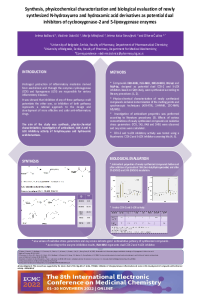
sciforum-066082.pdf
In silico approaches to evaluate the binding affinity of Verbascoside on Sirtuin1 (SIRT1) receptor for the treatment of diabetic wound healing
Anti-inflammatory activity of selected thiourea derivatives of naproxen on carrageenan induced paw edema in Wistar albino rats