Event submissions
Published
 10.3390/ECMC2022-13315 (registering DOI)
 This submission belongs to the session S4. Small molecules as drug candidates of the event 8th International Electronic Conference on Medicinal Chemistry
Published date
01 Nov, 2022
Academic Editor
'%3e%3cpath%20d='M12.6657%2010.9104C12.4185%2010.325%2012.0599%209.79327%2011.6097%209.34482C11.1609%208.89508%2010.6293%208.5365%2010.0442%208.28888C10.0389%208.28626%2010.0337%208.28495%2010.0285%208.28233C10.8446%207.69279%2011.3752%206.73249%2011.3752%205.64904C11.3752%203.8542%209.92103%202.39999%208.1262%202.39999C6.33136%202.39999%204.87715%203.8542%204.87715%205.64904C4.87715%206.73249%205.40774%207.69279%206.22393%208.28364C6.21869%208.28626%206.21345%208.28757%206.20821%208.29019C5.62129%208.5378%205.09463%208.89284%204.64265%209.34613C4.1929%209.79493%203.83432%2010.3266%203.58671%2010.9117C3.34345%2011.4845%203.21226%2012.0987%203.20023%2012.7209C3.19988%2012.7349%203.20233%2012.7488%203.20744%2012.7619C3.21255%2012.7749%203.22022%2012.7867%203.22998%2012.7968C3.23975%2012.8068%203.25142%2012.8147%203.26431%2012.8202C3.2772%2012.8256%203.29105%2012.8284%203.30504%2012.8284H4.09109C4.14874%2012.8284%204.19459%2012.7825%204.1959%2012.7262C4.2221%2011.7148%204.62823%2010.7676%205.34617%2010.0497C6.08899%209.30683%207.0755%208.89808%208.1262%208.89808C9.17689%208.89808%2010.1634%209.30683%2010.9062%2010.0497C11.6242%2010.7676%2012.0303%2011.7148%2012.0565%2012.7262C12.0578%2012.7838%2012.1037%2012.8284%2012.1613%2012.8284H12.9474C12.9613%2012.8284%2012.9752%2012.8256%2012.9881%2012.8202C13.001%2012.8147%2013.0126%2012.8068%2013.0224%2012.7968C13.0322%2012.7867%2013.0398%2012.7749%2013.0449%2012.7619C13.0501%2012.7488%2013.0525%2012.7349%2013.0522%2012.7209C13.0391%2012.0947%2012.9094%2011.4855%2012.6657%2010.9104ZM8.1262%207.9024C7.52486%207.9024%206.9589%207.6679%206.53312%207.24211C6.10733%206.81633%205.87283%206.25037%205.87283%205.64904C5.87283%205.0477%206.10733%204.48174%206.53312%204.05596C6.9589%203.63018%207.52486%203.39567%208.1262%203.39567C8.72753%203.39567%209.29349%203.63018%209.71927%204.05596C10.1451%204.48174%2010.3796%205.0477%2010.3796%205.64904C10.3796%206.25037%2010.1451%206.81633%209.71927%207.24211C9.29349%207.6679%208.72753%207.9024%208.1262%207.9024Z'%20fill='%235D1EE1'/%3e%3c/g%3e%3c/svg%3e) Maria Emília Sousa
Maria Emília SousaCitation
Agnieszka Zagórska, Jakub Jończyk, Anna Czopek, Sarah D'Alessandro, Silvia Parapini, Donatella Taramelli, Serena Delbue, Lucia Signorini, Adam Markowski, Anna Jaromin, Design, synthesis and evaluation of potential inhibitors of main protease (Mpro) of SARS-CoV-2., in Proceedings of 8th International Electronic Conference on Medicinal Chemistry, 1 November–30 November 2022, MDPI: Basel, Switzerland, doi: 10.3390/ECMC2022-13315
Share
Email
Facebook
Twitter
LinkedIn
Design, synthesis and evaluation of potential inhibitors of main protease (Mpro) of SARS-CoV-2.

Agnieszka Zagórska 1
'%3e%3cpath%20d='M12.6647%2010.9104C12.4176%2010.325%2012.0589%209.7933%2011.6088%209.34485C11.16%208.89511%2010.6283%208.53653%2010.0432%208.28891C10.038%208.28629%2010.0327%208.28498%2010.0275%208.28236C10.8437%207.69282%2011.3743%206.73252%2011.3743%205.64907C11.3743%203.85423%209.92005%202.40002%208.12522%202.40002C6.33038%202.40002%204.87618%203.85423%204.87618%205.64907C4.87618%206.73252%205.40677%207.69282%206.22296%208.28367C6.21772%208.28629%206.21248%208.2876%206.20724%208.29022C5.62031%208.53783%205.09365%208.89287%204.64167%209.34616C4.19192%209.79496%203.83334%2010.3266%203.58573%2010.9117C3.34247%2011.4846%203.21128%2012.0987%203.19925%2012.721C3.1989%2012.735%203.20135%2012.7489%203.20646%2012.7619C3.21157%2012.7749%203.21924%2012.7868%203.22901%2012.7968C3.23877%2012.8068%203.25045%2012.8148%203.26334%2012.8202C3.27623%2012.8256%203.29007%2012.8284%203.30406%2012.8284H4.09012C4.14776%2012.8284%204.19362%2012.7825%204.19493%2012.7262C4.22113%2011.7148%204.62726%2010.7676%205.34519%2010.0497C6.08802%209.30686%207.07452%208.89811%208.12522%208.89811C9.17592%208.89811%2010.1624%209.30686%2010.9052%2010.0497C11.6232%2010.7676%2012.0293%2011.7148%2012.0555%2012.7262C12.0568%2012.7839%2012.1027%2012.8284%2012.1603%2012.8284H12.9464C12.9604%2012.8284%2012.9742%2012.8256%2012.9871%2012.8202C13%2012.8148%2013.0117%2012.8068%2013.0214%2012.7968C13.0312%2012.7868%2013.0389%2012.7749%2013.044%2012.7619C13.0491%2012.7489%2013.0515%2012.735%2013.0512%2012.721C13.0381%2012.0947%2012.9084%2011.4856%2012.6647%2010.9104ZM8.12522%207.90243C7.52388%207.90243%206.95792%207.66793%206.53214%207.24215C6.10636%206.81636%205.87185%206.2504%205.87185%205.64907C5.87185%205.04773%206.10636%204.48177%206.53214%204.05599C6.95792%203.63021%207.52388%203.3957%208.12522%203.3957C8.72655%203.3957%209.29252%203.63021%209.7183%204.05599C10.1441%204.48177%2010.3786%205.04773%2010.3786%205.64907C10.3786%206.2504%2010.1441%206.81636%209.7183%207.24215C9.29252%207.66793%208.72655%207.90243%208.12522%207.90243Z'%20fill='%235D1EE1'/%3e%3c/g%3e%3c/svg%3e)
Jakub Jończyk 1
Anna Czopek 1
Sarah D'Alessandro 2
Silvia Parapini 3

Donatella Taramelli 2
Serena Delbue 4
Lucia Signorini 4
Adam Markowski 5
Anna Jaromin 5
1. Faculty of Pharmacy, Chair of Medicinal Chemistry, Jagiellonian University Medical College, 9 Medyczna Street, 30-688 Kraków, Poland
2. Dipartimento di Scienze Farmacologiche e Biomolecolari, Università degli Studi di Milano, Via Pascal, 36, 20133 Milano
3. Dipartimento di Scienze Biomediche per la Salute, Università degli Studi di Milano, Via Pascal 36, 20133 Milano, Italy
4. Dipartimento di Scienze Biomediche Chirurgiche e Odontoiatriche, Università degli Studi di Milano, Via Pascal 36, 20133 Milano, Italy
5. Department of Lipids and Liposomes, Faculty of Biotechnology, University of Wrocław, Joliot-Curie 14a, 50-383 Wrocław, Poland
Abstract
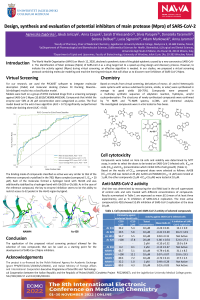
The World Health Organization (WHO), on March 12, 2020, declared a pandemic state of the global epidemic caused by a new coronavirus, SARS-CoV-2. Identifying the Main protease (Mpro) of SARS-CoV-2 as a drug target led to a speed-up drug design and discovery process. However, an effective algorithm is needed to indicate the activity against (Mpro) during virtual screening. In our studies, we proposed a virtual screening protocol combining molecular modeling and machine learning techniques that will allow us to discover novel inhibitors of SARS-CoV-2 Mpro. Based on results from virtual screening, potential Mpro inhibitors were selected for synthesis and further in vitro evaluation. The effectiveness of small-molecule compounds, derivatives of mono-, di- and tri-heterocyclic azole systems with various substituents of an amine, amide, or ester nature were evaluated in the test for antiviral activity. Compounds were first tested on Vero E6 cells to select non-toxic doses on SARS-CoV-2 infected cells. Next, we studied the anti-SARS-CoV-2 activity of selected compounds on infected Vero E6 cells. The most active compound showed 52.6% inhibition of SARS-CoV-2 replication at the dose of 20 µM. In summary, the application of the proposed virtual screening protocol allowed the selection of new compounds to be used as a starting point for developing SARS-Cov-2 Mpro inhibitors.
The project is co-financed by the Polish National Agency for Academic Exchange (PPN/BIT/2021/1/00056/U/00001), Italian Ministry of Foreign Affairs and International Cooperation Executive Programme of Scientific and Technological Cooperation between the Italian Republic and the Republic of Poland (PO22MO07), JUMC grants N42/DBS/000217, N42/DBS/000303.
Keywords
synthesis
drug-likeness properties
3CLpro
Mpro
COVID-19
Poster
sciforum-066169.pdf
Preparation and evaluation of sunscreen for cucumber seed extract
Synthesis, molecular docking analysis, ADMET and drug likeness prediction of a benzenesulfonamide derivative analogue of SLC-0111