Event submissions
Published
 10.3390/ecsa-9-13348 (registering DOI)
 This submission belongs to the session H. Posters of the event 9th International Electronic Conference on Sensors and Applications
Published date
01 Nov, 2022
Academic Editor
'%3e%3cpath%20d='M12.6657%2010.9104C12.4185%2010.325%2012.0599%209.79327%2011.6097%209.34482C11.1609%208.89508%2010.6293%208.5365%2010.0442%208.28888C10.0389%208.28626%2010.0337%208.28495%2010.0285%208.28233C10.8446%207.69279%2011.3752%206.73249%2011.3752%205.64904C11.3752%203.8542%209.92103%202.39999%208.1262%202.39999C6.33136%202.39999%204.87715%203.8542%204.87715%205.64904C4.87715%206.73249%205.40774%207.69279%206.22393%208.28364C6.21869%208.28626%206.21345%208.28757%206.20821%208.29019C5.62129%208.5378%205.09463%208.89284%204.64265%209.34613C4.1929%209.79493%203.83432%2010.3266%203.58671%2010.9117C3.34345%2011.4845%203.21226%2012.0987%203.20023%2012.7209C3.19988%2012.7349%203.20233%2012.7488%203.20744%2012.7619C3.21255%2012.7749%203.22022%2012.7867%203.22998%2012.7968C3.23975%2012.8068%203.25142%2012.8147%203.26431%2012.8202C3.2772%2012.8256%203.29105%2012.8284%203.30504%2012.8284H4.09109C4.14874%2012.8284%204.19459%2012.7825%204.1959%2012.7262C4.2221%2011.7148%204.62823%2010.7676%205.34617%2010.0497C6.08899%209.30683%207.0755%208.89808%208.1262%208.89808C9.17689%208.89808%2010.1634%209.30683%2010.9062%2010.0497C11.6242%2010.7676%2012.0303%2011.7148%2012.0565%2012.7262C12.0578%2012.7838%2012.1037%2012.8284%2012.1613%2012.8284H12.9474C12.9613%2012.8284%2012.9752%2012.8256%2012.9881%2012.8202C13.001%2012.8147%2013.0126%2012.8068%2013.0224%2012.7968C13.0322%2012.7867%2013.0398%2012.7749%2013.0449%2012.7619C13.0501%2012.7488%2013.0525%2012.7349%2013.0522%2012.7209C13.0391%2012.0947%2012.9094%2011.4855%2012.6657%2010.9104ZM8.1262%207.9024C7.52486%207.9024%206.9589%207.6679%206.53312%207.24211C6.10733%206.81633%205.87283%206.25037%205.87283%205.64904C5.87283%205.0477%206.10733%204.48174%206.53312%204.05596C6.9589%203.63018%207.52486%203.39567%208.1262%203.39567C8.72753%203.39567%209.29349%203.63018%209.71927%204.05596C10.1451%204.48174%2010.3796%205.0477%2010.3796%205.64904C10.3796%206.25037%2010.1451%206.81633%209.71927%207.24211C9.29349%207.6679%208.72753%207.9024%208.1262%207.9024Z'%20fill='%235D1EE1'/%3e%3c/g%3e%3c/svg%3e) Jean-marc Laheurte
Jean-marc LaheurteCitation
Simone Bassini, Elise Daems, Guy Van Camp, Ken Op de Beeck, Karolien De Wael, A Novel Photoelectrochemical Biosensor for Cystic Fibrosis Detection, in Proceedings of 9th International Electronic Conference on Sensors and Applications, 1 November–15 November 2022, MDPI: Basel, Switzerland, doi: 10.3390/ecsa-9-13348
Share
Email
Facebook
Twitter
LinkedIn
A Novel Photoelectrochemical Biosensor for Cystic Fibrosis Detection
'%3e%3cpath%20d='M12.6647%2010.9104C12.4176%2010.325%2012.0589%209.7933%2011.6088%209.34485C11.16%208.89511%2010.6283%208.53653%2010.0432%208.28891C10.038%208.28629%2010.0327%208.28498%2010.0275%208.28236C10.8437%207.69282%2011.3743%206.73252%2011.3743%205.64907C11.3743%203.85423%209.92005%202.40002%208.12522%202.40002C6.33038%202.40002%204.87618%203.85423%204.87618%205.64907C4.87618%206.73252%205.40677%207.69282%206.22296%208.28367C6.21772%208.28629%206.21248%208.2876%206.20724%208.29022C5.62031%208.53783%205.09365%208.89287%204.64167%209.34616C4.19192%209.79496%203.83334%2010.3266%203.58573%2010.9117C3.34247%2011.4846%203.21128%2012.0987%203.19925%2012.721C3.1989%2012.735%203.20135%2012.7489%203.20646%2012.7619C3.21157%2012.7749%203.21924%2012.7868%203.22901%2012.7968C3.23877%2012.8068%203.25045%2012.8148%203.26334%2012.8202C3.27623%2012.8256%203.29007%2012.8284%203.30406%2012.8284H4.09012C4.14776%2012.8284%204.19362%2012.7825%204.19493%2012.7262C4.22113%2011.7148%204.62726%2010.7676%205.34519%2010.0497C6.08802%209.30686%207.07452%208.89811%208.12522%208.89811C9.17592%208.89811%2010.1624%209.30686%2010.9052%2010.0497C11.6232%2010.7676%2012.0293%2011.7148%2012.0555%2012.7262C12.0568%2012.7839%2012.1027%2012.8284%2012.1603%2012.8284H12.9464C12.9604%2012.8284%2012.9742%2012.8256%2012.9871%2012.8202C13%2012.8148%2013.0117%2012.8068%2013.0214%2012.7968C13.0312%2012.7868%2013.0389%2012.7749%2013.044%2012.7619C13.0491%2012.7489%2013.0515%2012.735%2013.0512%2012.721C13.0381%2012.0947%2012.9084%2011.4856%2012.6647%2010.9104ZM8.12522%207.90243C7.52388%207.90243%206.95792%207.66793%206.53214%207.24215C6.10636%206.81636%205.87185%206.2504%205.87185%205.64907C5.87185%205.04773%206.10636%204.48177%206.53214%204.05599C6.95792%203.63021%207.52388%203.3957%208.12522%203.3957C8.72655%203.3957%209.29252%203.63021%209.7183%204.05599C10.1441%204.48177%2010.3786%205.04773%2010.3786%205.64907C10.3786%206.2504%2010.1441%206.81636%209.7183%207.24215C9.29252%207.66793%208.72655%207.90243%208.12522%207.90243Z'%20fill='%235D1EE1'/%3e%3c/g%3e%3c/svg%3e)
Simone Bassini 1

Elise Daems 1
Guy Van Camp 1
Ken Op de Beeck 1
Karolien De Wael 1
1. University of Antwerp
Abstract
Nucleic acids and corresponding mutations are crucial in the diagnosis of a broad range of genetic diseases such as cystic fibrosis.1 This is the most common and fatal autosomal recessive genetic disease in EU countries and the USA.2
Over the years, different electrochemical sensors have been developed for the detection of nucleic acids to meet the demand for point-of-care diagnostics. However, these technologies have different drawbacks such as: i) low limit of detection ii) need of a well-defined orientation of DNA strands on the electrode surface iii) need of a trained person and iv) time-consuming sample preparation.3
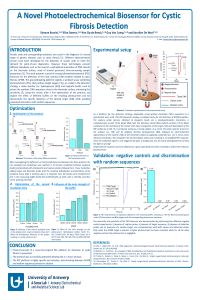
This work contributes to the diagnosis of cystic fibrosis via the development of a novel photoelectrochemical biosensor for the detection of its most common DNA mutation (i.e. F508, accounting for approximately 70% of all mutations) in the gene cystic fibrosis transmembrane conductance regulator.
This groundbreaking platform exploits a sandwich assay combining i) photosensitizers, that produce singlet oxygen (1O2), as a label in the detection strategy, ii) a redox reporter (i.e. hydroquinone) and iii) magnetic beads, used to attract the synthetic DNA sequences close to the electrode surface, enhancing the sensitivity.4 Since the signal is only triggered by light, a main advantage of our sensor is the clear distinction between signal and background by turning on/off the light source.
Using this platform, we explore the effect of different buffers on the resulting photocurrent and we demonstrate the specific detection of the desired target (F508) while avoiding unwanted interactions with random sequences.
References: : 1Wei, F. et al., Pediatr. Res., 2010, 67, 5, 458–468. 2Scotet, V. et al., Genes, 2020, 11, 589. 3Rashid, J. I. A. et al., Sens. Bio-Sens. Res., 2017, 16, 19–31. 4Shanmugam, S. T. et al., Biosens. Bioelectron., 2022, 195.
Keywords
Photoelectrochemistry
Biosensor
Cystic fibrosis
Biomarkers
Nucleic acids
Singlet oxygen
Photosensitizer
Manuscript
sciforum_064280_original_Bassini_Simone_Abstract -done.pdf
Poster
Poster_Bassini.pdf
LIGHT-TUNABLE HYBRID ORGANIC-INORGANIC NANOSTRUCTURED LAYERS FOR VIRTUAL SENSOR ARRAYS
Composites of functionalized multi-walled carbon nanotube and sodium alginate for tactile sensing applications