Event submissions
Published
 10.3390/IECBM2022-13383 (registering DOI)
 This submission belongs to the session B. Biomacromolecules: Carbohydrates of the event The 2nd International Electronic Conference on Biomolecules
Published date
01 Nov, 2022
Academic Editor
'%3e%3cpath%20d='M12.6657%2010.9104C12.4185%2010.325%2012.0599%209.79327%2011.6097%209.34482C11.1609%208.89508%2010.6293%208.5365%2010.0442%208.28888C10.0389%208.28626%2010.0337%208.28495%2010.0285%208.28233C10.8446%207.69279%2011.3752%206.73249%2011.3752%205.64904C11.3752%203.8542%209.92103%202.39999%208.1262%202.39999C6.33136%202.39999%204.87715%203.8542%204.87715%205.64904C4.87715%206.73249%205.40774%207.69279%206.22393%208.28364C6.21869%208.28626%206.21345%208.28757%206.20821%208.29019C5.62129%208.5378%205.09463%208.89284%204.64265%209.34613C4.1929%209.79493%203.83432%2010.3266%203.58671%2010.9117C3.34345%2011.4845%203.21226%2012.0987%203.20023%2012.7209C3.19988%2012.7349%203.20233%2012.7488%203.20744%2012.7619C3.21255%2012.7749%203.22022%2012.7867%203.22998%2012.7968C3.23975%2012.8068%203.25142%2012.8147%203.26431%2012.8202C3.2772%2012.8256%203.29105%2012.8284%203.30504%2012.8284H4.09109C4.14874%2012.8284%204.19459%2012.7825%204.1959%2012.7262C4.2221%2011.7148%204.62823%2010.7676%205.34617%2010.0497C6.08899%209.30683%207.0755%208.89808%208.1262%208.89808C9.17689%208.89808%2010.1634%209.30683%2010.9062%2010.0497C11.6242%2010.7676%2012.0303%2011.7148%2012.0565%2012.7262C12.0578%2012.7838%2012.1037%2012.8284%2012.1613%2012.8284H12.9474C12.9613%2012.8284%2012.9752%2012.8256%2012.9881%2012.8202C13.001%2012.8147%2013.0126%2012.8068%2013.0224%2012.7968C13.0322%2012.7867%2013.0398%2012.7749%2013.0449%2012.7619C13.0501%2012.7488%2013.0525%2012.7349%2013.0522%2012.7209C13.0391%2012.0947%2012.9094%2011.4855%2012.6657%2010.9104ZM8.1262%207.9024C7.52486%207.9024%206.9589%207.6679%206.53312%207.24211C6.10733%206.81633%205.87283%206.25037%205.87283%205.64904C5.87283%205.0477%206.10733%204.48174%206.53312%204.05596C6.9589%203.63018%207.52486%203.39567%208.1262%203.39567C8.72753%203.39567%209.29349%203.63018%209.71927%204.05596C10.1451%204.48174%2010.3796%205.0477%2010.3796%205.64904C10.3796%206.25037%2010.1451%206.81633%209.71927%207.24211C9.29349%207.6679%208.72753%207.9024%208.1262%207.9024Z'%20fill='%235D1EE1'/%3e%3c/g%3e%3c/svg%3e) Vladimir Uversky
Vladimir UverskyCitation
Italia Lima, Marcela Gaytán, Aurea Ramírez, Mar Villamiel, Rocío Campos, Liceth Cuellar, Use of mango by-products in the development of functional confectionery, in Proceedings of The 2nd International Electronic Conference on Biomolecules, 1 November–15 November 2022, MDPI: Basel, Switzerland, doi: 10.3390/IECBM2022-13383
Share
Email
Facebook
Twitter
LinkedIn
Use of mango by-products in the development of functional confectionery
'%3e%3cpath%20d='M12.6647%2010.9104C12.4176%2010.325%2012.0589%209.7933%2011.6088%209.34485C11.16%208.89511%2010.6283%208.53653%2010.0432%208.28891C10.038%208.28629%2010.0327%208.28498%2010.0275%208.28236C10.8437%207.69282%2011.3743%206.73252%2011.3743%205.64907C11.3743%203.85423%209.92005%202.40002%208.12522%202.40002C6.33038%202.40002%204.87618%203.85423%204.87618%205.64907C4.87618%206.73252%205.40677%207.69282%206.22296%208.28367C6.21772%208.28629%206.21248%208.2876%206.20724%208.29022C5.62031%208.53783%205.09365%208.89287%204.64167%209.34616C4.19192%209.79496%203.83334%2010.3266%203.58573%2010.9117C3.34247%2011.4846%203.21128%2012.0987%203.19925%2012.721C3.1989%2012.735%203.20135%2012.7489%203.20646%2012.7619C3.21157%2012.7749%203.21924%2012.7868%203.22901%2012.7968C3.23877%2012.8068%203.25045%2012.8148%203.26334%2012.8202C3.27623%2012.8256%203.29007%2012.8284%203.30406%2012.8284H4.09012C4.14776%2012.8284%204.19362%2012.7825%204.19493%2012.7262C4.22113%2011.7148%204.62726%2010.7676%205.34519%2010.0497C6.08802%209.30686%207.07452%208.89811%208.12522%208.89811C9.17592%208.89811%2010.1624%209.30686%2010.9052%2010.0497C11.6232%2010.7676%2012.0293%2011.7148%2012.0555%2012.7262C12.0568%2012.7839%2012.1027%2012.8284%2012.1603%2012.8284H12.9464C12.9604%2012.8284%2012.9742%2012.8256%2012.9871%2012.8202C13%2012.8148%2013.0117%2012.8068%2013.0214%2012.7968C13.0312%2012.7868%2013.0389%2012.7749%2013.044%2012.7619C13.0491%2012.7489%2013.0515%2012.735%2013.0512%2012.721C13.0381%2012.0947%2012.9084%2011.4856%2012.6647%2010.9104ZM8.12522%207.90243C7.52388%207.90243%206.95792%207.66793%206.53214%207.24215C6.10636%206.81636%205.87185%206.2504%205.87185%205.64907C5.87185%205.04773%206.10636%204.48177%206.53214%204.05599C6.95792%203.63021%207.52388%203.3957%208.12522%203.3957C8.72655%203.3957%209.29252%203.63021%209.7183%204.05599C10.1441%204.48177%2010.3786%205.04773%2010.3786%205.64907C10.3786%206.2504%2010.1441%206.81636%209.7183%207.24215C9.29252%207.66793%208.72655%207.90243%208.12522%207.90243Z'%20fill='%235D1EE1'/%3e%3c/g%3e%3c/svg%3e)
Italia Lima 1
Marcela Gaytán 2

Aurea Ramírez 3
Mar Villamiel 4

Rocío Campos 1
Liceth Cuellar 2
1. Programa de Posgrado en Alimentos del Centro de la República (PROPAC), Research and Graduate Studies in Food Science, School of Chemistry
2. Research and Graduate Studies in Food Science, School of Chemistry, Universidad Autónoma de Querétaro
3. Tecnológico de Monterrey, Campus Toluca
4. Instituto de Investigación en Ciencias de la Alimentación, CIAL (CSIC-UAM)
Abstract
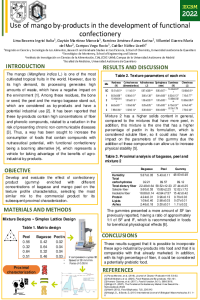
The mango (Mangifera indica L.) is one of the most cultivated fruits in the world, however, its processing generates high amounts of waste, called agro-industrial by-products, among which the stone or seed, peel and bagasse stand out. It has been reported that these by-products contain significant amounts of nutrients and phytochemicals, mainly fiber and phenolic compounds, which represent a potential added value for the food industry, which has increased the interest in their study and applications by various authors. One of these booming applications is functional confectionery, which represents a vehicle for taking advantage of the benefits of these by-products. Therefore, the present work seeks to develop and evaluate the effect of a functional confectionery product (gummy) enriched with different concentrations of bagasse and mango peel on the texture profile characteristics (TPA), essential for sensory evaluation, selecting the mixture with greater similarity to the commercial product for its subsequent proximal characterization. As a result, for mixture 2, which contains a high pectin and bagasse content, added to a low shell content, with respect to the other mixtures, it presents a TPA profile similar to the control commercial gummy. The proximal composition showed 41% carbohydrates, of which 59% belongs to total dietary fiber, divided into 26% soluble and 33% insoluble. When performing the Pearson correlation of mixtures vs. the texture profile, the hardness parameter is negatively correlated with the type of mixture, which in turn is related to both the gumminess and the chewiness of the product. These results suggest that it is possible to incorporate these agro-industrial by-products into food and that it is comparable with that already marketed. In addition, with its high percentage of fiber, it could be considered a potentially prebiotic food.
Keywords
Mango bagasse-mango peel-functional candy-fiber
Manuscript
sciforum-060802-done.pdf
Poster
Poster sciforum-060802.pdf
Study on the changes of urine differential protein expression of female athletes after different intensity treadmill exercise
Stability and in vitro biosafety study of an emulsion of Calendula officinalis L. with potential application in treating skin burn wounds