Event submissions
Published

This submission belongs to the session A. Biomacromolecules: Proteins of the event The 2nd International Electronic Conference on Biomolecules
Published date
01 Nov, 2022
Academic Editor
'%3e%3cpath%20d='M12.6657%2010.9104C12.4185%2010.325%2012.0599%209.79327%2011.6097%209.34482C11.1609%208.89508%2010.6293%208.5365%2010.0442%208.28888C10.0389%208.28626%2010.0337%208.28495%2010.0285%208.28233C10.8446%207.69279%2011.3752%206.73249%2011.3752%205.64904C11.3752%203.8542%209.92103%202.39999%208.1262%202.39999C6.33136%202.39999%204.87715%203.8542%204.87715%205.64904C4.87715%206.73249%205.40774%207.69279%206.22393%208.28364C6.21869%208.28626%206.21345%208.28757%206.20821%208.29019C5.62129%208.5378%205.09463%208.89284%204.64265%209.34613C4.1929%209.79493%203.83432%2010.3266%203.58671%2010.9117C3.34345%2011.4845%203.21226%2012.0987%203.20023%2012.7209C3.19988%2012.7349%203.20233%2012.7488%203.20744%2012.7619C3.21255%2012.7749%203.22022%2012.7867%203.22998%2012.7968C3.23975%2012.8068%203.25142%2012.8147%203.26431%2012.8202C3.2772%2012.8256%203.29105%2012.8284%203.30504%2012.8284H4.09109C4.14874%2012.8284%204.19459%2012.7825%204.1959%2012.7262C4.2221%2011.7148%204.62823%2010.7676%205.34617%2010.0497C6.08899%209.30683%207.0755%208.89808%208.1262%208.89808C9.17689%208.89808%2010.1634%209.30683%2010.9062%2010.0497C11.6242%2010.7676%2012.0303%2011.7148%2012.0565%2012.7262C12.0578%2012.7838%2012.1037%2012.8284%2012.1613%2012.8284H12.9474C12.9613%2012.8284%2012.9752%2012.8256%2012.9881%2012.8202C13.001%2012.8147%2013.0126%2012.8068%2013.0224%2012.7968C13.0322%2012.7867%2013.0398%2012.7749%2013.0449%2012.7619C13.0501%2012.7488%2013.0525%2012.7349%2013.0522%2012.7209C13.0391%2012.0947%2012.9094%2011.4855%2012.6657%2010.9104ZM8.1262%207.9024C7.52486%207.9024%206.9589%207.6679%206.53312%207.24211C6.10733%206.81633%205.87283%206.25037%205.87283%205.64904C5.87283%205.0477%206.10733%204.48174%206.53312%204.05596C6.9589%203.63018%207.52486%203.39567%208.1262%203.39567C8.72753%203.39567%209.29349%203.63018%209.71927%204.05596C10.1451%204.48174%2010.3796%205.0477%2010.3796%205.64904C10.3796%206.25037%2010.1451%206.81633%209.71927%207.24211C9.29349%207.6679%208.72753%207.9024%208.1262%207.9024Z'%20fill='%235D1EE1'/%3e%3c/g%3e%3c/svg%3e) Vladimir Uversky
Vladimir UverskyCitation
Anastasiia Petushkova, Arthur Zalevsky, Neonila Gorokhovets, Vladimir Makarov, Lyudmila Savvateeva, Marina Serebryakova, Andrey Golovin, Evgeni Zernii, Andrey Zamyatnin, pH-dependent specificity of papain-like cysteine proteases is determined by S1 binding pocket, in Proceedings of The 2nd International Electronic Conference on Biomolecules, 1 November–15 November 2022, MDPI: Basel, Switzerland, doi: 10.3390/IECBM2022-13385
Share
Email
Facebook
Twitter
LinkedIn
pH-dependent specificity of papain-like cysteine proteases is determined by S1 binding pocket
'%3e%3cpath%20d='M12.6647%2010.9104C12.4176%2010.325%2012.0589%209.7933%2011.6088%209.34485C11.16%208.89511%2010.6283%208.53653%2010.0432%208.28891C10.038%208.28629%2010.0327%208.28498%2010.0275%208.28236C10.8437%207.69282%2011.3743%206.73252%2011.3743%205.64907C11.3743%203.85423%209.92005%202.40002%208.12522%202.40002C6.33038%202.40002%204.87618%203.85423%204.87618%205.64907C4.87618%206.73252%205.40677%207.69282%206.22296%208.28367C6.21772%208.28629%206.21248%208.2876%206.20724%208.29022C5.62031%208.53783%205.09365%208.89287%204.64167%209.34616C4.19192%209.79496%203.83334%2010.3266%203.58573%2010.9117C3.34247%2011.4846%203.21128%2012.0987%203.19925%2012.721C3.1989%2012.735%203.20135%2012.7489%203.20646%2012.7619C3.21157%2012.7749%203.21924%2012.7868%203.22901%2012.7968C3.23877%2012.8068%203.25045%2012.8148%203.26334%2012.8202C3.27623%2012.8256%203.29007%2012.8284%203.30406%2012.8284H4.09012C4.14776%2012.8284%204.19362%2012.7825%204.19493%2012.7262C4.22113%2011.7148%204.62726%2010.7676%205.34519%2010.0497C6.08802%209.30686%207.07452%208.89811%208.12522%208.89811C9.17592%208.89811%2010.1624%209.30686%2010.9052%2010.0497C11.6232%2010.7676%2012.0293%2011.7148%2012.0555%2012.7262C12.0568%2012.7839%2012.1027%2012.8284%2012.1603%2012.8284H12.9464C12.9604%2012.8284%2012.9742%2012.8256%2012.9871%2012.8202C13%2012.8148%2013.0117%2012.8068%2013.0214%2012.7968C13.0312%2012.7868%2013.0389%2012.7749%2013.044%2012.7619C13.0491%2012.7489%2013.0515%2012.735%2013.0512%2012.721C13.0381%2012.0947%2012.9084%2011.4856%2012.6647%2010.9104ZM8.12522%207.90243C7.52388%207.90243%206.95792%207.66793%206.53214%207.24215C6.10636%206.81636%205.87185%206.2504%205.87185%205.64907C5.87185%205.04773%206.10636%204.48177%206.53214%204.05599C6.95792%203.63021%207.52388%203.3957%208.12522%203.3957C8.72655%203.3957%209.29252%203.63021%209.7183%204.05599C10.1441%204.48177%2010.3786%205.04773%2010.3786%205.64907C10.3786%206.2504%2010.1441%206.81636%209.7183%207.24215C9.29252%207.66793%208.72655%207.90243%208.12522%207.90243Z'%20fill='%235D1EE1'/%3e%3c/g%3e%3c/svg%3e)
Anastasiia Petushkova 1,2
Arthur Zalevsky 3
Neonila Gorokhovets 1
Vladimir Makarov 1
Lyudmila Savvateeva 1
Marina Serebryakova 4

Andrey Golovin 1,2,3
Evgeni Zernii 4

Andrey Zamyatnin 1,2,4
1. Institute of Molecular Medicine, Sechenov First Moscow State Medical University, Moscow, Russia
2. Sirius University of Science and Technology, Sochi, Russia
3. Faculty of Bioengineering and Bioinformatics, Lomonosov Moscow State University, Moscow, Russia
4. Belozersky Institute of Physico-Chemical Biology, Lomonosov Moscow State University, Moscow, Russia
Abstract
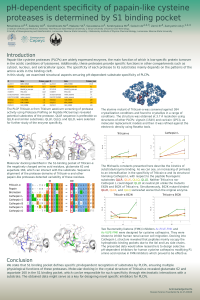
Papain-like cysteine proteases (PLCPs) are widely expressed enzymes, the main function of which is low-specific protein turnover in the acidic conditions of lysosomes. Additionally, these proteases provide specific functions in other compartments such as cytosol, nucleus, and extracellular space. The specificity of each protease to its substrates mainly depends on the patterns of the amino acids in the binding cleft. This specificity is highly regulated by media conditions and the presence of accessory proteins. In this study, we examined structural aspects ensuring pH-dependent substrate specificity of PLCPs. Experiments employing fluorogenic peptide substrates demonstrated that plant PLCPs and human cathepsins possess a pH-dependent specificity for the residue in the P1 position. X-ray crystallographic studies and molecular simulations allowed overall structure determination of the enzymes to predict residues in the S1 binding pocket which can form electrostatic contacts with the substrates. Sequence analysis established variability of these residues among PLCPs. Based on the obtained data we designed a peptide inhibitor for human cathepsin L and described its inhibitory potential. As a conclusion, we state that the S1 binding pocket defines specific pH-dependent recognition of substrates by PLCPs, ensuring multiple physiological functions of these proteases. This work was supported by the Russian Science Foundation (grant No. 22-25-00648).
Keywords
papain-like cysteine proteases
cysteine cathepsin
enzymatic activity
substrate specificity
binding cleft
Manuscript
sciforum-060883-done.pdf
Poster
poster_mdpi.pdf
Stability and in vitro biosafety study of an emulsion of Calendula officinalis L. with potential application in treating skin burn wounds
Study of spheroids fusion via multiphysics simulations: feasibility of applying permanent magnetic field gradients