Event submissions
Published
 10.3390/IECBM2022-13403 (registering DOI)
 This submission belongs to the session A. Biomacromolecules: Proteins of the event The 2nd International Electronic Conference on Biomolecules
Published date
01 Nov, 2022
Academic Editor
'%3e%3cpath%20d='M12.6657%2010.9104C12.4185%2010.325%2012.0599%209.79327%2011.6097%209.34482C11.1609%208.89508%2010.6293%208.5365%2010.0442%208.28888C10.0389%208.28626%2010.0337%208.28495%2010.0285%208.28233C10.8446%207.69279%2011.3752%206.73249%2011.3752%205.64904C11.3752%203.8542%209.92103%202.39999%208.1262%202.39999C6.33136%202.39999%204.87715%203.8542%204.87715%205.64904C4.87715%206.73249%205.40774%207.69279%206.22393%208.28364C6.21869%208.28626%206.21345%208.28757%206.20821%208.29019C5.62129%208.5378%205.09463%208.89284%204.64265%209.34613C4.1929%209.79493%203.83432%2010.3266%203.58671%2010.9117C3.34345%2011.4845%203.21226%2012.0987%203.20023%2012.7209C3.19988%2012.7349%203.20233%2012.7488%203.20744%2012.7619C3.21255%2012.7749%203.22022%2012.7867%203.22998%2012.7968C3.23975%2012.8068%203.25142%2012.8147%203.26431%2012.8202C3.2772%2012.8256%203.29105%2012.8284%203.30504%2012.8284H4.09109C4.14874%2012.8284%204.19459%2012.7825%204.1959%2012.7262C4.2221%2011.7148%204.62823%2010.7676%205.34617%2010.0497C6.08899%209.30683%207.0755%208.89808%208.1262%208.89808C9.17689%208.89808%2010.1634%209.30683%2010.9062%2010.0497C11.6242%2010.7676%2012.0303%2011.7148%2012.0565%2012.7262C12.0578%2012.7838%2012.1037%2012.8284%2012.1613%2012.8284H12.9474C12.9613%2012.8284%2012.9752%2012.8256%2012.9881%2012.8202C13.001%2012.8147%2013.0126%2012.8068%2013.0224%2012.7968C13.0322%2012.7867%2013.0398%2012.7749%2013.0449%2012.7619C13.0501%2012.7488%2013.0525%2012.7349%2013.0522%2012.7209C13.0391%2012.0947%2012.9094%2011.4855%2012.6657%2010.9104ZM8.1262%207.9024C7.52486%207.9024%206.9589%207.6679%206.53312%207.24211C6.10733%206.81633%205.87283%206.25037%205.87283%205.64904C5.87283%205.0477%206.10733%204.48174%206.53312%204.05596C6.9589%203.63018%207.52486%203.39567%208.1262%203.39567C8.72753%203.39567%209.29349%203.63018%209.71927%204.05596C10.1451%204.48174%2010.3796%205.0477%2010.3796%205.64904C10.3796%206.25037%2010.1451%206.81633%209.71927%207.24211C9.29349%207.6679%208.72753%207.9024%208.1262%207.9024Z'%20fill='%235D1EE1'/%3e%3c/g%3e%3c/svg%3e) Vladimir Uversky
Vladimir UverskyCitation
Akandé ROUCHIDANE EYITAYO, Marie-France GIRAUD, Laetitia DAURY, Olivier LAMBERT, Cécile GONZALEZ, Stéphen MANON, Cell-free synthesis and reconstitution of Bax in nanodiscs: comparison between wild-type Bax and a constitutively active mutant, in Proceedings of The 2nd International Electronic Conference on Biomolecules, 1 November–15 November 2022, MDPI: Basel, Switzerland, doi: 10.3390/IECBM2022-13403
Share
Email
Facebook
Twitter
LinkedIn
Cell-free synthesis and reconstitution of Bax in nanodiscs: comparison between wild-type Bax and a constitutively active mutant
'%3e%3cpath%20d='M12.6647%2010.9104C12.4176%2010.325%2012.0589%209.7933%2011.6088%209.34485C11.16%208.89511%2010.6283%208.53653%2010.0432%208.28891C10.038%208.28629%2010.0327%208.28498%2010.0275%208.28236C10.8437%207.69282%2011.3743%206.73252%2011.3743%205.64907C11.3743%203.85423%209.92005%202.40002%208.12522%202.40002C6.33038%202.40002%204.87618%203.85423%204.87618%205.64907C4.87618%206.73252%205.40677%207.69282%206.22296%208.28367C6.21772%208.28629%206.21248%208.2876%206.20724%208.29022C5.62031%208.53783%205.09365%208.89287%204.64167%209.34616C4.19192%209.79496%203.83334%2010.3266%203.58573%2010.9117C3.34247%2011.4846%203.21128%2012.0987%203.19925%2012.721C3.1989%2012.735%203.20135%2012.7489%203.20646%2012.7619C3.21157%2012.7749%203.21924%2012.7868%203.22901%2012.7968C3.23877%2012.8068%203.25045%2012.8148%203.26334%2012.8202C3.27623%2012.8256%203.29007%2012.8284%203.30406%2012.8284H4.09012C4.14776%2012.8284%204.19362%2012.7825%204.19493%2012.7262C4.22113%2011.7148%204.62726%2010.7676%205.34519%2010.0497C6.08802%209.30686%207.07452%208.89811%208.12522%208.89811C9.17592%208.89811%2010.1624%209.30686%2010.9052%2010.0497C11.6232%2010.7676%2012.0293%2011.7148%2012.0555%2012.7262C12.0568%2012.7839%2012.1027%2012.8284%2012.1603%2012.8284H12.9464C12.9604%2012.8284%2012.9742%2012.8256%2012.9871%2012.8202C13%2012.8148%2013.0117%2012.8068%2013.0214%2012.7968C13.0312%2012.7868%2013.0389%2012.7749%2013.044%2012.7619C13.0491%2012.7489%2013.0515%2012.735%2013.0512%2012.721C13.0381%2012.0947%2012.9084%2011.4856%2012.6647%2010.9104ZM8.12522%207.90243C7.52388%207.90243%206.95792%207.66793%206.53214%207.24215C6.10636%206.81636%205.87185%206.2504%205.87185%205.64907C5.87185%205.04773%206.10636%204.48177%206.53214%204.05599C6.95792%203.63021%207.52388%203.3957%208.12522%203.3957C8.72655%203.3957%209.29252%203.63021%209.7183%204.05599C10.1441%204.48177%2010.3786%205.04773%2010.3786%205.64907C10.3786%206.2504%2010.1441%206.81636%209.7183%207.24215C9.29252%207.66793%208.72655%207.90243%208.12522%207.90243Z'%20fill='%235D1EE1'/%3e%3c/g%3e%3c/svg%3e)
Akandé ROUCHIDANE EYITAYO 1
Marie-France GIRAUD 2
Laetitia DAURY 2
Olivier LAMBERT 2
Cécile GONZALEZ 3

Stéphen MANON 4
1. IBGC, UMR 5095, Université de Bordeaux, Centre National de la Recherche Scientifique
2. CBMN, UMR5248, Université de Bordeaux, Centre National de la Recherche Scientifique
3. IBCP, UMR5086, Université de Lyon 1, Centre National de la Recherche Scientifique
4. IBGC, UMR5095, Université de Bordeaux, Centre National de la Recherche Scientifique
Abstract
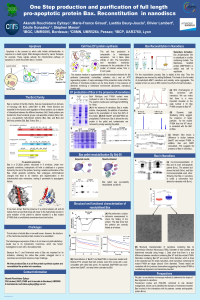
Bax is a major player in the mitochondrial pathway of apoptosis, by permeabilizing the Outer Mitochondrial Membrane (OMM) to various apoptogenic factors, including cytochrome c. In order to get further insight into the structure and function of Bax when it is inserted in the OMM, we attempted to reconstitute Bax in nanodiscs. Cell-free protein synthesis in the presence of nanodiscs did not allow to obtain Bax-containing nanodiscs, but it provided a simple way to purify full-length Bax without any tag. Purified wild-type Bax (BaxWT) and a constitutively active mutant (BaxP168A) displayed structural and functionnal properties that were in line with previous characterizations following their expression in yeast and human cells followed by their reconstitution into liposomes, showing that the mutant BaxP168A was more active than BaxWT. Both Bax variants were then reconstituted in nanodiscs by co-formation. Size exclusion chromatography, dynamic light scattering and transmission electron microscopy showed that nanodiscs formed with BaxP168A were larger than nanodiscs formed with BaxWT. We calculated that nanodiscs containing BaxP168A displayed a pore having a diameter of about 4.8 nm. This was consistent with the hypothesis that BaxP168A was reconstituted in nanodiscs as an active oligomer, corresponding to an intermediate step between the initial insertion of active Bax monomers/dimers (forming a pore having a diameter of 3.5 nm) and the formation of large pores observed during late apoptosis (having a diameter above 40 nm).
Keywords
apoptosis
B-cell lymphoma-2 (Bcl-2) family
Bax
nanodiscs
liposomes
electron microscopy (EM)
Manuscript
sciforum-064359-done.pdf
Poster
Rouchidane eyitayo et al.pdf
Space and terrestrial temperature-induced nucleation and growth of protein single crystals
Biotechnological complex based on lipase and β-cyclodextrin on hydrolysis of acylglycerides in plant oils and fats