Event submissions
Published

This submission belongs to the session S5. Biomolecules as therapeutics of the event 8th International Electronic Conference on Medicinal Chemistry
Published date
01 Nov, 2022
Academic Editor
'%3e%3cpath%20d='M12.6657%2010.9104C12.4185%2010.325%2012.0599%209.79327%2011.6097%209.34482C11.1609%208.89508%2010.6293%208.5365%2010.0442%208.28888C10.0389%208.28626%2010.0337%208.28495%2010.0285%208.28233C10.8446%207.69279%2011.3752%206.73249%2011.3752%205.64904C11.3752%203.8542%209.92103%202.39999%208.1262%202.39999C6.33136%202.39999%204.87715%203.8542%204.87715%205.64904C4.87715%206.73249%205.40774%207.69279%206.22393%208.28364C6.21869%208.28626%206.21345%208.28757%206.20821%208.29019C5.62129%208.5378%205.09463%208.89284%204.64265%209.34613C4.1929%209.79493%203.83432%2010.3266%203.58671%2010.9117C3.34345%2011.4845%203.21226%2012.0987%203.20023%2012.7209C3.19988%2012.7349%203.20233%2012.7488%203.20744%2012.7619C3.21255%2012.7749%203.22022%2012.7867%203.22998%2012.7968C3.23975%2012.8068%203.25142%2012.8147%203.26431%2012.8202C3.2772%2012.8256%203.29105%2012.8284%203.30504%2012.8284H4.09109C4.14874%2012.8284%204.19459%2012.7825%204.1959%2012.7262C4.2221%2011.7148%204.62823%2010.7676%205.34617%2010.0497C6.08899%209.30683%207.0755%208.89808%208.1262%208.89808C9.17689%208.89808%2010.1634%209.30683%2010.9062%2010.0497C11.6242%2010.7676%2012.0303%2011.7148%2012.0565%2012.7262C12.0578%2012.7838%2012.1037%2012.8284%2012.1613%2012.8284H12.9474C12.9613%2012.8284%2012.9752%2012.8256%2012.9881%2012.8202C13.001%2012.8147%2013.0126%2012.8068%2013.0224%2012.7968C13.0322%2012.7867%2013.0398%2012.7749%2013.0449%2012.7619C13.0501%2012.7488%2013.0525%2012.7349%2013.0522%2012.7209C13.0391%2012.0947%2012.9094%2011.4855%2012.6657%2010.9104ZM8.1262%207.9024C7.52486%207.9024%206.9589%207.6679%206.53312%207.24211C6.10733%206.81633%205.87283%206.25037%205.87283%205.64904C5.87283%205.0477%206.10733%204.48174%206.53312%204.05596C6.9589%203.63018%207.52486%203.39567%208.1262%203.39567C8.72753%203.39567%209.29349%203.63018%209.71927%204.05596C10.1451%204.48174%2010.3796%205.0477%2010.3796%205.64904C10.3796%206.25037%2010.1451%206.81633%209.71927%207.24211C9.29349%207.6679%208.72753%207.9024%208.1262%207.9024Z'%20fill='%235D1EE1'/%3e%3c/g%3e%3c/svg%3e) Alfredo Berzal-Herranz
Alfredo Berzal-HerranzCitation
Maria Mernea, Maria-Eliza Satmaru, Alina-Nicoleta Toma, Cristina Doina Niţu, Dan Florin Mihailescu, Speranta Avram, Miruna Silvia Stan, A molecular docking study on natural compounds as anxiolytics and antidepressants, in Proceedings of 8th International Electronic Conference on Medicinal Chemistry, 1 November–30 November 2022, MDPI: Basel, Switzerland, doi: 10.3390/ECMC2022-13412
Share
Email
Facebook
Twitter
LinkedIn
A molecular docking study on natural compounds as anxiolytics and antidepressants
'%3e%3cpath%20d='M12.6647%2010.9104C12.4176%2010.325%2012.0589%209.7933%2011.6088%209.34485C11.16%208.89511%2010.6283%208.53653%2010.0432%208.28891C10.038%208.28629%2010.0327%208.28498%2010.0275%208.28236C10.8437%207.69282%2011.3743%206.73252%2011.3743%205.64907C11.3743%203.85423%209.92005%202.40002%208.12522%202.40002C6.33038%202.40002%204.87618%203.85423%204.87618%205.64907C4.87618%206.73252%205.40677%207.69282%206.22296%208.28367C6.21772%208.28629%206.21248%208.2876%206.20724%208.29022C5.62031%208.53783%205.09365%208.89287%204.64167%209.34616C4.19192%209.79496%203.83334%2010.3266%203.58573%2010.9117C3.34247%2011.4846%203.21128%2012.0987%203.19925%2012.721C3.1989%2012.735%203.20135%2012.7489%203.20646%2012.7619C3.21157%2012.7749%203.21924%2012.7868%203.22901%2012.7968C3.23877%2012.8068%203.25045%2012.8148%203.26334%2012.8202C3.27623%2012.8256%203.29007%2012.8284%203.30406%2012.8284H4.09012C4.14776%2012.8284%204.19362%2012.7825%204.19493%2012.7262C4.22113%2011.7148%204.62726%2010.7676%205.34519%2010.0497C6.08802%209.30686%207.07452%208.89811%208.12522%208.89811C9.17592%208.89811%2010.1624%209.30686%2010.9052%2010.0497C11.6232%2010.7676%2012.0293%2011.7148%2012.0555%2012.7262C12.0568%2012.7839%2012.1027%2012.8284%2012.1603%2012.8284H12.9464C12.9604%2012.8284%2012.9742%2012.8256%2012.9871%2012.8202C13%2012.8148%2013.0117%2012.8068%2013.0214%2012.7968C13.0312%2012.7868%2013.0389%2012.7749%2013.044%2012.7619C13.0491%2012.7489%2013.0515%2012.735%2013.0512%2012.721C13.0381%2012.0947%2012.9084%2011.4856%2012.6647%2010.9104ZM8.12522%207.90243C7.52388%207.90243%206.95792%207.66793%206.53214%207.24215C6.10636%206.81636%205.87185%206.2504%205.87185%205.64907C5.87185%205.04773%206.10636%204.48177%206.53214%204.05599C6.95792%203.63021%207.52388%203.3957%208.12522%203.3957C8.72655%203.3957%209.29252%203.63021%209.7183%204.05599C10.1441%204.48177%2010.3786%205.04773%2010.3786%205.64907C10.3786%206.2504%2010.1441%206.81636%209.7183%207.24215C9.29252%207.66793%208.72655%207.90243%208.12522%207.90243Z'%20fill='%235D1EE1'/%3e%3c/g%3e%3c/svg%3e)
Maria Mernea 1
Maria-Eliza Satmaru 1
Alina-Nicoleta Toma 1
Cristina Doina Niţu 2,3
Dan Florin Mihailescu 1
Speranta Avram 1

Miruna Silvia Stan 4
1. Department of Anatomy, Animal Physiology and Biophysics, Faculty of Biology, University of Bucharest, Bucharest, Romania
2. Doctoral School of Biology, Faculty of Biology, University of Bucharest, Bucharest, Romania
3. Institute of Oncology “Prof. dr. Al. Trestioreanu”, Bucharest, Romania
4. Department of Biochemistry and Molecular Biology, Faculty of Biology, University of Bucharest, Bucharest, Romania
Abstract
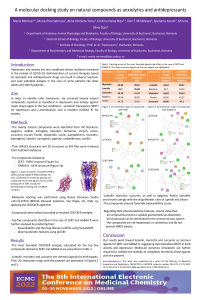
Anxiety and depression are two conditions whose incidence increased in the context of COVID-19. Administration of current therapies based on anxiolytic and antidepressant drugs can result in adverse reactions and even potential dangers in the case of some patients like older adults and elderly patients. Aiming to identify safer treatments, we used molecular docking to screen twenty natural compounds against γ-aminobutyric acid A receptor (GABAA receptor), a major drug target in anxiety, and against serotonin transporter (SERT), a major drug target in depression. The list of compounds included molecules that were previously reported as beneficial in the two conditions. In the case of all molecules, we predicted their drug-likeness, bioavailability and pharmacokinetic profiles. Molecular docking has showed that the top five molecules in terms of affinity for GABAA receptor are luteolin, baicalein, myricetin, chrysin and curcumin. In the case of SERT, the top five ligands resulted to be myricetin, luteolin, curcumin, apigenin and fisetin. According to the predictions performed here, these molecules comply with drug-likeness rules, are bioavailable and non-toxic, present a high intestinal absorption and are distributed to the central nervous system. Our results point toward luteolin, myricetin and curcumin as common ligands for GABAA receptor and SERT, suggesting their beneficial effect in both anxiety and depression.
Keywords
natural compounds
anxiolytics
antidepressants
molecular docking
Poster
sciforum-066187.pdf
Chiral derivatives of xanthones: synthesis, enantiomeric purity and enantioselectivity in the reversal antimicrobial resistance mechanisms
Chalcones as potential inhibitors of pancreatic lipase