Event submissions
Published

This submission belongs to the session S8. Pharmaceutical development of the event 8th International Electronic Conference on Medicinal Chemistry
Published date
01 Nov, 2022
Academic Editor
'%3e%3cpath%20d='M12.6657%2010.9104C12.4185%2010.325%2012.0599%209.79327%2011.6097%209.34482C11.1609%208.89508%2010.6293%208.5365%2010.0442%208.28888C10.0389%208.28626%2010.0337%208.28495%2010.0285%208.28233C10.8446%207.69279%2011.3752%206.73249%2011.3752%205.64904C11.3752%203.8542%209.92103%202.39999%208.1262%202.39999C6.33136%202.39999%204.87715%203.8542%204.87715%205.64904C4.87715%206.73249%205.40774%207.69279%206.22393%208.28364C6.21869%208.28626%206.21345%208.28757%206.20821%208.29019C5.62129%208.5378%205.09463%208.89284%204.64265%209.34613C4.1929%209.79493%203.83432%2010.3266%203.58671%2010.9117C3.34345%2011.4845%203.21226%2012.0987%203.20023%2012.7209C3.19988%2012.7349%203.20233%2012.7488%203.20744%2012.7619C3.21255%2012.7749%203.22022%2012.7867%203.22998%2012.7968C3.23975%2012.8068%203.25142%2012.8147%203.26431%2012.8202C3.2772%2012.8256%203.29105%2012.8284%203.30504%2012.8284H4.09109C4.14874%2012.8284%204.19459%2012.7825%204.1959%2012.7262C4.2221%2011.7148%204.62823%2010.7676%205.34617%2010.0497C6.08899%209.30683%207.0755%208.89808%208.1262%208.89808C9.17689%208.89808%2010.1634%209.30683%2010.9062%2010.0497C11.6242%2010.7676%2012.0303%2011.7148%2012.0565%2012.7262C12.0578%2012.7838%2012.1037%2012.8284%2012.1613%2012.8284H12.9474C12.9613%2012.8284%2012.9752%2012.8256%2012.9881%2012.8202C13.001%2012.8147%2013.0126%2012.8068%2013.0224%2012.7968C13.0322%2012.7867%2013.0398%2012.7749%2013.0449%2012.7619C13.0501%2012.7488%2013.0525%2012.7349%2013.0522%2012.7209C13.0391%2012.0947%2012.9094%2011.4855%2012.6657%2010.9104ZM8.1262%207.9024C7.52486%207.9024%206.9589%207.6679%206.53312%207.24211C6.10733%206.81633%205.87283%206.25037%205.87283%205.64904C5.87283%205.0477%206.10733%204.48174%206.53312%204.05596C6.9589%203.63018%207.52486%203.39567%208.1262%203.39567C8.72753%203.39567%209.29349%203.63018%209.71927%204.05596C10.1451%204.48174%2010.3796%205.0477%2010.3796%205.64904C10.3796%206.25037%2010.1451%206.81633%209.71927%207.24211C9.29349%207.6679%208.72753%207.9024%208.1262%207.9024Z'%20fill='%235D1EE1'/%3e%3c/g%3e%3c/svg%3e) Alfredo Berzal-Herranz
Alfredo Berzal-HerranzCitation
CHANCHAL KIRAN THAKUR, Chandrabose Karthikeyan, Subhasmita Bhal, Chanakya Nath Kundu, N.S. Hari Narayana Moorthy, Targeted Delivery of Doxorubicin to Breast Cancer Cells by Multiwalled Carbon Nanotubes Functionalized with Lysine via 1,3-Dipolar Cycloaddition and Conjugation with Sugar moieties., in Proceedings of 8th International Electronic Conference on Medicinal Chemistry, 1 November–30 November 2022, MDPI: Basel, Switzerland, doi: 10.3390/ECMC2022-13421
Share
Email
Facebook
Twitter
LinkedIn
Targeted Delivery of Doxorubicin to Breast Cancer Cells by Multiwalled Carbon Nanotubes Functionalized with Lysine via 1,3-Dipolar Cycloaddition and Conjugation with Sugar moieties.
'%3e%3cpath%20d='M12.6647%2010.9104C12.4176%2010.325%2012.0589%209.7933%2011.6088%209.34485C11.16%208.89511%2010.6283%208.53653%2010.0432%208.28891C10.038%208.28629%2010.0327%208.28498%2010.0275%208.28236C10.8437%207.69282%2011.3743%206.73252%2011.3743%205.64907C11.3743%203.85423%209.92005%202.40002%208.12522%202.40002C6.33038%202.40002%204.87618%203.85423%204.87618%205.64907C4.87618%206.73252%205.40677%207.69282%206.22296%208.28367C6.21772%208.28629%206.21248%208.2876%206.20724%208.29022C5.62031%208.53783%205.09365%208.89287%204.64167%209.34616C4.19192%209.79496%203.83334%2010.3266%203.58573%2010.9117C3.34247%2011.4846%203.21128%2012.0987%203.19925%2012.721C3.1989%2012.735%203.20135%2012.7489%203.20646%2012.7619C3.21157%2012.7749%203.21924%2012.7868%203.22901%2012.7968C3.23877%2012.8068%203.25045%2012.8148%203.26334%2012.8202C3.27623%2012.8256%203.29007%2012.8284%203.30406%2012.8284H4.09012C4.14776%2012.8284%204.19362%2012.7825%204.19493%2012.7262C4.22113%2011.7148%204.62726%2010.7676%205.34519%2010.0497C6.08802%209.30686%207.07452%208.89811%208.12522%208.89811C9.17592%208.89811%2010.1624%209.30686%2010.9052%2010.0497C11.6232%2010.7676%2012.0293%2011.7148%2012.0555%2012.7262C12.0568%2012.7839%2012.1027%2012.8284%2012.1603%2012.8284H12.9464C12.9604%2012.8284%2012.9742%2012.8256%2012.9871%2012.8202C13%2012.8148%2013.0117%2012.8068%2013.0214%2012.7968C13.0312%2012.7868%2013.0389%2012.7749%2013.044%2012.7619C13.0491%2012.7489%2013.0515%2012.735%2013.0512%2012.721C13.0381%2012.0947%2012.9084%2011.4856%2012.6647%2010.9104ZM8.12522%207.90243C7.52388%207.90243%206.95792%207.66793%206.53214%207.24215C6.10636%206.81636%205.87185%206.2504%205.87185%205.64907C5.87185%205.04773%206.10636%204.48177%206.53214%204.05599C6.95792%203.63021%207.52388%203.3957%208.12522%203.3957C8.72655%203.3957%209.29252%203.63021%209.7183%204.05599C10.1441%204.48177%2010.3786%205.04773%2010.3786%205.64907C10.3786%206.2504%2010.1441%206.81636%209.7183%207.24215C9.29252%207.66793%208.72655%207.90243%208.12522%207.90243Z'%20fill='%235D1EE1'/%3e%3c/g%3e%3c/svg%3e)
CHANCHAL KIRAN THAKUR 1
Chandrabose Karthikeyan 1
Subhasmita Bhal 2
Chanakya Nath Kundu 2
N.S. Hari Narayana Moorthy 1
1. Cancept Therapeutics Laboratory, Department of Pharmacy, Indira Gandhi National Tribal University, Lalpur, Amarkantak (MP)-484887, India.
2. Cancer Biology Division, School of Biotechnology, KIIT deemed to be University, Campus-11, Patia, Bhubaneswar, Odisha, 751024, India.
Abstract
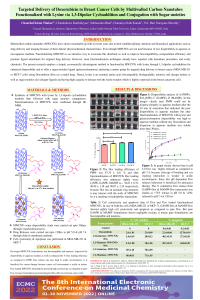
Multiwalled carbon nanotubes (MWCNTs) have gained a lot of multidisciplinary attention and biomedical applications such as drug delivery, because of their distinct physicochemical characteristics. Even though MWCNTs are not used because of low dispersibility in aqueous or non-aqueous medium. Functionalizing MWCNTs is an attractive way to overcome this drawback, it improves biocompatibility and promotes ligand attachment for targeted drug delivery. However, most functionalization techniques include hazardous procedures and costly chemicals. The current study uses a straightforward, economically advantageous method to functionalize MWCNTs with lysine through 1,3-dipolar cycloaddition for enhanced dispersibility and to offer a ligand anchoring ε-amino group for targeted delivery to breast cancer. MWCNTs had been functionalized with lysine and sugar moieties ligands (galactose/mannose) to create efficient nanocarriers that can bind to lectin receptors in MDA-MB-231 or MCF-7 cancer cells. Doxorubicin (Dox) was loaded into the ligands conjugated MWCNTs. In comparison to pristine MWCNTs, 1,3-lysinated MWCNTs conjugated with ligands demonstrated enhanced dispersion in an aqueous medium and greater drug loading capacity. Drug release studies in pH 7.4 were 20% only & in pH 5.0 was around 75%. Dox-loaded MWCNTs provided pH-dependent releases and enhanced Dox accumulation inside the cancer cells, as evidenced by higher inhibition of MDA-MB-231 or MCF-7 compared to plain Dox, and unloaded Dox MWCNTs nanoformulations provided negligible cytotoxicity. Based on the results, MWCNTs functionalized with lysine by 1,3-dipolar cycloaddition offer promising nontoxic nanoplatforms with improved aqueous dispersibility and potential for conjugation with ligands for targeted delivery of Dox to breast cancer cells.
Keywords
multiwalled carbon nanotube
lysine
MDA-MB-231
sugar moieties
Poster
sciforum-066230.pdf
Podophyllotoxin content analysis of Linum album Kotschy ex Boiss subjected to short-term potassium deficiency stress
New ruthenium-cyclopentadienyl complexes target specifically mutated KRAS in colorectal cancer