Event submissions
Published
 10.3390/ECMC2022-13423 (registering DOI)
 This submission belongs to the session S3. General of the event 8th International Electronic Conference on Medicinal Chemistry
Published date
01 Nov, 2022
Academic Editor
'%3e%3cpath%20d='M12.6657%2010.9104C12.4185%2010.325%2012.0599%209.79327%2011.6097%209.34482C11.1609%208.89508%2010.6293%208.5365%2010.0442%208.28888C10.0389%208.28626%2010.0337%208.28495%2010.0285%208.28233C10.8446%207.69279%2011.3752%206.73249%2011.3752%205.64904C11.3752%203.8542%209.92103%202.39999%208.1262%202.39999C6.33136%202.39999%204.87715%203.8542%204.87715%205.64904C4.87715%206.73249%205.40774%207.69279%206.22393%208.28364C6.21869%208.28626%206.21345%208.28757%206.20821%208.29019C5.62129%208.5378%205.09463%208.89284%204.64265%209.34613C4.1929%209.79493%203.83432%2010.3266%203.58671%2010.9117C3.34345%2011.4845%203.21226%2012.0987%203.20023%2012.7209C3.19988%2012.7349%203.20233%2012.7488%203.20744%2012.7619C3.21255%2012.7749%203.22022%2012.7867%203.22998%2012.7968C3.23975%2012.8068%203.25142%2012.8147%203.26431%2012.8202C3.2772%2012.8256%203.29105%2012.8284%203.30504%2012.8284H4.09109C4.14874%2012.8284%204.19459%2012.7825%204.1959%2012.7262C4.2221%2011.7148%204.62823%2010.7676%205.34617%2010.0497C6.08899%209.30683%207.0755%208.89808%208.1262%208.89808C9.17689%208.89808%2010.1634%209.30683%2010.9062%2010.0497C11.6242%2010.7676%2012.0303%2011.7148%2012.0565%2012.7262C12.0578%2012.7838%2012.1037%2012.8284%2012.1613%2012.8284H12.9474C12.9613%2012.8284%2012.9752%2012.8256%2012.9881%2012.8202C13.001%2012.8147%2013.0126%2012.8068%2013.0224%2012.7968C13.0322%2012.7867%2013.0398%2012.7749%2013.0449%2012.7619C13.0501%2012.7488%2013.0525%2012.7349%2013.0522%2012.7209C13.0391%2012.0947%2012.9094%2011.4855%2012.6657%2010.9104ZM8.1262%207.9024C7.52486%207.9024%206.9589%207.6679%206.53312%207.24211C6.10733%206.81633%205.87283%206.25037%205.87283%205.64904C5.87283%205.0477%206.10733%204.48174%206.53312%204.05596C6.9589%203.63018%207.52486%203.39567%208.1262%203.39567C8.72753%203.39567%209.29349%203.63018%209.71927%204.05596C10.1451%204.48174%2010.3796%205.0477%2010.3796%205.64904C10.3796%206.25037%2010.1451%206.81633%209.71927%207.24211C9.29349%207.6679%208.72753%207.9024%208.1262%207.9024Z'%20fill='%235D1EE1'/%3e%3c/g%3e%3c/svg%3e) Alfredo Berzal-Herranz
Alfredo Berzal-HerranzCitation
Silvana Alfei, Debora Caviglia, Alessia Zorzoli, Danilo Marinpietri, Chiara Brullo, Gian Carlo Schito, Anna Maria Schito, Enhanced Antibacterial Activity of a Cationic Copolymer by its Complexation with a Weakly Active Pyrazole Derivative, in Proceedings of 8th International Electronic Conference on Medicinal Chemistry, 1 November–30 November 2022, MDPI: Basel, Switzerland, doi: 10.3390/ECMC2022-13423
Share
Email
Facebook
Twitter
LinkedIn
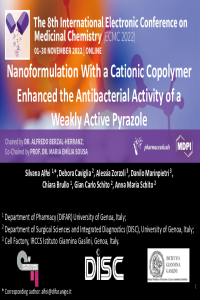
Enhanced Antibacterial Activity of a Cationic Copolymer by its Complexation with a Weakly Active Pyrazole Derivative

Silvana Alfei 1
'%3e%3cpath%20d='M12.6647%2010.9104C12.4176%2010.325%2012.0589%209.7933%2011.6088%209.34485C11.16%208.89511%2010.6283%208.53653%2010.0432%208.28891C10.038%208.28629%2010.0327%208.28498%2010.0275%208.28236C10.8437%207.69282%2011.3743%206.73252%2011.3743%205.64907C11.3743%203.85423%209.92005%202.40002%208.12522%202.40002C6.33038%202.40002%204.87618%203.85423%204.87618%205.64907C4.87618%206.73252%205.40677%207.69282%206.22296%208.28367C6.21772%208.28629%206.21248%208.2876%206.20724%208.29022C5.62031%208.53783%205.09365%208.89287%204.64167%209.34616C4.19192%209.79496%203.83334%2010.3266%203.58573%2010.9117C3.34247%2011.4846%203.21128%2012.0987%203.19925%2012.721C3.1989%2012.735%203.20135%2012.7489%203.20646%2012.7619C3.21157%2012.7749%203.21924%2012.7868%203.22901%2012.7968C3.23877%2012.8068%203.25045%2012.8148%203.26334%2012.8202C3.27623%2012.8256%203.29007%2012.8284%203.30406%2012.8284H4.09012C4.14776%2012.8284%204.19362%2012.7825%204.19493%2012.7262C4.22113%2011.7148%204.62726%2010.7676%205.34519%2010.0497C6.08802%209.30686%207.07452%208.89811%208.12522%208.89811C9.17592%208.89811%2010.1624%209.30686%2010.9052%2010.0497C11.6232%2010.7676%2012.0293%2011.7148%2012.0555%2012.7262C12.0568%2012.7839%2012.1027%2012.8284%2012.1603%2012.8284H12.9464C12.9604%2012.8284%2012.9742%2012.8256%2012.9871%2012.8202C13%2012.8148%2013.0117%2012.8068%2013.0214%2012.7968C13.0312%2012.7868%2013.0389%2012.7749%2013.044%2012.7619C13.0491%2012.7489%2013.0515%2012.735%2013.0512%2012.721C13.0381%2012.0947%2012.9084%2011.4856%2012.6647%2010.9104ZM8.12522%207.90243C7.52388%207.90243%206.95792%207.66793%206.53214%207.24215C6.10636%206.81636%205.87185%206.2504%205.87185%205.64907C5.87185%205.04773%206.10636%204.48177%206.53214%204.05599C6.95792%203.63021%207.52388%203.3957%208.12522%203.3957C8.72655%203.3957%209.29252%203.63021%209.7183%204.05599C10.1441%204.48177%2010.3786%205.04773%2010.3786%205.64907C10.3786%206.2504%2010.1441%206.81636%209.7183%207.24215C9.29252%207.66793%208.72655%207.90243%208.12522%207.90243Z'%20fill='%235D1EE1'/%3e%3c/g%3e%3c/svg%3e)
Debora Caviglia 2
Alessia Zorzoli 3
Danilo Marinpietri 3

Chiara Brullo 4
Gian Carlo Schito 5
Anna Maria Schito 2
1. Department of Pharmacy University of Genoa, Viale Cembrano 4, 16148, Genova, Italy
2. Department of Surgical Sciences and Integrated Diagnostics (DISC), University of Genoa, 16132 Genoa, Italy
3. Cell Factory, IRCCS Istituto Giannina Gaslini, 16147 Genoa, Italy
4. Department of Pharmacy University of Genoa, Viale Benedetto XV, Genova, Italy
5. Department of Surgical Sciences and Integrated Diagnostics (DISC), University of Genoa
Abstract
Molecules containing the pyrazole nucleus are widely reported as promising candidates to develop new antimicrobial compounds against multidrug resistant (MDR) bacteria no longer inhibited by available antibiotics. Recently, aiming at improving the too high minimum inhibitory concentrations (MICs) of a pyrazole hydrochloride salt (CB1H), CB1H-loaded nanoparticles (CB1H-P7 NPs) were prepared using a potent cationic bactericidal macromolecule (P7) as polymer matrix. Here, CB1H-P7 NPs have been successfully tested on several MDR clinically relevant isolates of Gram-positive and Gram-negative species. CB1H-P7 NPs displayed very low MICs, often 2-fold lower than those of P7 (0.6-4.8 μM vs. 1.2-9.3 μM) [2]. Upon complexation, the antibacterial effects of pristine CB1H were improved by 2-16.4-fold, and, unexpectedly, also the already potent activity shown by P7, when administered alone, was improved by 2-8 times after complexation. Time-killing experiments have established that CB1H-P7 NPs possess rapid bactericidal effects against representative strains of both Gram-positive and Gram-negative species, such as methicillin-resistant Staphylococcus aureus, MDR Pseudomonas aeruginosa, including a colistin-resistant isolate, carbapenemases-producing Escherichia coli and Klebsiella pneumoniae. Selectivity indices up to 2.4, determined by cytotoxicity experiments on human keratinocytes (HaCaT), suggested that CB1H-P7 NPs could be promising for therapeutic uses in the treatment of infections sustained by most isolates, including MDR strains, tested in this study.
Keywords
pyrazole compounds
CB1H-loaded copolymer NPs
Gram-positive and Gram-negative MDR isolates
MICs and MBCs
time-kill experiments
cytotoxicity on human cells
selectivity index
Poster
Alfei_Genova-1.pdf
New ruthenium-cyclopentadienyl complexes target specifically mutated KRAS in colorectal cancer
Pd-catalyzed cycloaddition of bicyclic aziridine with isocyanates