Event submissions
Published
 10.3390/ECMC2022-13432 (registering DOI)
 This submission belongs to the session S4. Small molecules as drug candidates of the event 8th International Electronic Conference on Medicinal Chemistry
Published date
01 Nov, 2022
Academic Editor
'%3e%3cpath%20d='M12.6657%2010.9104C12.4185%2010.325%2012.0599%209.79327%2011.6097%209.34482C11.1609%208.89508%2010.6293%208.5365%2010.0442%208.28888C10.0389%208.28626%2010.0337%208.28495%2010.0285%208.28233C10.8446%207.69279%2011.3752%206.73249%2011.3752%205.64904C11.3752%203.8542%209.92103%202.39999%208.1262%202.39999C6.33136%202.39999%204.87715%203.8542%204.87715%205.64904C4.87715%206.73249%205.40774%207.69279%206.22393%208.28364C6.21869%208.28626%206.21345%208.28757%206.20821%208.29019C5.62129%208.5378%205.09463%208.89284%204.64265%209.34613C4.1929%209.79493%203.83432%2010.3266%203.58671%2010.9117C3.34345%2011.4845%203.21226%2012.0987%203.20023%2012.7209C3.19988%2012.7349%203.20233%2012.7488%203.20744%2012.7619C3.21255%2012.7749%203.22022%2012.7867%203.22998%2012.7968C3.23975%2012.8068%203.25142%2012.8147%203.26431%2012.8202C3.2772%2012.8256%203.29105%2012.8284%203.30504%2012.8284H4.09109C4.14874%2012.8284%204.19459%2012.7825%204.1959%2012.7262C4.2221%2011.7148%204.62823%2010.7676%205.34617%2010.0497C6.08899%209.30683%207.0755%208.89808%208.1262%208.89808C9.17689%208.89808%2010.1634%209.30683%2010.9062%2010.0497C11.6242%2010.7676%2012.0303%2011.7148%2012.0565%2012.7262C12.0578%2012.7838%2012.1037%2012.8284%2012.1613%2012.8284H12.9474C12.9613%2012.8284%2012.9752%2012.8256%2012.9881%2012.8202C13.001%2012.8147%2013.0126%2012.8068%2013.0224%2012.7968C13.0322%2012.7867%2013.0398%2012.7749%2013.0449%2012.7619C13.0501%2012.7488%2013.0525%2012.7349%2013.0522%2012.7209C13.0391%2012.0947%2012.9094%2011.4855%2012.6657%2010.9104ZM8.1262%207.9024C7.52486%207.9024%206.9589%207.6679%206.53312%207.24211C6.10733%206.81633%205.87283%206.25037%205.87283%205.64904C5.87283%205.0477%206.10733%204.48174%206.53312%204.05596C6.9589%203.63018%207.52486%203.39567%208.1262%203.39567C8.72753%203.39567%209.29349%203.63018%209.71927%204.05596C10.1451%204.48174%2010.3796%205.0477%2010.3796%205.64904C10.3796%206.25037%2010.1451%206.81633%209.71927%207.24211C9.29349%207.6679%208.72753%207.9024%208.1262%207.9024Z'%20fill='%235D1EE1'/%3e%3c/g%3e%3c/svg%3e) Alfredo Berzal-Herranz
Alfredo Berzal-HerranzCitation
Carlos Manuel Gastalho, Sofia S. F. C. Ernesto, Ana Rodrigues Costa, Célia Maria Antunes, Anthony Burke, Elisabete da Palma Carreiro, Novel Quercetin-1,2,3- Triazole Hybrids using the 1,3-Dipolar Cycloaddition (Click) Reaction: synthesis and antiproliferative activity assays, in Proceedings of 8th International Electronic Conference on Medicinal Chemistry, 1 November–30 November 2022, MDPI: Basel, Switzerland, doi: 10.3390/ECMC2022-13432
Share
Email
Facebook
Twitter
LinkedIn
Novel Quercetin-1,2,3- Triazole Hybrids using the 1,3-Dipolar Cycloaddition (Click) Reaction: synthesis and antiproliferative activity assays

Carlos Manuel Gastalho 1,2,3
'%3e%3cpath%20d='M12.6647%2010.9104C12.4176%2010.325%2012.0589%209.7933%2011.6088%209.34485C11.16%208.89511%2010.6283%208.53653%2010.0432%208.28891C10.038%208.28629%2010.0327%208.28498%2010.0275%208.28236C10.8437%207.69282%2011.3743%206.73252%2011.3743%205.64907C11.3743%203.85423%209.92005%202.40002%208.12522%202.40002C6.33038%202.40002%204.87618%203.85423%204.87618%205.64907C4.87618%206.73252%205.40677%207.69282%206.22296%208.28367C6.21772%208.28629%206.21248%208.2876%206.20724%208.29022C5.62031%208.53783%205.09365%208.89287%204.64167%209.34616C4.19192%209.79496%203.83334%2010.3266%203.58573%2010.9117C3.34247%2011.4846%203.21128%2012.0987%203.19925%2012.721C3.1989%2012.735%203.20135%2012.7489%203.20646%2012.7619C3.21157%2012.7749%203.21924%2012.7868%203.22901%2012.7968C3.23877%2012.8068%203.25045%2012.8148%203.26334%2012.8202C3.27623%2012.8256%203.29007%2012.8284%203.30406%2012.8284H4.09012C4.14776%2012.8284%204.19362%2012.7825%204.19493%2012.7262C4.22113%2011.7148%204.62726%2010.7676%205.34519%2010.0497C6.08802%209.30686%207.07452%208.89811%208.12522%208.89811C9.17592%208.89811%2010.1624%209.30686%2010.9052%2010.0497C11.6232%2010.7676%2012.0293%2011.7148%2012.0555%2012.7262C12.0568%2012.7839%2012.1027%2012.8284%2012.1603%2012.8284H12.9464C12.9604%2012.8284%2012.9742%2012.8256%2012.9871%2012.8202C13%2012.8148%2013.0117%2012.8068%2013.0214%2012.7968C13.0312%2012.7868%2013.0389%2012.7749%2013.044%2012.7619C13.0491%2012.7489%2013.0515%2012.735%2013.0512%2012.721C13.0381%2012.0947%2012.9084%2011.4856%2012.6647%2010.9104ZM8.12522%207.90243C7.52388%207.90243%206.95792%207.66793%206.53214%207.24215C6.10636%206.81636%205.87185%206.2504%205.87185%205.64907C5.87185%205.04773%206.10636%204.48177%206.53214%204.05599C6.95792%203.63021%207.52388%203.3957%208.12522%203.3957C8.72655%203.3957%209.29252%203.63021%209.7183%204.05599C10.1441%204.48177%2010.3786%205.04773%2010.3786%205.64907C10.3786%206.2504%2010.1441%206.81636%209.7183%207.24215C9.29252%207.66793%208.72655%207.90243%208.12522%207.90243Z'%20fill='%235D1EE1'/%3e%3c/g%3e%3c/svg%3e)
Sofia S. F. C. Ernesto 4

Ana Rodrigues Costa 1,2

Célia Maria Antunes 1,2

Anthony Burke 5

Elisabete da Palma Carreiro 3
1. University of Évora, Department of Medical Sciences and Health. School of Health and Human Development
2. Institute of Earth Sciences - ICT, University of Évora
3. LAQV-REQUIMTE - Laboratório Associado para a Química Verde - Universidade de Évora , IIFA
4. University of Évora, Department of Chemistry and Biochemistry. School of Sciences and Technologies
5. University of Coimbra, Faculty of Pharmacy
Abstract
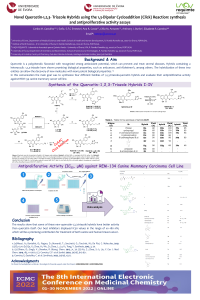
Quercetin is a polyphenolic flavonoid with recognized strong antioxidant potential, which can prevent and treat several diseases. Hybrids containing a heterocyclic 1,2,3-triazole have shown promising biological properties, such as anticancer, anti-Alzheimer’s, among others. The hybridization of these two entities can allow the discovery of new molecules with more potent biological properties.
Novel quercetin-1,2,3-triazole hybrids were prepared in good to excelent yields via Cu(I)-catalyzed azide-alkyne cycloaddition reaction under microwave irradiation. These new hybrids contain a 1,4-disubstituted 1,2,3-triazole ring at the 3-OH position of quercetin whilst the remaining hydroxyl groups were either protected as methyl or benzyl groups or left unprotected.
All the quercetin-1,2,3-triazole hybrids I–IV were tested on REM-134 canine mammary cancer cell line, which is commonly used as a translational model for human breast cancer. These new analogues exhibit potent antiproliferative activity against this cancer cell line. The results show that some of these new quercetin-1,2,3-triazole hybrids have better activity than quercetin itself. Our best inhibitors displayed IC50 values in the range of 41–180 nM, which will be a promising contribution for treatment of both canine and human breast cancer.
Keywords
quercetin
1,2,3-triazole
hybrids
antitumor
antiproliferative
REM-134
breast cancer
canine
Poster
sciforum-066295.pdf
Phytochemical and bioactivity studies from Plectranthus ecklonii
YAMACS: A graphical user interface of GROMACS